Roughly three-quarters of Palisades fire survivors remain displaced
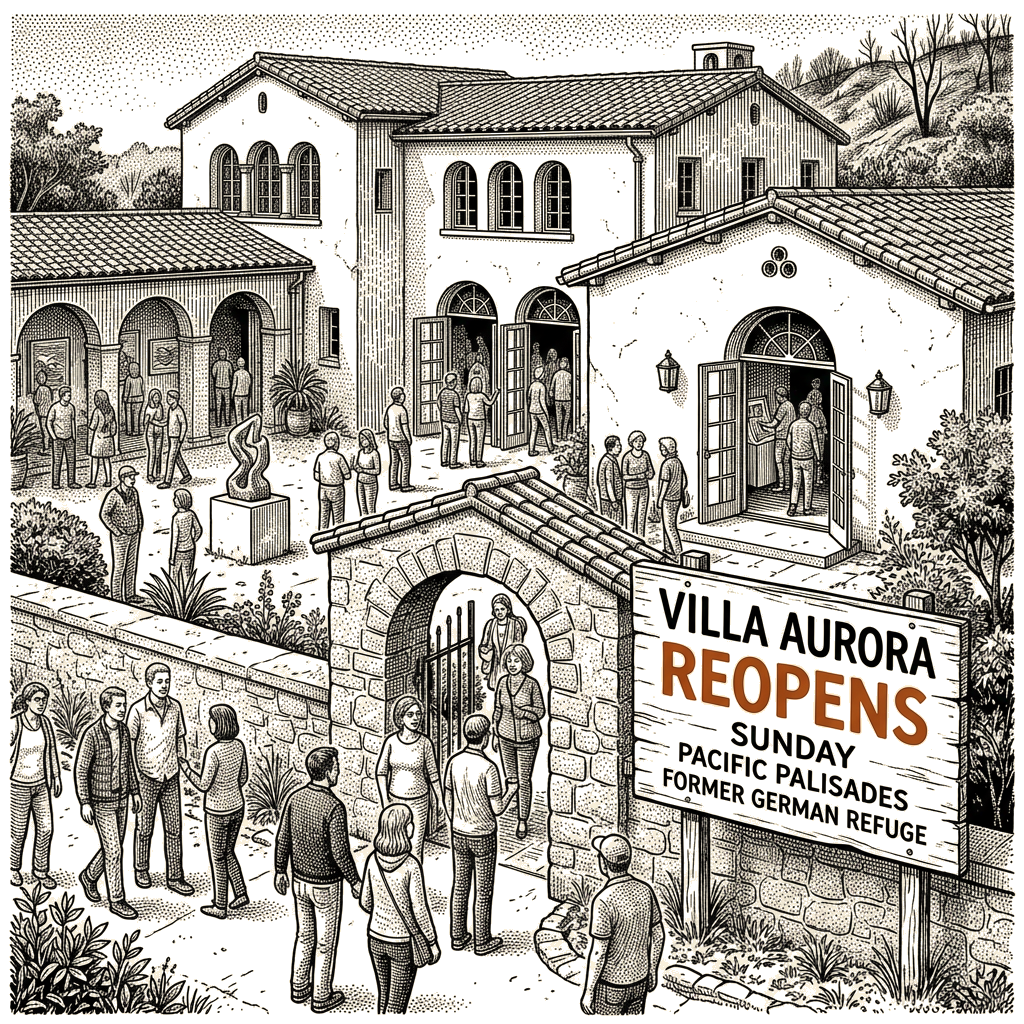
Hundreds of friends of Villa Aurora crowded into the Pacific Palisades house on Sunday to mark the resumption of speaker events and artistic residencies at the 1920s Spanish Mediterranean villa, which narrowly escaped destruction in the January 2025 Los Angeles wildfires. The crowd applauded the return of several artworks rescued while the hillsides were still ablaze, including an 18th-century Hebrew scroll of the Book of Esther and several busts and paintings, and applauded again for city firefighters who managed to stop the flames at the property’s edge.
The villa’s history runs through some of the twentieth century’s most prominent German-speaking intellectuals. To anti-Nazi exiles including Thomas Mann, Bertolt Brecht, and Lion Feuchtwanger — the novelist who purchased Villa Aurora in 1943 and turned it into a cultural gathering point — Pacific Palisades became known as “Weimar-by-the-Sea.” The exiles were outspoken in their opposition to Hitler’s regime and, later, to the anti-communist investigations in the United States that affected many of them directly.
Although no one at Sunday’s reopening mentioned Donald Trump by name, both Villa Aurora director Claudia Gordon and the leadership of the nearby Mann house — also now a cultural center and also narrowly surviving the fires — emphasized the villa’s role as a symbol of refuge, freedom of the arts, freedom of speech and defense of democracy.
Gordon said the reopening carried particular weight given the conditions in Pacific Palisades 19 months after the fires. “Villa Aurora is returning at a time when solidarity, dialogue and mutual support within the community are of particular importance,” she said. She recognized the thousands of neighbors in Pacific Palisades who lost their homes and acknowledged the continuing impact of the fires, as victims and city officials complain of inadequate insurance payouts and the Trump administration’s refusal to release about $15bn in federal aid.
Villa Aurora’s survival relied on support from many quarters, including the German government and other Los Angeles cultural institutions. In the days after the fire, staff of the Wende Museum, which curates artifacts from dissident movements including anti-communists in cold-war-era Germany and Poland, won permission to cross police lines to rescue artwork and verify whether the building was still intact.
Christine Rank, the Wende Museum’s director of collections, described how she and a small team were given just an hour to gather what they could. “We brought boxes and blankets, but we also ended up using sheets and trash cans, whatever we could find to transport the material,” she said.
Among the artifacts recovered was a portrait of Feuchtwanger’s wife, Marta, whose unveiling was the centerpiece of Sunday’s reopening. Danijel Skrelja from the German consul general’s office in Los Angeles said, “This house is coming alive.”
The burn scars remain plainly visible from Villa Aurora’s balcony. In the garden, now being rebuilt and replanted, the scorched stump of a eucalyptus tree indicates how close the flames came and how unpredictable the pattern of fire damage proved to be. Several neighboring houses were destroyed outright.
Nineteen months on, the heart of Pacific Palisades is one large construction site, with some houses already reconstructed and reoccupied and others still being rebuilt. The Palisades Village, a shopping center belonging to former mayoral candidate Rick Caruso, reopened two weeks ago, with some pre-fire tenants returning and other local businesses whose buildings did not survive moving in. Other restaurants and businesses have announced that they too will reopen shortly — in many cases in different Palisades locations than the ones they occupied before.
The recovery remains uneven across the affected communities. Roughly three-quarters of Palisades fire survivors were still displaced as of late July, according to a report by the nonprofit Department of Angels, with many struggling with debt and inadequate insurance payouts even as sources of financial assistance have fallen away. In Altadena, where the Eaton fire ravaged a community in the inland foothills of the San Gabriel Mountains, about two-thirds of fire survivors are yet to return home. City officials and other experts expect full recovery to take as long as five years.