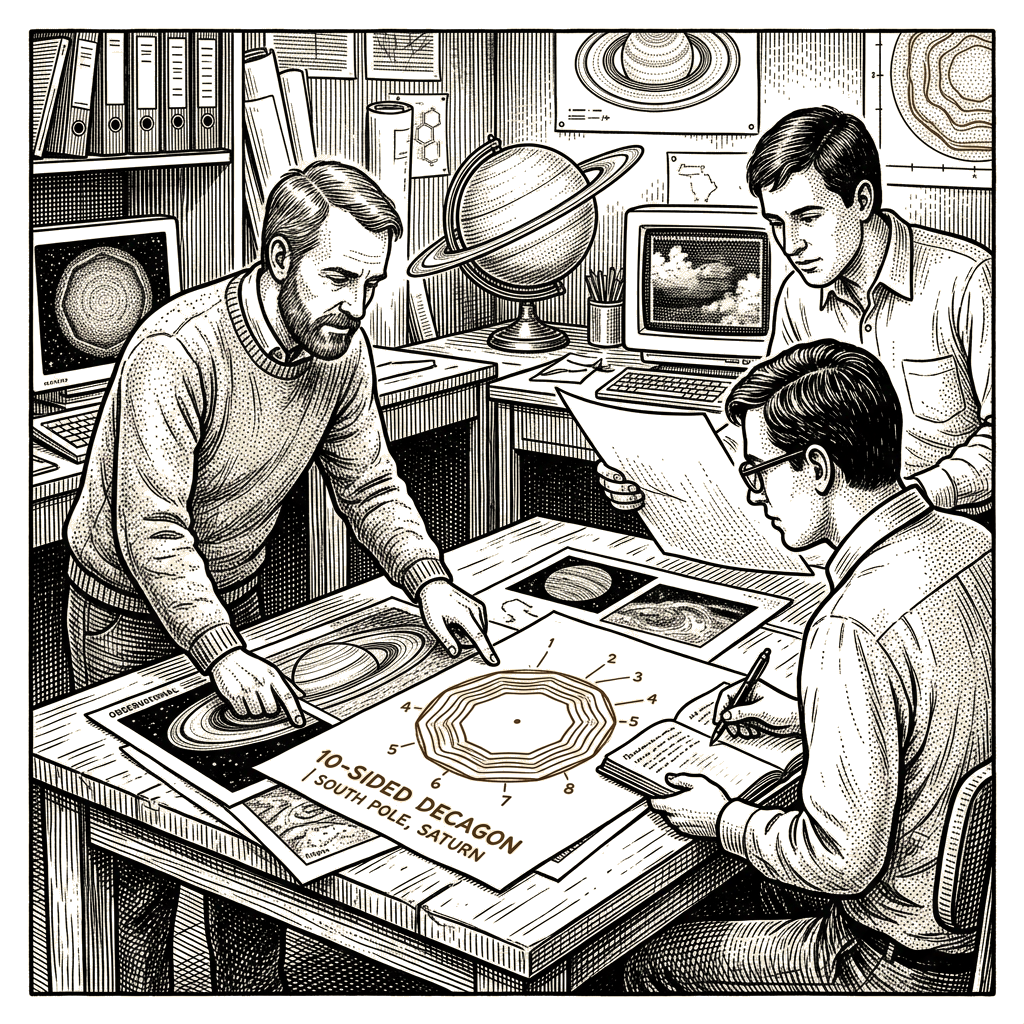
Formed between 2017 and 2023 while south pole tilted away from Earth
A Spanish-led research team has identified a 10-sided wave pattern in the icy ammonia clouds above Saturn’s south pole, a spinning, meandering decagon that the researchers say appears larger and more unstable than the hexagon at Saturn’s north pole.
The Hubble Space Telescope first detected the formation in 2023, after earlier observations of the region turned up empty, the team reported Wednesday. The researchers suspect the pattern emerged between 2017 and 2023, a window during which Saturn’s south pole was tilted away from Earth and out of view.
One side of the decagon already exceeds 10,000 miles (16,700 kilometers), and the team said the formation could still be evolving.
Lead author Agustin Sanchez-Lavega of the University of the Basque Country said the finding raises questions about whether the northern hexagon — which NASA’s twin Voyagers first spied in the 1980s — is as singular as it has been characterized. “The ‘unique’ hexagon is not as extraordinary as we thought,” Sanchez-Lavega said in an email.
Unlike the hexagon at Saturn’s north pole, the new southern decagon is described by the team as spinning and meandering, behavior the researchers characterize as less stable than its northern counterpart.