Vote also advanced Golden bill shielding Maine lobster industry from whale rules
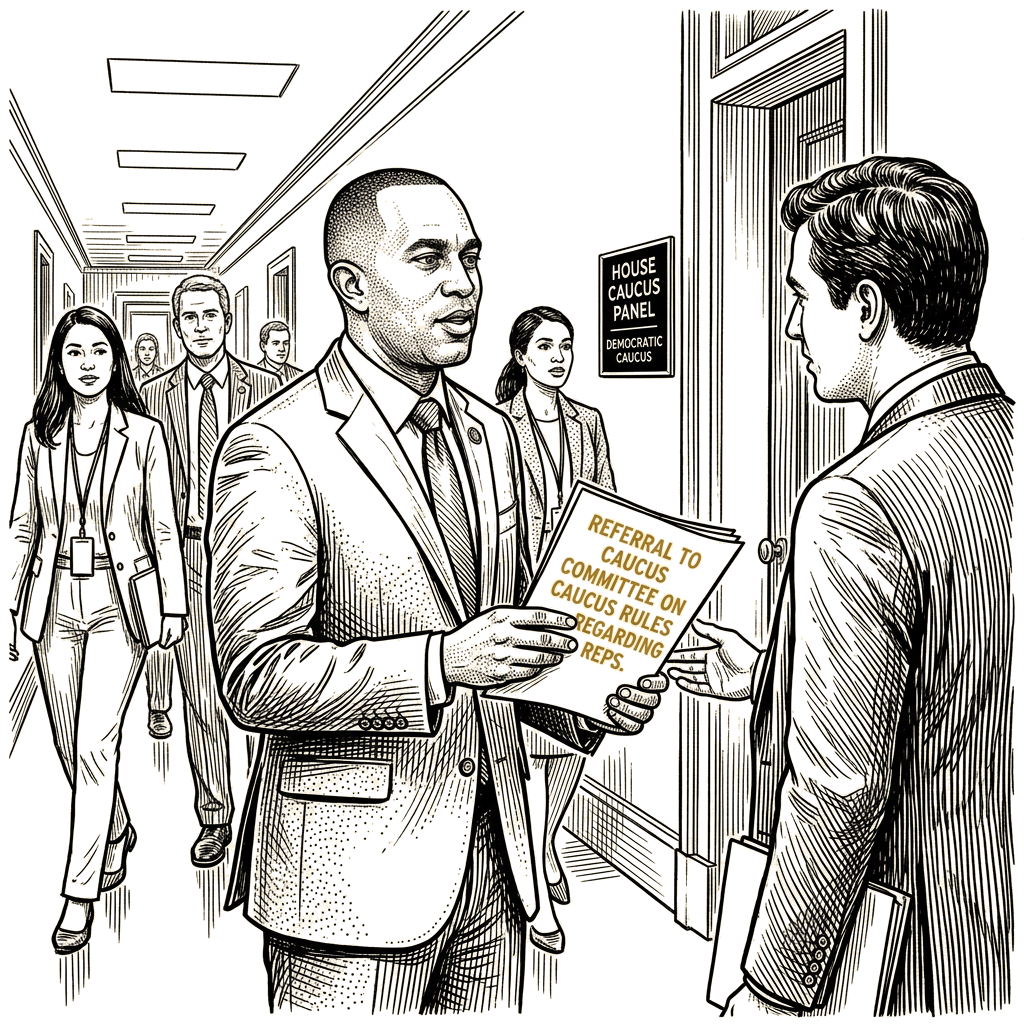
House Minority Leader Hakeem Jeffries moved Tuesday night to refer two of his caucus’s center-right members to the panel that enforces internal party discipline, after the pair broke with leadership on a procedural vote that had been on the verge of failure.
Jeffries announced in a joint statement with Democratic Whip Katherine Clark and caucus chair Pete Aguilar that he had asked the committee on caucus rules to take up the actions of Reps. Jared Golden of Maine and Marie Gluesenkamp Perez of Washington. “The decision by two of our colleagues to blindside the entire House Democratic caucus and join with the Republican majority to pass a procedural rule on the brink of failing represents a significant breach of trust,” the three leaders said. “It necessitates a serious response.”
The procedural measure at issue, known simply as a “rule,” is the routine vehicle the House majority uses to bring legislation to the floor. Five Republican hardliners had been prepared to vote it down over a dispute unrelated to the rule’s substance — a rebellion that would have handed Speaker Mike Johnson a public defeat and potentially upended the chamber’s legislative calendar for the rest of the month.
Golden and Gluesenkamp Perez supplied the votes that let the rule pass, 210 to 208. Under House rules, a tied vote is treated as a defeat, making their support decisive. Members of the minority party rarely back the majority’s procedural rules, which typically pass on party-line votes and are treated by leadership as a basic marker of caucus discipline.
Neither Golden nor Gluesenkamp Perez gave Democratic leaders advance notice, according to House Democratic leadership. Clark told reporters shortly after the vote that the move “came as a surprise.” Jeffries later told reporters that the two Democrats “blindsided the entire caucus and created a significant breach of trust.”
The rebellion arrived at an awkward turn for Jeffries. For much of the past several weeks, he and other senior Democrats had trained their fire on the party’s left, repeatedly condemning Hasan Piker, a left-wing livestreamer, over remarks about antisemitism and the Sept. 11 attacks that Piker said had been taken out of context. That campaign drew accusations from progressives that leadership was picking an unwinnable fight with a Twitch personality while ignoring bigger political threats. On Tuesday, the bigger threat to comity came from the party’s center-right instead.
The rule that Golden and Gluesenkamp Perez backed cleared the way for a package of Republican-favored bills to reach the floor. Those included a GOP resolution condemning socialism and the Democratic Socialists of America — a measure Republicans are expected to use against Democrats in midterm campaign messaging. The same resolution included a poison-pill statement of support for Trump’s Save Act, which experts say could make it harder for millions of Americans to vote. The procedural structure was designed to force House Democrats to choose between voting against the resolution in what Republicans could portray as tacit support for socialism, or voting in favor and lending a non-binding blessing to the voting legislation.
The rule also advanced a bipartisan bill, co-authored by Golden, to shield Maine’s lobster industry from federal whale-protection regulations that the fishing industry says could put smaller operators out of business.
Golden said that bill was his reason for breaking ranks. “I voted for the rule for one simple reason: it paved the way for a vote on my bill to protect Maine lobstermen from costly, burdensome new regulations that would put them out of business,” he said in a statement.
Gluesenkamp Perez, who leads the conservative Democratic Blue Dog Coalition, cited similar concerns for working waterfront communities in her southwest Washington district. On social media, she said that “what the DC bubble doesn’t get is that working waterfronts require working people.”
Golden, who is retiring at the end of this Congress, has indicated he had lined up other Democratic votes for the rule beforehand, suggesting the move was deliberate rather than a last-minute miscalculation.
The episode has exposed deeper strains inside a Democratic caucus that has struggled to project unity since its losses in the 2024 elections. Asked by reporters whether the two lawmakers would face consequences, Jeffries said on Tuesday that the matter was “under discussion.” By evening, he had escalated that to a formal referral.
Axios has reported that stripping Golden and Gluesenkamp Perez of committee assignments was among the options being weighed by frustrated members as a way to “make an example” of the pair, though no decision has been made and it remains unclear what disciplinary powers the committee on caucus rules can actually exercise.
Golden and Gluesenkamp Perez, both first elected in swing or Republican-leaning districts, have each broken with their party before, including on past government-funding bills and an earlier version of a Republican voter-fraud measure. Golden co-chaired the centrist Blue Dog Coalition until Gluesenkamp Perez succeeded him in the role.
Johnson, for his part, told reporters after the vote that critics who had predicted his majority would fail to pass the rule “were wrong.” “The rule has passed,” Johnson said. “Many of you thought that would not happen today, but we passed a rule to continue business this week. Republicans are here to work.”