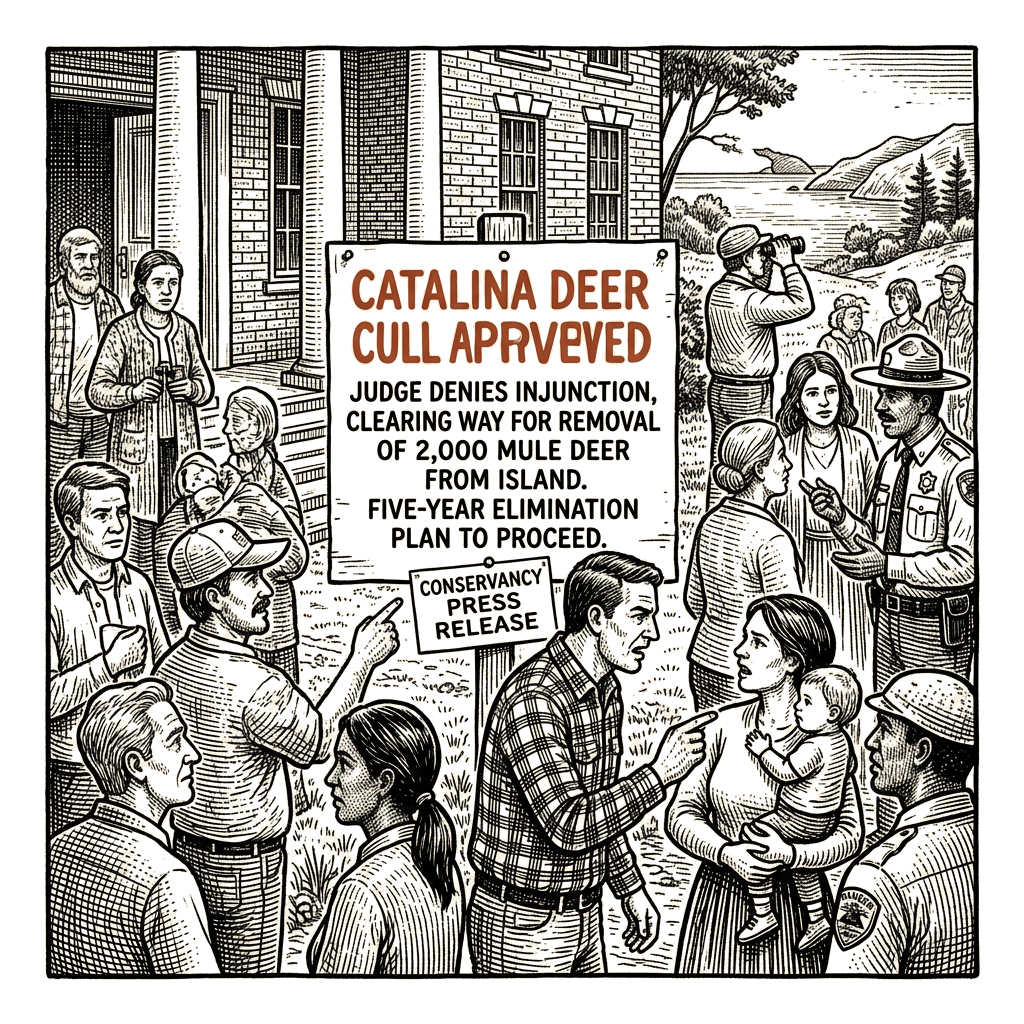
Plan aims to halt native shrub loss tied to invasive fire-prone grasses
The Catalina Island Conservancy can now begin a five-year plan to eliminate the island’s roughly 2,000 mule deer after a Los Angeles County judge tentatively denied a preliminary injunction Tuesday that a coalition of animal activists and hunters had sought to block. The conservancy controls 88% of Santa Catalina Island off the southern California coast.
The deer consume native shrubs already stressed by climate change, preventing those plants from regenerating quickly enough and enabling invasive grasses to replace them. Those grasses ignite and spread fire more easily than native vegetation, a particular concern as Southern California faces increasingly dangerous wildfire seasons.
“We understand the gravity of the situation and the responsibility, and it’s a noble sacrifice on the part of the deer that didn’t ask for this,” Pepe Barton, the conservancy’s director of communications, said. “But this is a necessary step to protect the island, the native plants and animals that are only found here, as well as the residents and livelihoods that depend on Catalina.” Barton added that elimination was “never our first choice.”
Opponents mounted both legal and public challenges. A coalition of animal activists and hunters filed suit seeking the injunction. An online petition against the cull had gathered more than 32,000 signatures. Los Angeles County Supervisor Janice Hahn, an outspoken critic, asked California Governor Gavin Newsom to intervene earlier in the week; the plea was to no avail.
The scientific case draws on research by Anna L Jacobsen, a plant biologist and professor at California State University, Bakersfield, who studied the deer-vegetation relationship after major fires in 2006 and 2007. Jacobsen said non-native deer can drive native shrubs to local extinction, opening ground for invasive grasses that ignite and spread fire faster than native species.
Max Moritz, a wildfire specialist who provides scientific advisory to California state and local governments, said prevention in southern California “has shifted away from, say, fuel reduction to focusing on ignitions.” He acknowledged that the public’s emotional attachment to the deer can make the science behind the decision harder to see, but added: “From a scientific, ecological, and fire perspective, removal is the best way.”
The conservancy examined alternatives before settling on elimination. Contraception and sterilization were studied but deemed infeasible for such a large population; fencing was not approved; four decades of regular hunting seasons had not reduced numbers substantially; and introducing new predators was ruled out as a risk to native animals and residents.
The California Department of Fish and Wildlife approved the plan in January, granting a restoration management permit. Roughly 200 deer are to be hunted with rifles over the next two months. Island residents will be allowed one final open hunting season from late October through mid-December. Meat from the cull will be directed to the California condor recovery program or to local tribal groups. Carcasses near trails and roads will be removed by the conservancy; only those in steep, dangerous terrain will be allowed to decompose naturally.
A small population of deer near Avalon, the island’s main town, will be sterilized rather than killed. Santa Catalina Island is the last leg of Channel Islands National Park to remove non-native deer species.