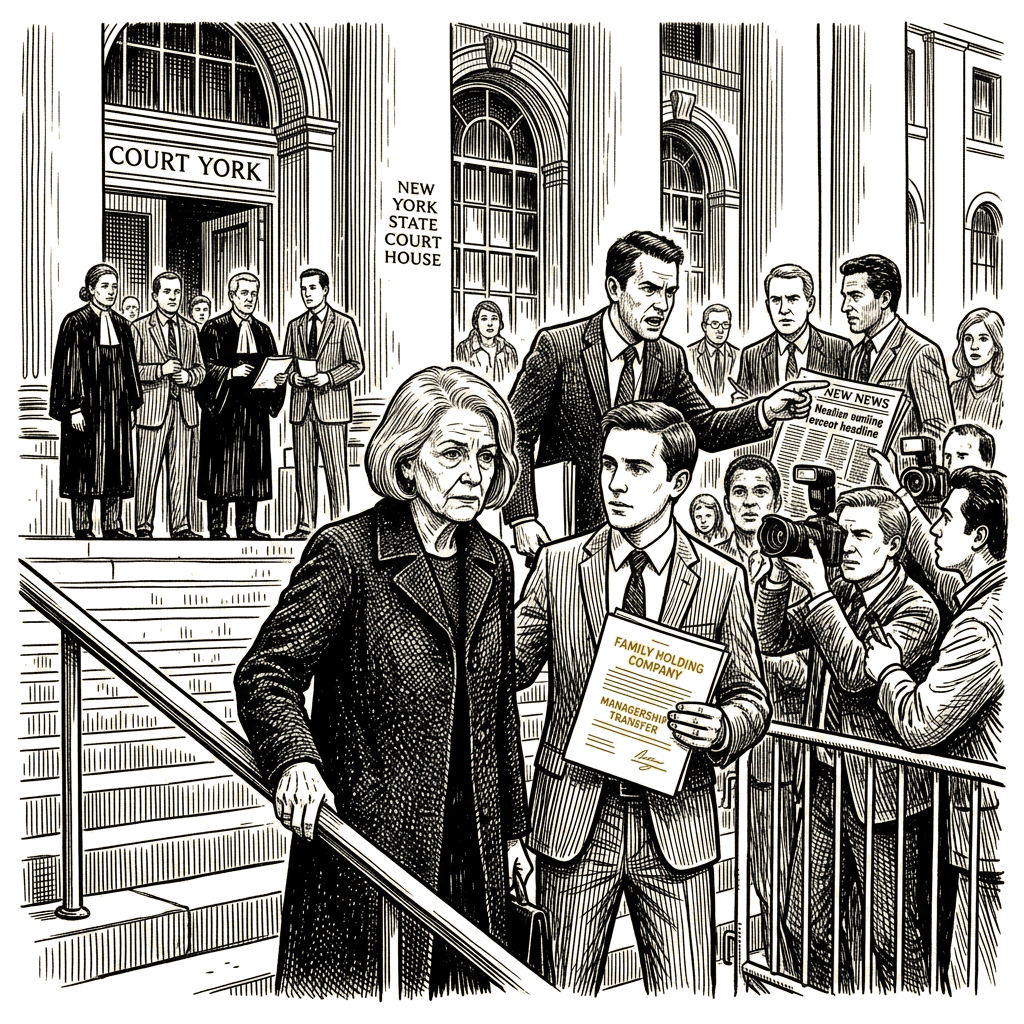
Steven and Amy allege appraisal undervalued company holdings by over $500 million
The Goldman family has owned significant New York City real estate since the mid-twentieth century, when Sol Goldman, a Brooklyn grocer’s son, began assembling a portfolio that at his peak numbered roughly 1,900 properties across the city, including a stake in the Chrysler Building. Sol died in 1987 and left what was described at the time as a billion-dollar estate, which his four children inherited in equal shares.
Sol’s widow Lillian subsequently fought her children in court over what she viewed as her rightful portion of his wealth. Jane and three of her siblings took their father’s side, accusing their mother of disloyalty. “I love them very much,” Lillian told reporters after a court hearing. “But I don’t like them.”
Jane, Sol’s daughter, took over the family real estate company, Solil Management — a name combining her father’s and mother’s first names — with her brother Allan as co-executor. She has run the business for nearly four decades, presiding over holdings that include the land beneath the Gramercy Park Hotel and the Cartier Building on Fifth Avenue, much of it held through 99-year ground leases. Allan, who was later diagnosed with Parkinson’s disease, had focused on other matters and stepped back from day-to-day operations before his death.
The current dispute centers on an appraisal that valued some company holdings at figures Steven and Amy say were too low. In a Delaware complaint, they alleged that Jane had “engaged in a brazen and illegal scheme to wrest control of the largest privately owned real estate empire in New York City from her family members,” according to the complaint, which called the family battle “a real-life parallel to the television show Succession.”
Jane’s lawyer pushed back on the comparison in court: “The comparison fits in one respect: Both are works of fiction.” Of the appraisal, Jane’s lawyer added: “There’s not a stitch of evidence she did anything wrong.” A judge has not ruled on the merits of the Delaware case.
During a 2024 Delaware trial, Jane testified that Steven had come to her Midtown Manhattan office roughly four years earlier and threatened to share unflattering information with her older sister Amy unless Jane gave him a quarter of the business. “I’m going to tell Amy and you’re going to look very bad, and you don’t want that,” Steven allegedly said, according to Jane’s account. Jane said she suspected her nephew was bluffing. “He was a professional poker player for a while,” she told the court. “I think he was bluffing me, and he was trying to get me to agree.”
Steven, who has described poker as a hobby, characterized the alleged conversation differently. He said he had received information from family employees that an appraisal was improperly conducted and that Jane had purposefully lowered it, and that he and Jane had discussed how public lawsuits weren’t good for the estate. He called the blackmail allegation “ridiculous” from the witness stand.
The dispute widened after Allan’s death on January 15, 2022, in St. Petersburg’s City Hospital No. 40, where he had been taken by Natalia Vostrikova, a woman who had spent more than 15 years by his side. Steven later sued Vostrikova; in a court affidavit, she said she and Allan had been romantically involved since 2002 but had not married due to his children’s objections. Steven refers to Vostrikova as a caretaker; people close to the family have described her as a longtime partner. The two later settled the suit.
After the funeral, Steven, who had become executor of his father’s estate, visited Jane at her office and asked whether he could step into a more active role in the family business. Jane, who had hoped Steven and her own son Michael might one day run the company together, said she viewed Steven as too young and inexperienced. “I didn’t think either one of them were ready,” Jane testified. “And my son would admit he wasn’t ready.”
Steven, now 35, went on to become a partner at Arena Capital, a small real-estate private-equity firm investing in the Hudson Valley. Michael, who had worked at asset manager Blackstone, joined Solil last year. Jane stepped down in late July as a manager of a key Goldman family holding company, with Michael taking her place — a transition Steven was not directly notified of.
Steven and Amy filed their Delaware suit over the appraisal; Steven and his sisters filed a separate action in New York. “I’m going to spend millions and millions of dollars to fight you in court,” Jane told Amy during one dispute, according to Amy. Jane has called Amy’s account of that conversation “a complete lie.” The New York cases continue in both a trial court and in Surrogate’s Court.
The Goldman family has been fighting on and off for roughly 40 years, with prior rounds lobbing accusations of cheating, fraud, and mental illness. “The law is ill equipped to deal with the latent jealousy and hidden ambitions that lurk below the surface of inheritance disputes,” the pattern suggests; courts can divide money and property but cannot settle what money has come to mean.
Jane, who enters her office to an oil painting of her father, has said she believes Sol would have wanted his holdings kept intact for generations to come. Sol, who once reportedly told his friend, attorney Raoul Felder, that “real estate is a quiet business” while holding a finger to his lips, built the company with borrowed money — buying a $500 lot as a teenager after putting together $50 from a pharmacist and a liquor store owner. The current dispute has been anything but quiet.