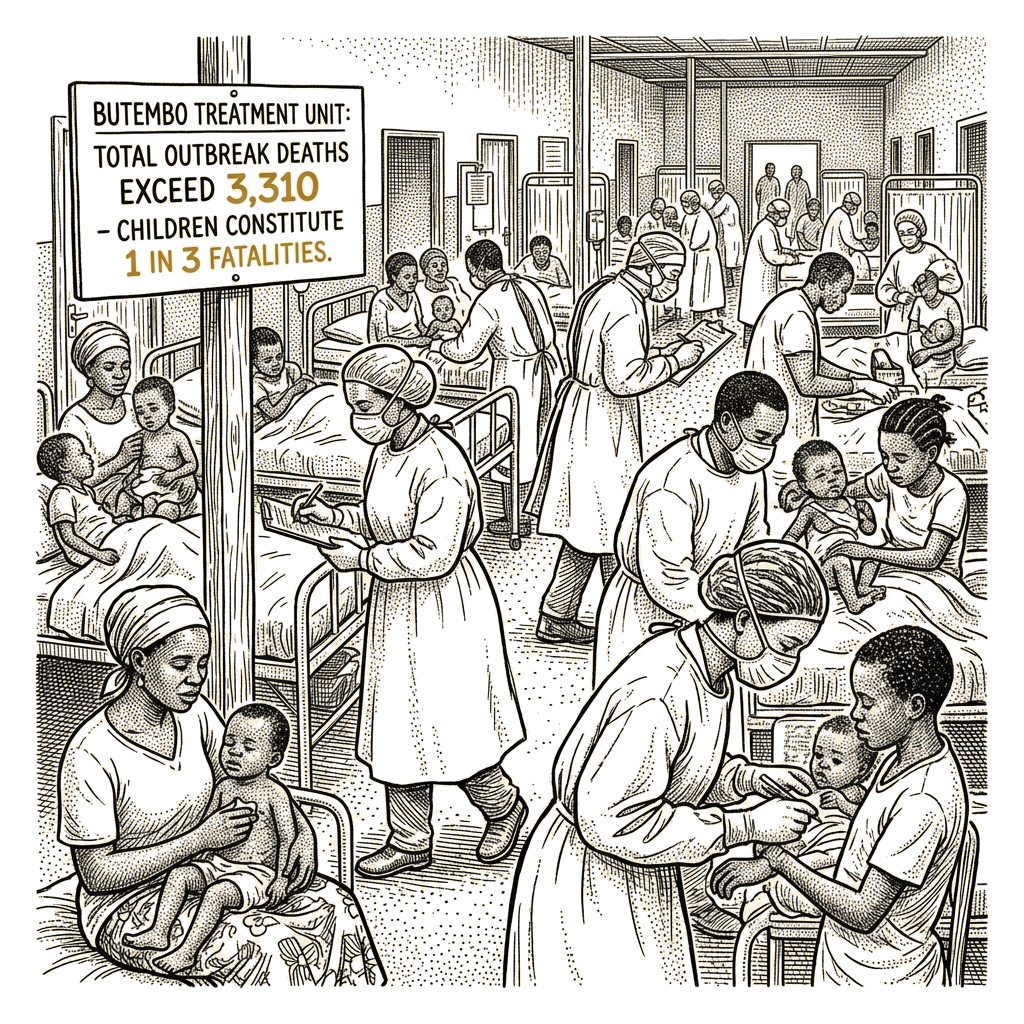
Children represent 1 in 3 deaths, 1 in 4 confirmed cases
Children have borne a disproportionate share of deaths in the Ebola outbreak in the Democratic Republic of the Congo. They make up 1 in 4 confirmed cases but represent 1 in 3 overall deaths, and according to Dr. Rupa Narra, a Doctors Without Borders unit in Butembo lost eight patients last week, all under age 5.
All 30 beds at the treatment unit are full. Narra, a U.S. pediatrician who arrived in August, said the unit has begun placing confirmed Ebola patients in quarantine beds because of the number of people arriving at the clinic.
“I don’t know how this is going to slow down,” Narra said. “It’s the most devastating thing I’ve ever seen in my life.”
The outbreak has reached at least 6,800 confirmed cases and more than 3,310 deaths since May, putting it on track to be the worst on record.
The Bundibugyo strain of ebolavirus is driving the outbreak. The strain has no approved antiviral medication or vaccine. Without those medical options, about 30% of adults diagnosed with the virus die within two weeks, while the death rate is higher among children, whose immune systems are less developed. For newborns, the virus is almost always fatal.
Narra and her colleagues provide supportive care by running fluids through an IV, giving oxygen or blood transfusions, and treating hypothermia, fever and secondary infections as patients’ bodies fight the virus. Narra also helps train about a dozen doctors and nurses in Butembo to adjust that care for pediatric and newborn patients.
“I had to change my mindset, that we were going to save kids,” Narra said. “Now, it’s — we’re going to minimize suffering, and we’re going to let the Congolese staff know that they did everything they could to save that baby’s life.”
Staff divide the unit’s capacity between 15 beds for sick patients awaiting test results and 15 beds for confirmed Ebola patients. The Bundibugyo strain can begin with symptoms similar to malaria, but patient volume has exceeded that division in recent days.
“It’s still not enough,” Narra said. “I know everyone is trying to scale up as fast as possible, but it’s moving at a rapidity that never was the case.”
Protective equipment and the absence of an approved vaccine complicate pediatric care. It is difficult to find someone who is already immune after a prior infection and can watch over the smallest patients. The difficulty and risks of working in protective gear limit Narra and her colleagues to about an hour at a time.
According to Narra, shortly after she arrived in Butembo, a young mother died in the Ebola unit soon after giving birth, leaving her newborn daughter entirely alone. “I didn’t know what we were going to do with this baby, because there were no other family members who had been exposed, and there was a high likelihood for this child to have Ebola,” Narra said.
When Narra entered the baby’s room, she found a woman holding the infant. “Actually, she was an Ebola survivor,” Narra said. “She did not know the family and agreed to take care of this baby.” The baby lived for 10 days before succumbing to the virus, and the caregiver never left her side.
Narra puts on a fully disinfected hazmat suit every day before seeing patients, leaving only her eyes visible. She cannot bring in a toy to distract them, wear a funny hat, pick them up and show them around the clinic, or hold their hand through the night when they get really sick.
“You’re 5 years old, and these people walk in with what looks like a spacesuit. Of course you’re going to scream!” Narra said. “That’s been the very difficult part for me — is I can’t be at the bedside of this critical child.”
Another 5-year-old patient waited in quarantine for test results while her father sat with her and let her watch Bollywood movies on his smartphone. Narra, whose family is from southern India, recognized a song from the romantic comedy Desi Boyz.
After her shift, Narra removed her protective gear, ran outside to the patient’s window and performed her best Bollywood dance moves from the film. “And then, she was smiling, laughing and clapping,” Narra said. “I was like — I don’t even know these moves but I will make them up for you!” The girl’s test results came back negative a few days later.
The outbreak is concentrated in the eastern border region between the Democratic Republic of the Congo, Rwanda and Uganda. Clashes between the Congolese army and Rwandan-backed paramilitary forces have forced families to seek refuge in cities such as Butembo. The regional healthcare system was already stretched thin, regularly treating children with malnutrition and outbreaks of malaria or measles on a regular basis. The conflict and cuts to foreign aid have disrupted routine vaccinations and other assistance.
Narra previously worked as an epidemiologist responding to the West Africa Ebola outbreak in 2014, which killed 11,310 people. She was a pediatrician in a Brooklyn emergency department when COVID-19 reached the United States and has worked for Doctors Without Borders in Haiti.
“I’ve never seen anything like this,” Narra said. “The speed of transmission, along with other aspects of a fragile healthcare system.”