American visits to island surge 60% as officials target high-spending travelers
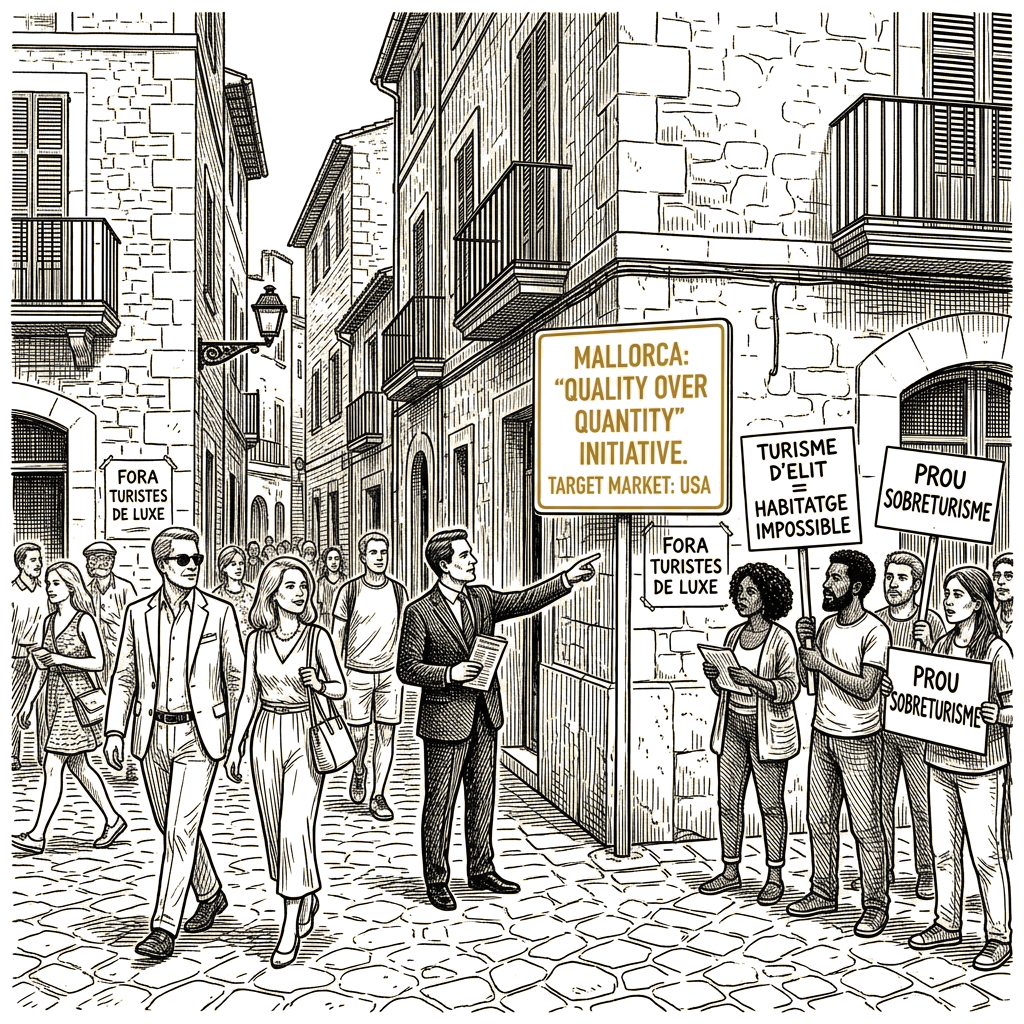
Mallorca, a Mediterranean island roughly 125 miles east of the Spanish mainland with about one million residents, is on track to welcome about 14 million tourists this year. In peak summer months, the island’s daily population rises by roughly 50%, straining infrastructure and fueling protests that have brought crowds to beaches and streets bearing the message “Tourists, go home.” Pedro Homar, managing director of Palma’s tourism board and an eighth-generation Mallorcan, said the island is pivoting away from its reputation as a destination for British bachelor parties and budget package-holidayers. “Tourism is our way of life,” Homar said. “The change of model is quality over quantity. We need to have less tourists that spend more.”
On the visitors he wants, Homar said: “They are not rowdy at all. They travel with the idea of understanding the culture, mingling with the locals, buying local arts and crafts.” The U.K. and German markets, he added, are no longer the target. “We are no longer appealing to tourists in the U.K. [or] Germany, whose main motivation is partying and drinking,” he said.
American tourists in Spain spent about $410 per day in July, compared with roughly $240 by German visitors and $260 by British travelers, according to government data. Germans and Brits still make up about half of Mallorca’s tourists, but American visits have surged 60% this year through June. United Airlines has expanded direct flights to the island from its Newark hub, a Mandarin Oriental hotel opened this year, and boutique properties catering to U.S. guests have proliferated across the island. Hospitality executive María Martínez, who works for the boutique chain IT Mallorca Unique Spaces, which has six boutique hotels across the island, said her company has trained staff to meet American expectations. “They want more small talk, guidance on itineraries and are more interested in the island’s history,” Martínez said. Americans are the chain’s main client group.
Laurel and Dustin McQuate, visitors from Breckenridge, Colorado, traveled to Mallorca this month with a group of eight to celebrate a friend’s 50th birthday. They rented a house for about $6,000, a boat for a day, and two cars. “We live in the mountains, so we were like, ‘A beach? Yes, yes,’” Laurel McQuate said. The group planned winery visits and a day in Palma, and the couple was particularly excited about shopping at local markets and trying local pastries. “I have no room in my suitcase,” McQuate said.
Wealthy South Korean honeymooners have also emerged as a sought-after market. Newlywed Sukyung Lee spent four days on the island in September, praising Caló des Moro, a beach nestled between steep cliffs. “The ocean is beautiful…it’s famous for a reason,” Lee said.
Mallorca’s sun-drenched beaches and hilltop villages had been a popular hangout for foreign writers, artists and musicians for more than a century before the mass tourism era. The island’s transformation into a mass tourism destination dates to the 1950s and ’60s, when the authoritarian government of Francisco Franco promoted foreign tourism as a way to soften the image of his authoritarian regime internationally — under the slogan “Spain is different!” Low-cost packages from British and German operators opened the island to large-scale European travel. In Playa de Palma, a three-mile-long stretch of southern coastline, tourism workers speak fluent German and restaurants serve döner kebab and currywurst. In Magaluf, a beach town popular among British visitors, restaurants offer full English breakfasts and Yorkshire pudding.
The island’s party-tourism reputation has long frustrated residents who complain of public drunkenness, nudity and drug use. On parts of the island, local authorities have implemented fines for drunken behavior, banned party boats, and capped all-inclusive drinks at six per day. On a recent summer day, the beaches of Magaluf were quiet and filled with families.
Despite those efforts, many residents say the visitor rebrand does not address the core problem. The shift toward wealthier tourists has done little to quell anger from locals, who argue the problem is the number of tourists, not just the type. “They occupy our streets, our homes, our spaces, and often fail to respect the people who are working for them,” said Stella Arbona, a 23-year-old bakery worker. “There’s hardly any space left for the locals.”
The housing shortage is the most visible pressure point. The flood of tourists has pushed the island’s infrastructure to its limit, leading to traffic jams, strained water resources and a severe shortage of affordable housing for locals. Thousands of homes and villas have been converted to short-term rentals such as Airbnbs, and a black market for illegal apartment rentals has further reduced supply. The government is stepping up enforcement on short-term rentals and working to build more subsidized housing, but those efforts will take time. On the outskirts of Palma, more than 100 camper vans now occupy the parking lot of a public pool, home to residents priced out of the rental market. Begoña Iglesias, 62, has lived in a camper she shares with her son Hector for about four years. “We are collateral damage of the island’s housing crisis,” Iglesias said. She said she has fielded more inquiries from people interested in joining the camper community.
One local politician this year proposed capping tourist arrivals across the Balearics at 2023 levels. Leaders are instead pursuing measures including caps on cruise ship arrivals and restrictions on new hotel construction. Juan Antonio Amengual, mayor of Calvià, Mallorca’s second-biggest municipality, acknowledged the scale of the challenge. “The problem has grown over many years, and we may need the same time to solve the problem,” Amengual said.
Jaume Moreno, a longtime taxi driver on the island, captured the dependency that complicates every response. “We depend entirely on them,” Moreno said of the visitors. The island’s tourism economy, which the non-profit Exceltur says accounts for nearly half of all economic activity in the Balearics, leaves little room for disruption.