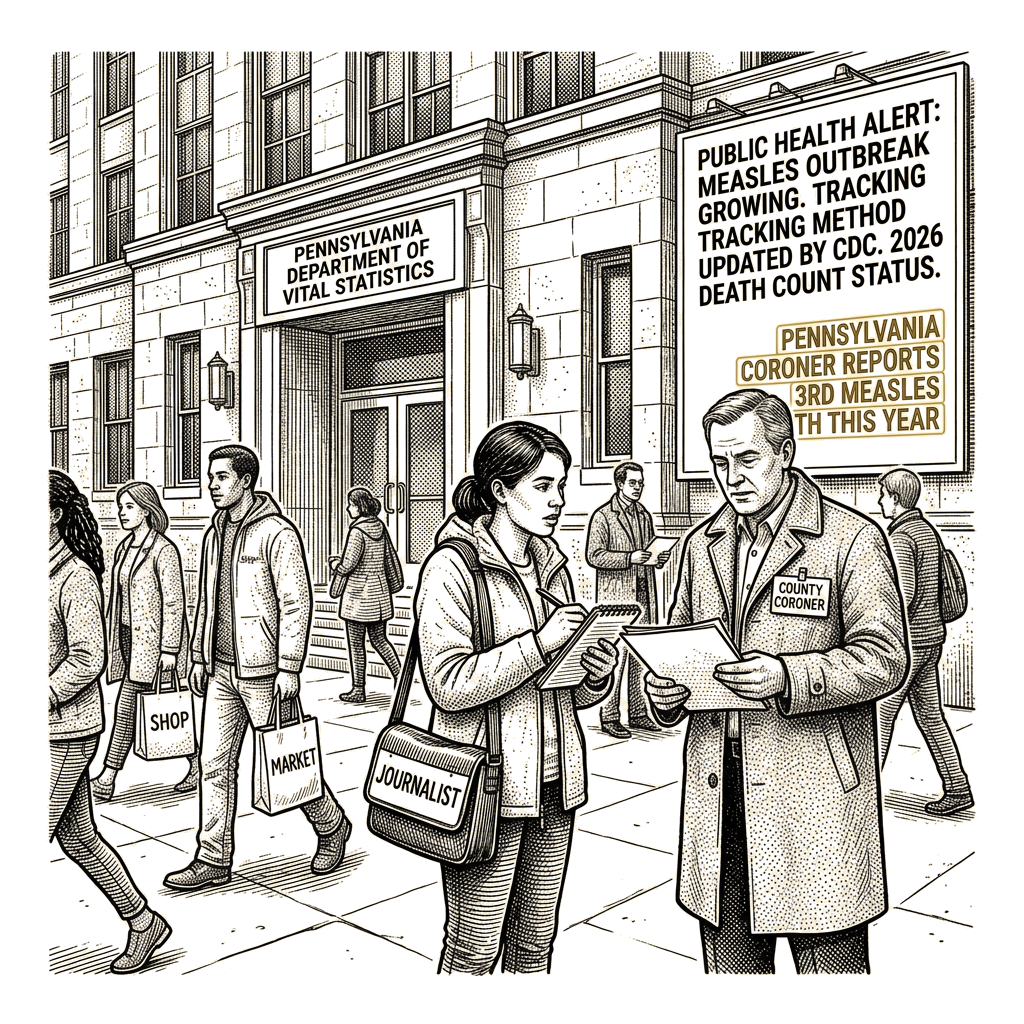
Coroner reports third probable measles death in unvaccinated Pennsylvania woman
The US Centers for Disease Control and Prevention has changed how it counts measles deaths, switching to a federal mortality-tracking system that currently records no 2026 US measles deaths — even as a Pennsylvania coroner on Sunday reported what would be the state’s third apparent measles-related fatality of the year.
The shift, announced in a note posted to the agency’s website on 4 September, moves the CDC from the National Notifiable Diseases Surveillance System, which the agency has described as the supply chain for data from local jurisdictions and states to the federal government, to data from the National Center for Health Statistics, which tracks mortality trends over time.
“CDC will report measles deaths if and when the National Center for Health Statistics reports measles as the underlying cause of death,” Emily Hilliard, a US Department of Health and Human Services spokesperson, said.
The CDC placed an asterisk under its tally of deaths that links to a note stating that the NCHS “does not currently have any death records from 2026 that indicate measles is the underlying cause.” Pennsylvania officials have confirmed two measles deaths this year — a newborn and a six-week-old infant.
The methodology change came the day after a Reuters report described Health and Human Services Secretary Robert F. Kennedy Jr. asking CDC Director Erica Schwartz not to count the earlier deaths in the official CDC tally. According to the Reuters report, Kennedy had previously argued without evidence that the two earlier deaths may not be from measles.
Kennedy has not publicly commented on the Sunday death, posting on X about fitness, Medicaid and Medicare fraud, and screen time. The Guardian reports that Kennedy spent nearly two decades at the helm of the Children’s Health Defense, an anti-vaccine organization, and has repeatedly spread misinformation about vaccines.
The third death was reported Sunday by Greg Furlong, the Jefferson County coroner. The woman who died was 40 years old, unvaccinated, and had chronic obstructive pulmonary disease with around-the-clock oxygen support — both of which made her vulnerable to complications, Furlong said. She had not sought medical care for her apparent infection. “They were going to, but obviously got to the point where it turned to the worst and ultimately led to her death,” Furlong said.
The woman had a classic measles rash and other symptoms, and a close contact had recently tested positive for measles, Furlong said. A nasal swab is undergoing testing for measles, with results expected within days. Furlong said the death would be classified as probable measles-related because of the epidemiological connection to a confirmed case.
Furlong said the woman would not have died without the measles case, despite her conditions. “None of us know when our last day is here on this Earth,” he said. “But I strongly 100% believe if this wouldn’t have come into her life that she would be alive today,” he said, adding: “Even with her underlying conditions, I believe she’d be alive today.”
Furlong emphasized that maintaining a measles immunization rate of at least 95% is “absolutely” important for protecting people who are vulnerable to infection, including infants under six months and pregnant people, who cannot be vaccinated. “We can all learn from this, and hopefully we can encourage more people who aren’t immunized to get immunized,” Furlong said, adding: “People do not want to be a statistic.”
“Hopefully this is something that more people get tested, more people get immunized. It’s something we thought we had eradicated, and here we are,” he said. “But it’s a shame that had to lead to somebody’s death.”
Pennsylvania had 676 confirmed measles cases as of Friday, Furlong said, but he said he believed the official case numbers undercount actual infections. “I 100% guarantee it,” he said. He announced the death Sunday to inform the public, and the Pennsylvania Department of Health will notify the CDC once it completes its investigation, including the nasal swab results, he said.
The methodology change drew criticism from former CDC officials. Debra Houry, a former CDC chief medical officer, called the move “puzzling.” “The change doesn’t make any sense,” she said. The NCHS system is “not meant to confirm an individual case” but is instead “usually focused on high-quality, long-term mortality trend analysis,” she said.
“CDC’s recommendation for the MMR vaccine has remained unchanged, and the Secretary has repeatedly said that the MMR vaccination remains the most effective way to prevent measles infection,” Hilliard, the HHS spokesperson, said.