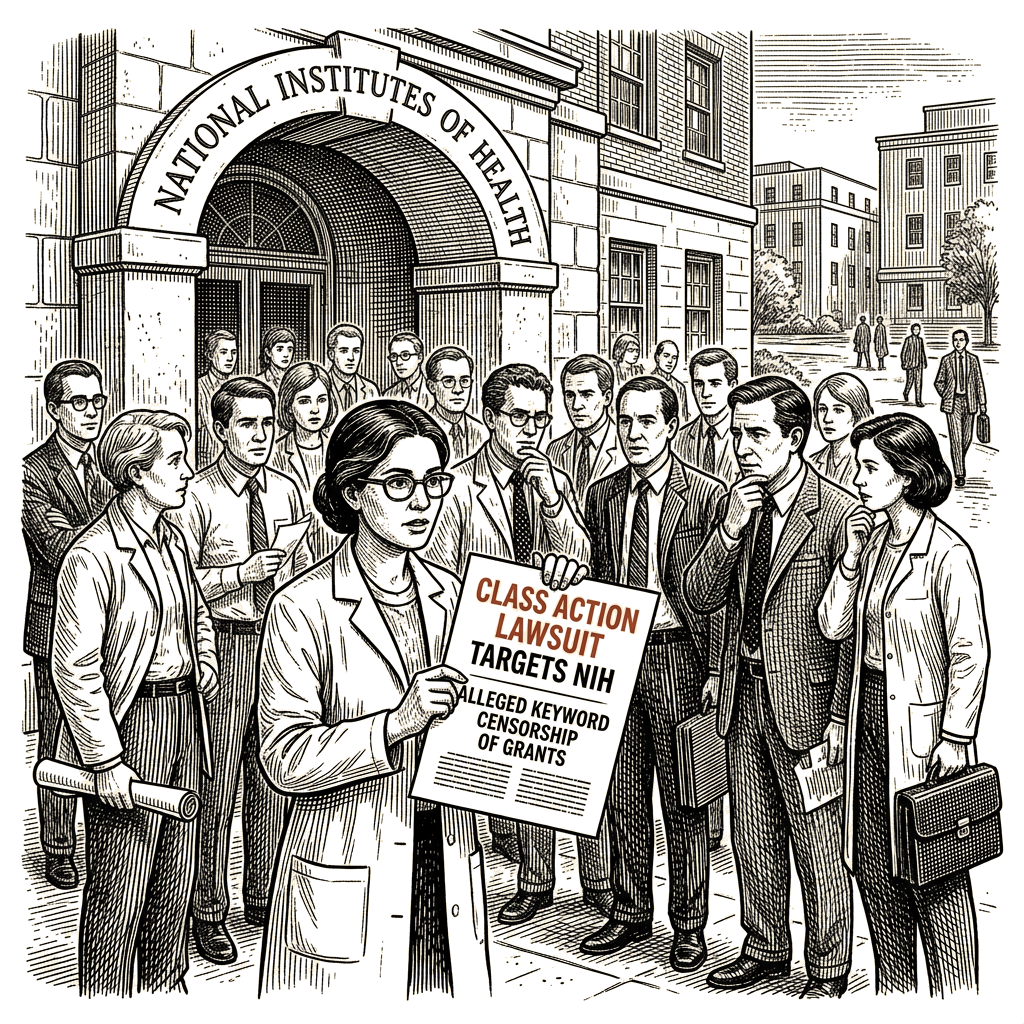
Scientists say keyword list forced canceled appointments, halted studies
Researchers filed a class action lawsuit against the National Institutes of Health on Wednesday, alleging the Trump administration is blocking and cancelling scientific grants to censor topics with which it disagrees. The suit was filed in San Francisco and is backed by the American Civil Liberties Union, the Center for Science in the Public Interest, and other groups. The NIH is the world’s largest public funder of biomedical research.
The suit alleges the administration has used a list of 235 keywords — including “gender” and “racist” — to prevent topics ranging from health equity to climate change from being funded. The ACLU, in the suit, describes the keyword list as “troubling” and argues it adds “a layer of ideological review to traditional scientific review.”
“The Trump administration is weaponizing federal research funding to suppress disfavored views, pressuring scientists to censor their work or risk losing funding for research that might produce results that don’t conform to the administration’s ideology,” said Olga Akselrod, senior counsel in the ACLU’s Racial Justice Program. “While NIH can make calls about what topics to fund, it cannot do so in a manner that is inconsistent with governing statutes and regulations. The First Amendment also ensures NIH cannot screen out projects or applicants because it thinks they’ll express views the government does not like. NIH has crossed each of these lines.”
The plaintiffs seek to cover all researchers whose grants have not been restored by court orders, as well as grants whose investigators have been forced to renegotiate, faced delays, or denials.
Ann Cohen, an associate professor of psychiatry at the University of Pittsburgh, said in a press release that her team’s study on Alzheimer’s disease was designed to better understand how to identify and reduce the risk of dementia in communities who are at high risk of developing the disease and have been historically understudied. “For more than a decade, our team has built trusted relationships with communities that have too often been excluded from research, giving us critical information that can help improve early detection and treatments for Alzheimer’s disease, work that benefits everyone,” Cohen said.
“Losing this funding has forced us to abruptly cancel appointments for participants, preventing them from receiving promised research results, and slowing or stopping critical data analysis,” Cohen said. “This puts years of trust and scientific progress at risk.”
“For more than 15 years, my research has focused on gender equity, sexual harassment, and the barriers that can push talented individuals out of science and medicine,” said Arghavan Salles, a surgeon and clinical associate professor at the Stanford University Department of Medicine. “Now, I can no longer accurately describe my research because using words like ‘gender,’ ‘equity,’ or ‘sexual harassment’ would be flagged as inconsistent with NIH priorities,” Salles said.
“Scientists should not have to scrub their research to receive federal funding, particularly after taxpayers have already invested years in supporting this work,” Salles said.
Grants have historically been awarded through a scientific peer review process, moving forward sound proposals and providing a predictable path to stable, years-long funding. In 2025, the Trump administration began canceling thousands of grants across government, disrupting more than 5,700 at the NIH, according to the grant-tracking project Grant Witness. More than 4,500 of those have been restored, according to Grant Witness.
The Department of Health and Human Services, which oversees NIH, did not immediately respond to a request for comment.