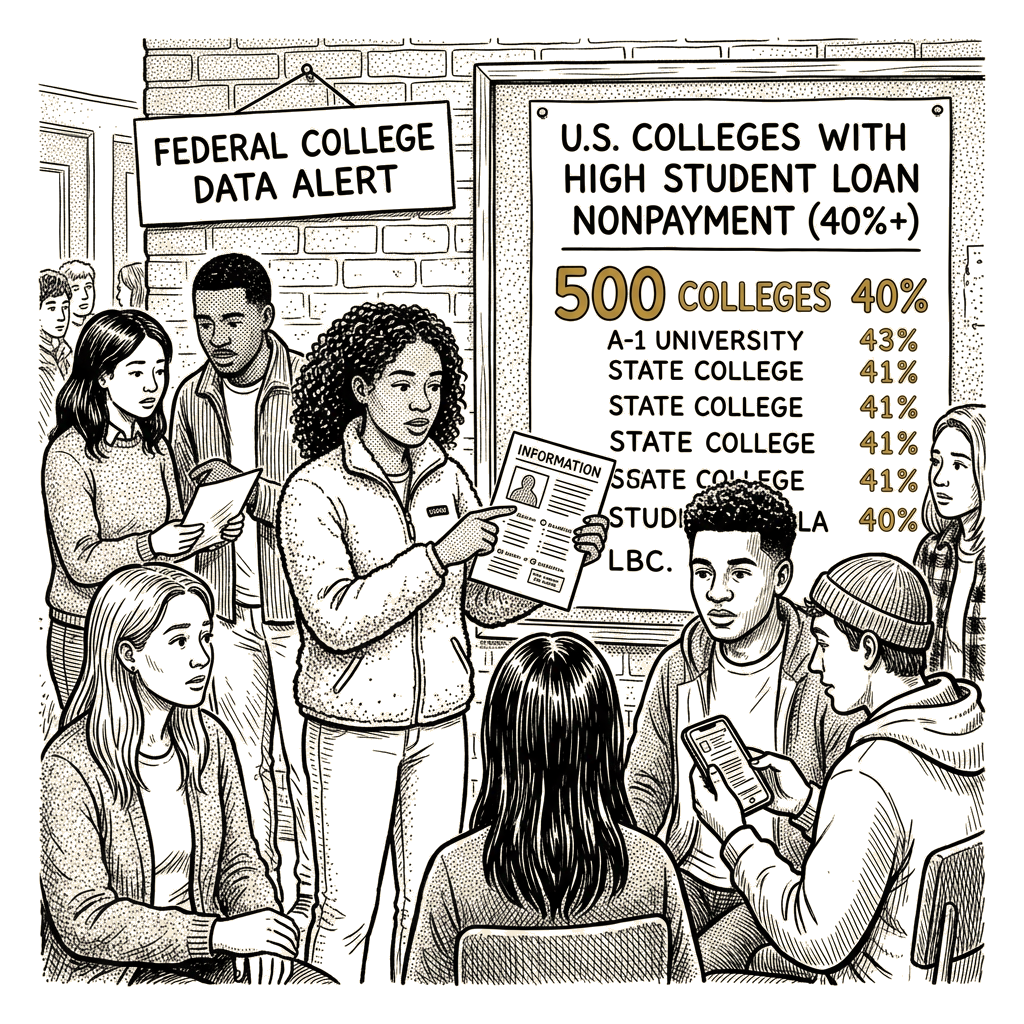
For-profit colleges dominate the list and rely on federal student aid
Five-hundred U.S. colleges and universities are on the Education Department’s list of institutions where at least 40% of recent students who borrowed federal loans are not paying them back, according to the latest federal nonpayment-rate data. The data cover roughly 17 million borrowers who entered repayment for the first time between January 2020 and May 2025. Of the 500 institutions on the list, 424 are private, for-profit schools — institutions of the type the Obama administration targeted more than a decade ago, in an effort that pressured two large chains to close — and just 15 are public colleges.
“These numbers are really jaw-dropping,” said Eileen Connor, who directs the Project on Predatory Student Lending, a borrower-advocacy nonprofit that reviewed the data. The nonpayment rate captures borrowers who are at least three months late on payments or who have already crossed the nine-month threshold into default. Public institutions and private nonprofit colleges averaged nonpayment rates of around 15%, while for-profit colleges averaged 33%.
The Education Department declined to comment for NPR’s story but referred the outlet to a press release from February in which the administration had begun publicly raising the issue. “Institutions cannot benefit from taxpayer dollars while ignoring the fact that a significant share of their students are not well-prepared to repay their loans. It’s time for institutions to step up or risk losing access to federal student aid,” said Nicholas Kent, the Education Department’s undersecretary, in that earlier statement.
One explanation, NPR reported, is that pandemic-driven disruptions to the student loan system have left many borrowers feeling confused. But Lisa Collenbaugh’s story offers another possibility: many of these troubled schools charge too much for too little — and aren’t being held accountable.
The for-profit schools on the list are heavily dependent on federal dollars. Of the 424 for-profit institutions flagged, the vast majority rely on the federal government for more than half their revenue, according to federal data compiled by the Project on Predatory Student Lending and reviewed by NPR. Federal law penalizes schools that exceed 90% reliance on federal sources, which is why many schools on the list hover just below that ceiling. American InterContinental University System receives 89% of its revenue from federal aid. At Miller-Motte College, nearly 86% of revenue comes from federal aid. On UEI College’s campuses, federal aid accounts for between 79% and 85% of revenue.
“If the federal student loan program did not exist, these schools would not exist,” Connor said. “Why would any bank give or lend money to someone to go to these schools when it’s a near certainty that they’re not going to be able to repay it?” She described the practice as “the definition of predatory lending.” Preston Cooper, who studies higher education at the American Enterprise Institute, drew a parallel: “If a private lender were looking at a school that has a 40%, 50% delinquency rate on past loans, they would probably say, ‘We’re not going to lend to that school.’ Why does it make sense for the federal government and for taxpayers?”
A borrower’s path through UEI College
UEI College, with 22 campuses mainly in California, has more borrowers in the data pool — almost 32,000 — than most other schools on the list. Like many of the schools on the list, UEI is a for-profit college that specializes in career training, including 10-month programs to become medical assistants, dental assistants and HVAC technicians, among others. The federal data show UEI’s nonpayment rate at around 55%, with more than 17,000 recent borrowers late on payments or in default.
Collenbaugh enrolled at a Los Angeles-area UEI campus in 2015 to become a computer systems technician, agreeing to pay nearly $20,000 for the short-term training program. She was sleeping in her car at the time, and a friend recommended the school as a way to find a career and stability. “I wanted to do something that would help my life,” Collenbaugh remembers. “If there was a career path, that would be amazing. And that was my understanding of what was gonna happen at UEI.”
Tuition cost $19,500 in 2015, according to Collenbaugh’s old receipts. “When I see a career school charging $20,000 for a short-term certificate, some red flags are going off in my head,” said the American Enterprise Institute’s Cooper. “That’s more per annum than a lot of four-year colleges are charging.” Like most UEI students, Collenbaugh took out federal student loans to pay for it. She also received a federal Pell Grant for low-income students.
The coursework, Collenbaugh said, was oddly easy and did not appear to deliver the job-ready skills she had hoped for. The school struggled to find her an externship required for graduation. After she completed her other coursework, she said, the only externship the school could offer was on the other side of Los Angeles. “I just couldn’t afford the gas,” she said. “And I let them know that. And it was just like, ‘Oh, sorry.’” She dropped out before finishing the program and went years without making payments on her loans.
“I thought that I was gonna actually be prepared for a career path and my life was gonna change because of that. And looking back, it’s like, ‘Oh, they got me,’” Collenbaugh told NPR.
NPR shared Collenbaugh’s account with UEI. Spokesperson Joseph Cockrell said the school had discontinued her computer-systems training program in part because of evidence the program wasn’t working well, including poor completion and job-placement rates. “When a program we offer no longer has workforce demand or is not meeting the outcomes that our accreditors require, that the state requires, that the Department of Education requires, we make decisions about those programs,” Cockrell said. Cockrell added, not speaking specifically of Collenbaugh’s case, that UEI can support students only so much: “Transportation, childcare, work schedules and finances can all be very real obstacles, particularly for the population we serve. Our job is to work with students as much as reasonably possible to help them overcome those barriers.”
Darcy Schnuth, vice president of student finance at International Education Corp., UEI’s parent company, told NPR the school’s rate was higher than the company had anticipated. “We’re not fully sure why ours is higher than the rest within our sector,” Schnuth said. She attributed part of the difficulty to pandemic-era payment pauses and Biden-era loan-forgiveness promises that, she said, left many borrowers feeling disconnected from their debt. “After going two, three, four years without getting very much in communication, they thought they didn’t have loans anymore,” Schnuth said. IEC has hired two third-party companies to help reconnect with borrowers, she added.
Cooper said the pandemic-pause explanation does not capture the full picture: “This is really uncovering, I think, problems that were already there at these schools rather than being entirely attributable just to the end of the payment pause.” Cooper added that many for-profit schools like UEI have long had higher delinquency and default rates compared with more traditional schools. Schnuth said that serving lower-income students is a point of pride for IEC but that it also comes with greater risk — that students are more likely to drop out and not repay their debts than students in more traditional programs. “We definitely believe borrower demographics and financial circumstances are an important part of the difference,” Schnuth said. Collenbaugh, asked what she thinks drives UEI’s rate, told NPR the school saddles low-income students with big debts in return for low-quality training that often leads them nowhere. “It’s almost like this school is preying on the vulnerable,” she said.
Other schools on the list
The spread of high nonpayment is wide. Tulsa Welding School had nearly 20,000 recent borrowers in repayment as of May, with more than half not making payments. Miller-Motte College, with campuses in Tennessee, Georgia, North Carolina and Oklahoma, had 37,000 borrowers, with roughly half not paying. Miller-Motte’s parent company told NPR in a statement that “the student loan landscape in recent years has presented unprecedented external challenges for borrowers across higher education” and that the school is using “data-driven default management strategies to identify at-risk borrowers early and offer targeted intervention.”
Many cosmetology and barbering schools are also on the list, including the tiny Legends Barber College in Texas, where 81 of 100 borrowers are not repaying their loans. Legends said in a statement it “takes student loan repayment and borrower education seriously” and was reviewing the data and current repayment-support procedures so it could identify where additional outreach may be needed. Tulsa Welding School did not respond to NPR’s requests for comment.
Jordan Matsudaira, a professor at American University who was the Education Department’s inaugural chief economist in the Biden administration, said the prevalence of cosmetology schools in the data is unsurprising. Cosmetology schools are “notoriously programs that tend to deliver students who have lower earnings,” Matsudaira said. “It’s not surprising that they’re struggling to repay their debts.”
Federal accountability tests and what’s next
The nonpayment rates, high as they are, do not themselves trigger federal accountability. The relevant test, the cohort default rate, requires borrowers who are at least three months late on their payments to reach the nine-month default threshold and runs over three years. A 30% default rate for three consecutive years is supposed to cost a school its federal student aid access; a 40% rate triggers consequences after a single year. The test has been inoperative since the pandemic, when borrowers could not default on their loans. The Education Department told NPR it is set to resume soon. “The bill is going to come due, and a lot of schools could be dealing with very serious consequences,” Cooper said.
A second accountability measure is also on the way. Created as part of the Republicans’ One Big Beautiful Bill Act, the new “do no harm” test cuts off federal loans from programs whose graduates don’t earn more than workers who never went to college. “If a program cannot show that it leaves its graduates financially better off than if they had never enrolled, it should not be underwritten by federal taxpayers,” Kent said. The Education Department will begin calculating the first year of graduate earnings in early 2027, and some programs could be designated as low-earning in the 2028-2029 financial aid award year.
Florida Career College, also owned by International Education Corp., provides one example of how federal accountability can operate. The Education Department cut off FCC’s federal aid in 2023 after an investigation found the school had enrolled students without a high school diploma in violation of federal rules, a step the agency took after the Project on Predatory Student Lending filed a class-action lawsuit in 2020. The loss of federal dollars forced the school to close. Today, nearly two-thirds of FCC’s 28,000 recent borrowers are not repaying their loans.
The new earnings rule, however, measures earnings only — not debt. “It is a big gap in the new accountability rules,” Matsudaira said. “There are a fair number of programs that have earnings that are modest but high enough to clear the pretty low bar of the high school earnings test — but that have really high debt and students are struggling.” Cooper’s preliminary analysis, conducted at NPR’s request, found that around 500 schools with nonpayment rates above 30% might be flagged under both the earnings and nonpayment tests, but a roughly equal number of high-nonpayment schools could still pass the earnings bar.
Collenbaugh has found some of the stability she was looking for when she enrolled at UEI College. She works for a ministry in Orange County, California. “We bring Bible studies to drug and alcohol treatment centers, sober living homes, safe houses, places where people are rebuilding their lives.” As she rebuilds her life, Collenbaugh says, she still owes the U.S. government $10,389.47 for the certificate program she couldn’t afford to finish.