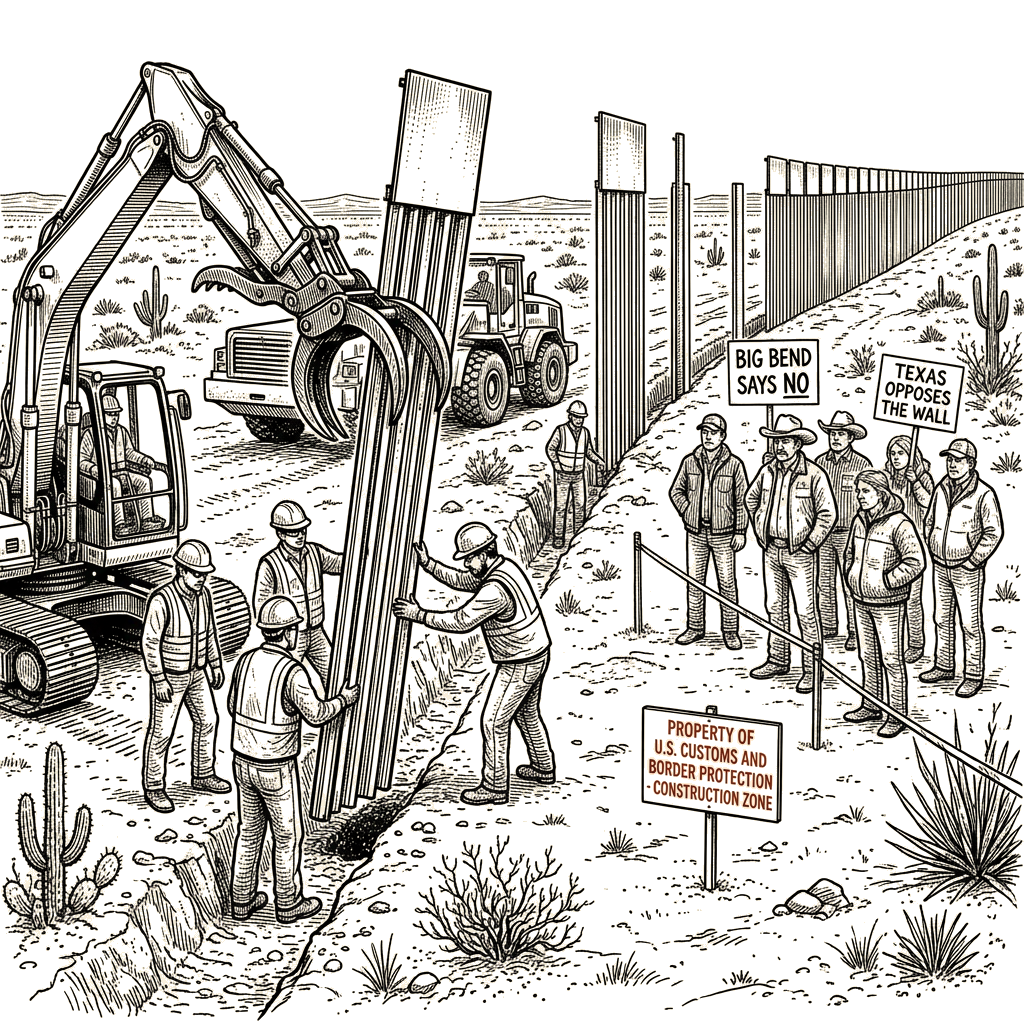
Plans extend into Big Bend National Park and three other protected areas
Customs and Border Protection confirmed by email that installation of the first “panels” of a 30-foot steel bollard border wall began in Hudspeth County, Texas, on September 15, 2026, according to The Guardian. The county lies just east of El Paso and marks the entry point for construction in the remote Big Bend region of west Texas, an area that has remained unwalled until now. CBP did not announce the construction ahead of time.
The news was first reported by the Associated Press. Images obtained by the No Big Bend Wall coalition show a towering fence standing in isolation that anyone could easily walk around on either side.
Clara Bensen, communications director for No Big Bend Wall, said isolated fencing is likely to remain the norm in much of the area if construction proceeds. Her group estimates that some 400 landowners hold title to properties with Rio Grande frontage where CBP is trying to obtain rights to construct more wall. More than half of those landowners have joined the coalition and aim to dispute the federal government’s assertion of eminent domain, according to Bensen. The disputes have left the federal government with an uneven patchwork of permissions, preventing CBP from completing work on a contiguous wall for the moment. CBP has been pressing landowners to grant access, offering signing bonuses as an incentive to avoid eminent domain disputes.
“It’s not about logic,” Bensen said. “They’re moving forward even if the plan is not fully baked, then trying to do busy work because they don’t have the land they need yet.” She added: “They’re just grasping on to whatever little plots of land they’ve managed to get so far.”
Republicans in Congress added $46.5 billion for border wall expansion into the so-called “big, beautiful” spending bill last year, according to The Guardian. With that funding, CBP has pressed forward with plans to expand its so-called “smart wall” — a mix of 30-foot fencing, vehicle barriers, patrol roads and detection sensors — into the Big Bend region.
The roughly 500-mile stretch that CBP refers to as the “Big Bend” region has historically accounted for less than 2 percent of apprehensions for unauthorized crossings, according to The Guardian. The area has remained unwalled largely because its towering cliffs, desert geography and lack of towns and cities on the Mexican side already act as natural impediments to unlawful migration. Unauthorized crossings in the region have dropped further since Trump returned to office and imposed a major crackdown on the border, The Guardian reported.
CBP’s plans for west Texas beyond Hudspeth County currently include erecting vehicle barriers and other security infrastructure in Big Bend National Park, widely viewed as the state’s most beloved wilderness. The possibility of construction at the park has sparked major protests and drawn increasingly bipartisan criticism from Texas lawmakers.
CBP Commissioner Rodney Scott temporarily paused construction last month after images of bulldozers clearing brush for new road construction drew backlash from public land advocates across the country, according to The Guardian.
Bob Krumenaker, a former Big Bend National Park superintendent who now chairs an advocacy group called Keep Big Bend Wild, said he and other supporters planned to travel to Washington, D.C., next week to urge lawmakers to shield the park from damage and the border security infrastructure. “I’m very optimistic that there is a lot of support for Big Bend,” Krumenaker said. “This is a nonpartisan issue.”
But while the park has drawn the most attention, CBP’s plans to expand its smart wall would have massive and sprawling effects across the Big Bend region. Private landowners are concerned about the eyesore tanking their property values, obstructing their access to the river, or disrupting their grazing operations.
The border barrier expansion would also affect Big Bend Ranch State Park, Black Gap Wildlife Management Area and Amistad National Recreation Area. Blasting from construction threatens to damage or destroy dozens of millennia-old rock art murals that dot the river valley.
“It’s all connected,” Bensen said. “It’s all part of the river.”
A photograph by Scott McWilliams, provided to the Associated Press, shows crews installing the first sections of the border wall in the Big Bend region on September 16, 2026.