Panel was divided 11-1 in favor of finding Clancy not criminally responsible
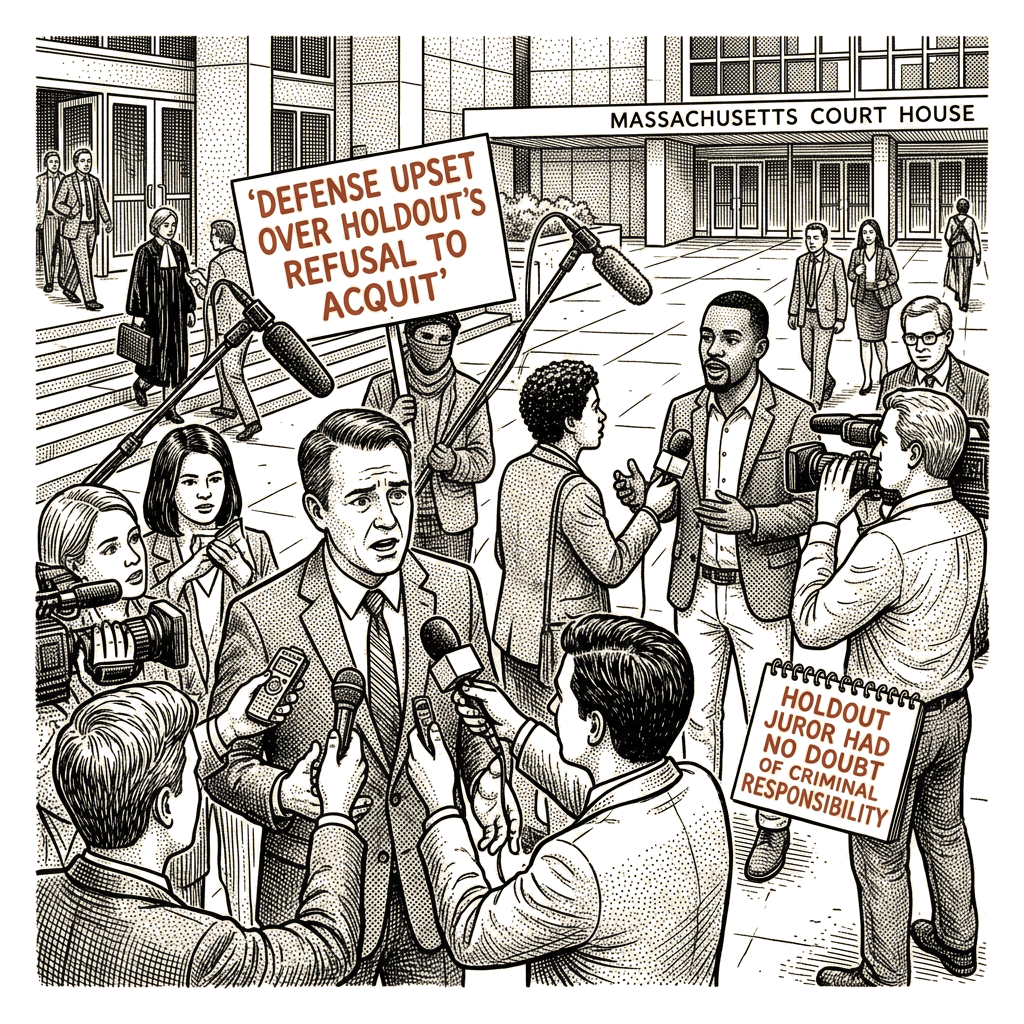
Defense attorney Kevin Reddington told ABC’s Good Morning America on Thursday that he was “upset” the lone holdout juror in Lindsay Clancy’s murder trial would not acquit her, saying the juror would not “apply the law of reasonable doubt” as instructed by the judge. He added that he hopes to reach an agreement with prosecutors to avoid a second trial.
The holdout juror, Michael Desronvil, separately told CBS News — the BBC’s US partner — the same day that he had no doubt Clancy was criminally responsible for strangling her three children at the family’s Massachusetts home. A judge had declared a mistrial on 4 September after the jury failed to reach a unanimous verdict following nearly 40 hours of deliberation.
The jury of nine women and three men considered a range of options including not guilty by reason of insanity, manslaughter and first-degree murder. Several jurors subsequently told CBS that the panel was ultimately divided 11-1 in favor of finding Clancy not criminally responsible. To find Clancy guilty, jurors had to be unanimously convinced beyond reasonable doubt both that she intentionally killed her children and that she did not do so as a result of postpartum psychosis, a rare and serious condition.
Clancy, 36, was charged with three counts of first-degree murder after strangling her daughter Cora, 5, her son Dawson, 3, and her infant son Callan, 8 months, at the family’s Massachusetts home before jumping from a second-floor window. She has admitted to the killings.
In his statement to CBS, Desronvil said the physical evidence, key witnesses and prosecution presentations convinced him that Clancy had planned the deaths. “Based on all the physical evidence, key witnesses and what the prosecution presents, I thought it was enough proof that she knew exactly what she was doing and planned it,” he said. “As I tried to explain different possible theories during deliberation, I kept getting cut off as if I had doubts based on the evidence presented.”
The jury foreperson, a retired fifth-grade teacher, told NBC that during deliberations Desronvil had “admitted he had reasonable doubt” but, as she started filling out the verdict sheets, said he still would not vote to find Clancy not guilty by reason of insanity. The foreperson described not being able to reach a verdict as “awful” and an “emotional rollercoaster.”
Another juror, Paula Devlin, told CBS Mornings that the panel had spent several days trying to persuade Desronvil to change his position. “We all worked together to convince ourselves once we got to that point where it was 10 to 2,” she said. A third juror told local CBS station WBZ-TV that most panelists had been “very firm in their stance” from the outset and that, while the holdout was not the only juror unwilling to see the other side, Desronvil would neither “follow” his reasonable doubt nor offer logical reasoning for his position — leaving the panel to conclude Clancy had not received a fair trial.
The identities of all 11 jurors have not been officially disclosed, but in the United States, once a case is over, any juror can choose to speak publicly about a case and the deliberations.
Clancy’s defense attorneys argued she had been suffering from postpartum psychosis at the time of the killings, citing her being placed on more than a dozen medications in the lead-up to the deaths and her contacts with a suicide hotline and an emergency room. A forensic psychiatrist who testified for the defense said Clancy had experienced a “command hallucination” and a “delusion of influence” during the killings. Her lawyers argued that postpartum psychosis left her unable to understand the nature of her actions or distinguish right from wrong.
The prosecution’s own psychiatrist testified that Clancy had shown no signs of psychosis during treatment sessions, and another psychiatrist noted that the condition is not currently recognized by the American Psychiatric Association. Prosecutors said the killings were calculated. Under Massachusetts law, prosecutors bore the burden of proving Clancy was criminally responsible beyond any reasonable doubt; the defense was not required to prove mental illness or lack of criminal responsibility.
Patrick Clancy, the children’s father and Lindsay Clancy’s ex-husband, is scheduled to discuss the case publicly in an interview with CBS’s 60 Minutes on Sunday. He is expected to discuss his grief, memories of his children and the conspiracy theories that have flooded social media since the trial began. He has said he still speaks to his children “all the time,” describing it as “a way I stay connected to them.”
The mistrial leaves the case unresolved. Prosecutors have not announced whether they will seek a retrial. The next court hearing is scheduled for 29 September at Plymouth Superior Court in Massachusetts.