Safety experts say five-year compliance timeline is unnecessary
The Clear Labels Act, introduced earlier this year by Sens. Rick Scott, R-Fla., and Kirsten Gillibrand, D-N.Y., aims to require that generic drug labels disclose where medications were actually manufactured — details that had largely been withheld until now, even from Congress. Current labels often include only the location of the packager or distributor, which can be thousands of miles from the factory where the drug was made.
The bill emerged after a ProPublica investigation last year found that the United States had continued importing generic drugs from foreign factories after FDA inspectors had identified quality and safety lapses at those sites, including leaks, mold and contaminated water. Medications made at those facilities were linked to thousands of reported adverse reactions in U.S. patients.
Under the original version of the bill, drug labels were to include a unique facility identification code, known as a DUNS number, that the FDA uses to identify individual factories. That identifier would have allowed researchers, doctors and patients to trace a generic drug back to the regulatory history of the specific facility where it was produced, and in some cases to find FDA inspection reports describing contamination and other safety breakdowns on factory floors. The original bill also called for the requirements to take effect as early as one year after passage.
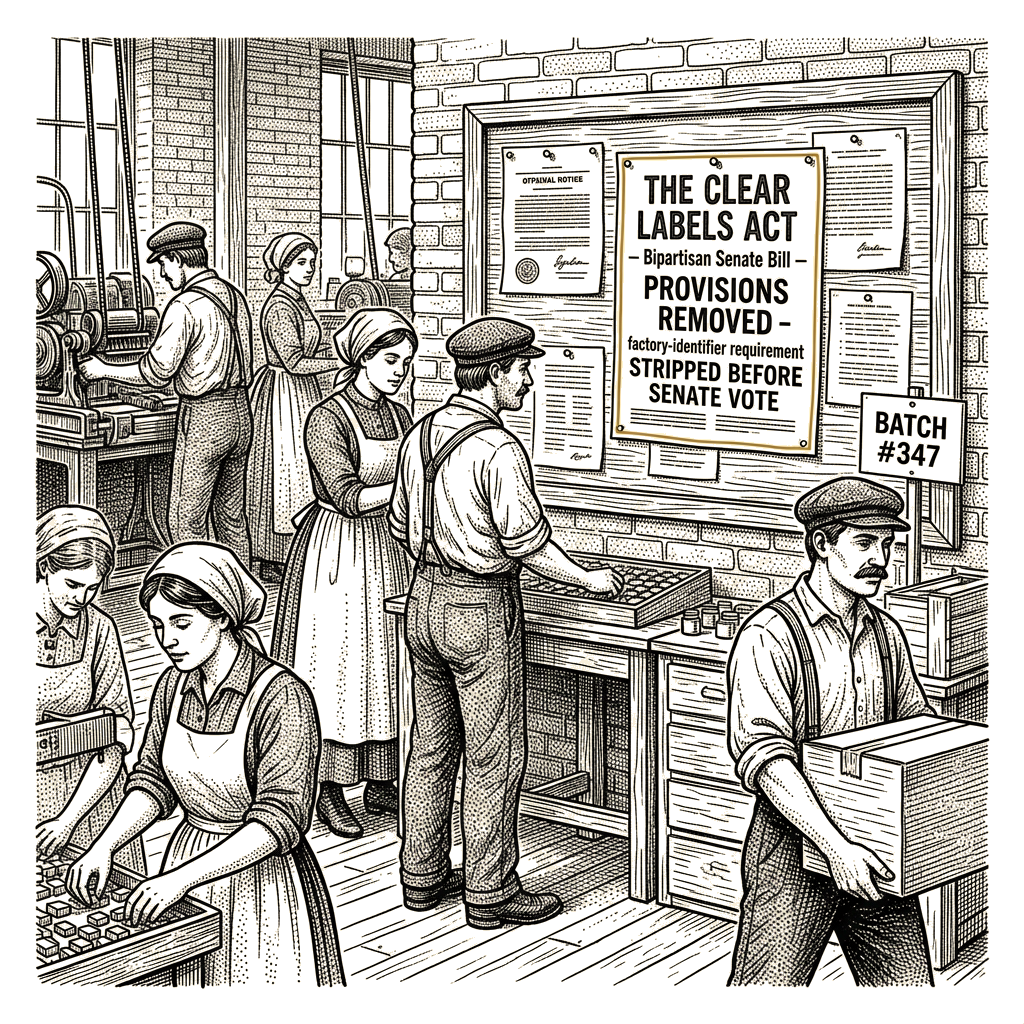
Both of those provisions have now been removed. The unique identifier requirement has been struck from the bill, and the timeline for companies to come into compliance has been extended to five years.
People familiar with the deliberations told ProPublica that lawmakers raised concerns that the original requirements would increase drug prices and create national security risks by exposing the precise locations where lifesaving medications are manufactured.
Drug-safety experts reacted sharply. “It’s just a clear watering down of the original bill,” said retired Army Col. Vic Suarez, a former medical supply-chain commander who has been leading a push for more domestic pharmaceutical manufacturing.
Dr. Kevin Schulman, a professor of medicine and health policy at Stanford University who has researched the economic pressures that lead to poor-quality generic drugs, questioned the extended timeline. “Five years after it passes might as well be a lifetime,” Schulman said. “Why is it that the supply chain, the medical distributors and the retailers don’t want to make sure that they supply the highest-quality product?”
In a joint press release, Scott and Gillibrand praised the bill’s progress through the Senate, calling it a “massive win for consumer safety and transparency,” but did not address the changes to the legislation. A representative from Gillibrand’s office said the five-year delay is intended to give the FDA time to complete its rulemaking process — a yearslong procedure used to introduce new regulations — and to give manufacturers time to redesign their labels.
Peter Baker, a former FDA inspector whose work involved the companies affected by the bill, said the five-year timeline is unnecessary. “If they wanted to do it in one year, they could,” Baker said. “I would love to hear their justification on why they need five years to develop some rules and guidance on transparency. … I mean, it’s a simple label change.”
Baker also pushed back against the national security concerns. He said information about where U.S. drugs are manufactured is already widely known, and including factory information on labels would not pose a significant risk. “It’s a public health concern over a national security concern,” Baker said. “I would say that those risks outweigh the national security concerns.”
Baker added that the burden of ensuring compliance will fall to already-overworked inspectors, who would be forced to determine whether manufacturers are skirting the address requirement. It would be easier to require the unique identifier, he said, because inspectors could more easily verify the information. “The more flexibility they allow, the more complex it is to enforce it,” Baker said.
Under the revised language, drug labels will be required to include only factory addresses — information that can be inconsistent and difficult to trace to a specific manufacturing facility. ProPublica reporters found that a single address in India can house multiple factories producing different drugs, or can appear with slight variations of the same address. When the newsroom built its Rx Inspector tool — a database that lets consumers look up where more than 40,000 generic drugs are made — it was able to connect a drug to a specific facility directly in 69 percent of cases when the DUNS number was available, but had to rely on automated address verification, geolocation and manual review when only addresses were available. Pharmacists and patients are already using the tool to learn more about the drugs they take and prescribe.
John Gray, an Ohio State University professor who testified before the Senate Special Committee on Aging, led by Scott and Gillibrand, raised concerns about the bill’s use of the term “place of business” rather than explicitly requiring a factory address. “If, in fact, ‘place of business’ can be interpreted as the location of the importer or the headquarters or something like that, it would be no different than what we have today,” Gray said. “Then we’ll be right back to where we are. It’ll say ‘Manufactured for So-and-So in New York City,’ but it’s actually made somewhere else around the world.”
People familiar with the negotiations over the bill’s language said they are confident that manufacturers will not be able to exploit such a loophole. They said the changes were primarily the result of compromises between committee offices and stakeholders, and that the FDA will have the final say in determining what counts as an acceptable address. Congress will work with the FDA to make sure the law is properly interpreted and enforced, according to those familiar with the negotiations.
The Association for Accessible Medicines, the generic drug industry’s lobbying group, did not respond to multiple requests for comment. A spokesperson for the association had previously told ProPublica that the additional requirements would cause “significant costs in exchange for limited return.” The group’s public filings show it spent more than $1 million between January and July on healthcare and generics-related bills, including the Clear Labels Act. The trade group representing brand-name manufacturers also did not respond to a request for comment; a spokesperson had previously said the industry would “welcome conversations about how to strengthen the biopharmaceutical supply chain.”
On the Senate Health, Education, Labor and Pensions Committee, the bill faced pushback from Sens. Maggie Hassan, D-N.H., who raised national security concerns, and Rand Paul, R-Ky., who said he worried about creating an additional hurdle to drug production. The revised bill passed the committee in July with Paul as the sole dissenter. A date for the full Senate vote has not yet been scheduled.