Trump announces progress on permanent Army base in Poland
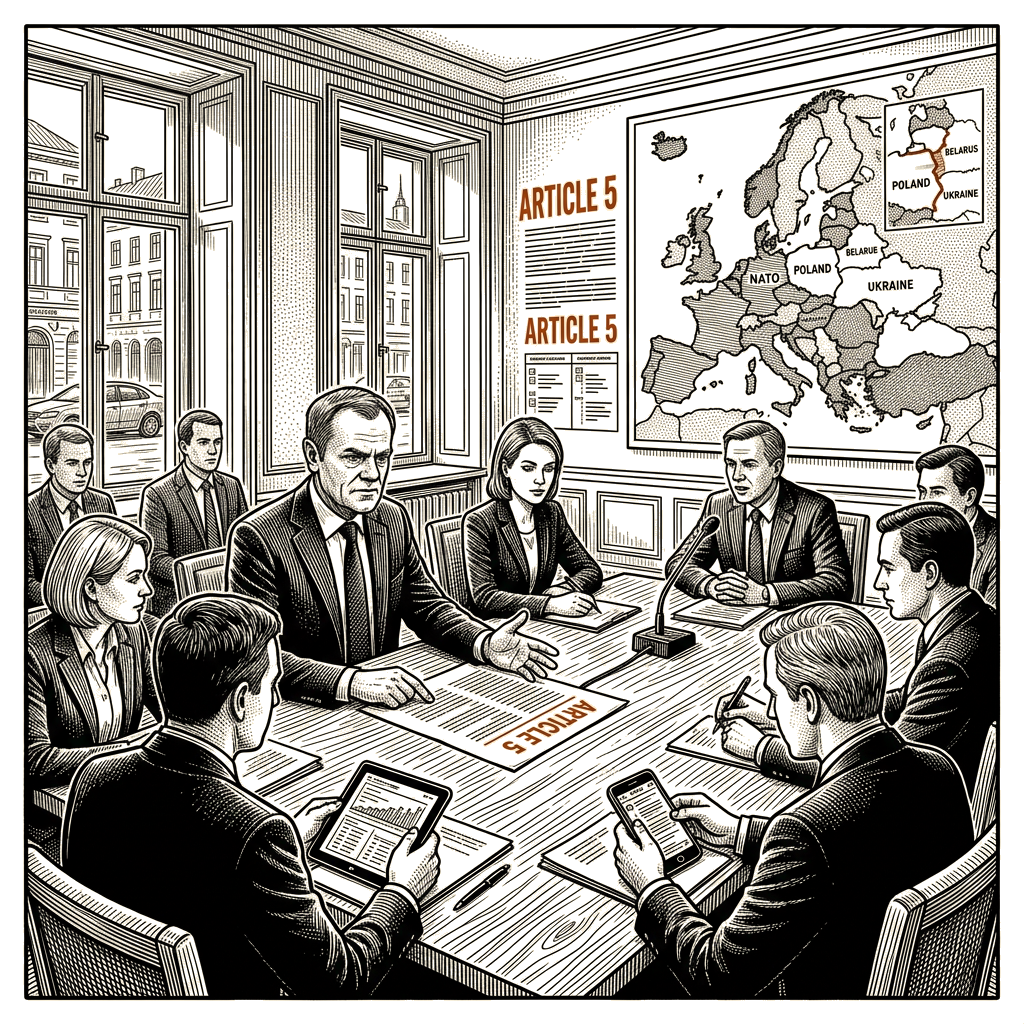
Poland’s Prime Minister Donald Tusk said Thursday that Russia plans to send drones or missiles into NATO countries that back Ukraine and label these incidents as “accidental,” according to NPR. Tusk said he received the intelligence from NATO, Ukraine and U.S. agencies, though he did not specify which he was citing.
The Polish prime minister said the operations Russia is planning aim to “paralyze NATO” or weaken the alliance’s collective response — the principle embodied in Article 5, under which an attack on one NATO member is treated as an attack on all members — to show that Article 5 “exists only in theory.” Tusk’s warning follows recent incidents along NATO’s eastern flank that NATO member countries have attributed to Russia, NPR reported.
NPR reporter Esme Nicholson emphasized that Tusk said “there is nothing to suggest an invasion.” But, she reported, the Polish prime minister also said his country faces a critical test as a key ally of Ukraine. Tusk questioned whether NATO members adequately consider the vulnerabilities of the alliance’s eastern flank, suggesting Poland may need Article 5 support more urgently than countries such as Portugal or Ireland.
Hours after Tusk’s remarks, Trump announced that the U.S. is making progress on establishing a permanent Army base in Poland, which currently hosts American troops on a rotational basis.
In a separate legal track, a federal judge ruled Thursday that Trump cannot demolish the Kennedy Center without first providing a 30-day notice. The decision followed a vote by the center’s board of directors to close the main building, citing its poor condition and finances. On Wednesday, Trump had said the complex could be “ripped down” if his name were not displayed on its main building. Trump has also said the Kennedy Center has lost millions of dollars but did not offer evidence of that claim, NPR reported.
NPR’s Anastasia Tsioulcas reported there has been confusion surrounding the building’s closure. On Wednesday, Matt Floca, the center’s executive director, called the closure “temporary.” That same day, a staff member from a law firm representing Ohio Rep. Joyce Beatty, who is suing Trump and the center’s board, submitted a sworn statement claiming she witnessed construction crews installing barriers while a forklift repeatedly hit the building’s pillars. On Thursday, eight architecture and culture groups asked the court to appoint an independent monitor or neutral party to protect the building and the institution.
Voting officials and civil rights groups filed federal lawsuits arguing that the Trump administration’s suggestion to deploy federal agents at polling places violates the 1965 Voting Rights Act, which bans voter intimidation. NPR was first to report on the latest lawsuit, which highlights the Trump administration’s pursuit of noncitizen voters. The filing alleges that immigration officers are “reportedly using flawed methodologies and faulty data that will almost certainly result in the surveillance, investigation, and even unlawful detention of U.S. citizens, particularly those from communities of color.” The plaintiffs say that a visible presence of immigration law enforcement around voting centers amounts to unlawful voter intimidation under federal voting rights laws. The White House had not responded to NPR’s request for comment at the time of publication.
An internal Department of Homeland Security email, newly acquired by NPR, raises concerns about the agency’s efforts to identify non-U.S. citizens on state voter rolls. The email included a 78-page document listing jurisdictions that provide election materials in non-English languages, alongside a Department of Justice checklist for prosecuting voter-related offenses.
In other NPR reporting, psychologist Marisa Franco told Life Kit that people who criticize themselves during emotionally tumultuous moments may be showing that they struggle with self-worth. Franco said self-worth is a skill people can develop, including by revisiting challenging memories. The exercise she recommends is to revisit a memory and imagine an adult version of oneself saying, “You’re safe, I care about you, and I’m never going to leave you.” Franco said the practice can improve self-esteem, reduce trauma symptoms and lead to changes in the hippocampus, the part of the brain where memories are stored. She added that when self-esteem is low, people may achieve great success but still feel like a failure.
NPR’s weekend recommendations included a fall film slate that critics say features a follow-up to “The Social Network,” the origin story of the “Rocky” film and more than 20 other movies. On television, the new series “Last Seen” follows an emergency dispatcher who becomes obsessed with uncovering the truth after receiving a call one night from a girl he believes might be his long-missing daughter. In books, Kate Atkinson’s “Our Noble Selves” is what NPR describes as a historical escape focusing on the Festival of Britain, a real-life celebration aimed at uplifting British people’s spirits after World War II.
In music, Neil Young released his 50th studio album, “Second Song,” featuring five new personal tracks along with two newly recorded songs he wrote during his teenage years in Canada. Before the album’s release Friday, Young spoke with NPR about the reflective work. In theater, producer Francesca Moody — who was instrumental in bringing “Fleabag” and “Baby Reindeer” to the Edinburgh Fringe festival before their global success — told NPR what she looks for in a performance. NPR also offered a quiz of the week’s highlights.
NPR also reported that gold-winning Olympian Jessie Diggins, after retiring from skiing this winter, competed in the 100-mile Superior Fall Trail Race and finished faster than any other woman. In the latest installment of NPR’s Far-Flung Postcards, reporter Jennifer Pak sent greetings from a shop called Bao Er Jiu in Beijing, where the baozi — a fluffy steamed bun with filling — are worth the wait in line. And when Teyu Chou was 11 years old, he immigrated from Taiwan to the U.S. with his family. The transition left him feeling isolated and confused, but a fellow student helped him overcome the language barrier with English lessons. Now, Chou has a family of his own, and he often thinks of his unsung hero whenever his kids are struggling, NPR reported.