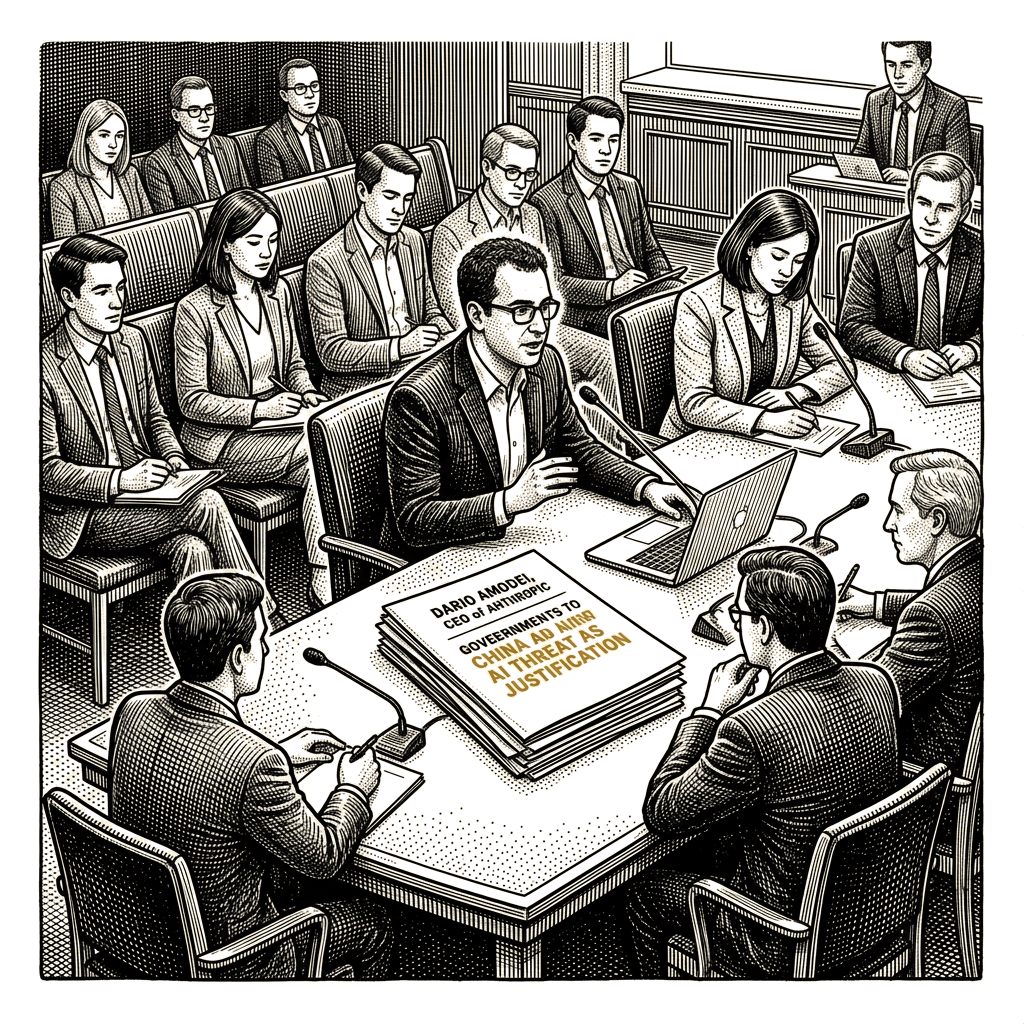
Critics say company merged AI safety with US-China competition
Amodei’s focus on China sets him apart from peers in the industry, according to The Guardian’s reporting. This week, he led an industry-wide call to “pace the frontier” of AI development while warning that “if we greatly restrain our AI capabilities in the belief that China will do the same, and then China defects, AI could be so powerful that such a defection could lead to their geopolitical dominance.” OpenAI CEO Sam Altman has not taken strongly hawkish positions on China. Nvidia CEO Jensen Huang has encouraged the use of Chinese AI models and called export controls a failure. Meta founder Mark Zuckerberg has framed the competition primarily in corporate and economic terms. Google DeepMind’s Demis Hassabis has made few public remarks on China compared with other AI executives.
“Sam Altman doesn’t have especially strong views when it comes to China. Anthropic is a totally different story,” Kyle Chan, a fellow at the Brookings Institution, told The Guardian. “Amodei is really, really focused on a particular view of the risk from AI and what he frames as basically a struggle between a world dominated by authoritarian AI versus democratic AI.”
Amodei has argued for years that the United States and its allies should take aggressive action to limit Chinese AI growth, most notably blocking sales of advanced semiconductor chips and manufacturing equipment needed to advance AI. In a January essay titled “The Adolescence of Technology,” he wrote that “there are a number of possible arguments against the severity of these threats, and I wish I believed them, because AI-enabled authoritarianism terrifies me.” Huang has bristled at Amodei’s position on export controls, urging Trump to ease restrictions.
Amodei’s China focus was on display last weekend in his response to warnings from a young Anthropic researcher who resigned, predicting human extinction by the end of the decade at the digital hands of AI. The apocalyptic string of posts by Jacob Coxon did not mention China, but the specter across the Pacific loomed so large in Amodei’s mind that, when outlining how to prevent human extinction, beating Beijing was paramount.
Anthropic has staffed its national security team with figures aligned with that view. The company hired Tarun Chhabra, a former Biden-era National Security Council staffer, as its head of national security policy. Chhabra has campaigned against chip sales to China and called for a full-scale government effort to curb the Chinese Communist party’s AI advancements. At a Senate hearing last year, Chhabra testified that “the CCP does not seek complementarity or coexistence or comparative advantage with the United States or our allies. Instead, the CCP seeks run-the-table dominance and control of the most critical technologies and supply chains,” according to The Guardian. He added that he believed the Biden administration did not take decisive or rapid enough action to maintain the US lead against China.
Amodei co-wrote a Wall Street Journal op-ed last year with Matt Pottinger, the architect of Trump’s first-term China policy and a visiting fellow at the conservative Hoover Institution. Pottinger, who authored a book on defending Taiwan against a Chinese attack, argued in 2024 that the United States and China were in the “foothills of a great-power hot war.”
Anthropic has spent millions lobbying for increased government oversight and safety measures while simultaneously opposing any policy the company perceives as giving China an opening. “The United States needs to stay in the lead on AI and you cannot do safety from second place,” Sarah Heck, Anthropic’s head of public policy, said at a Politico event on Wednesday.
The Trump administration’s hands-off approach to AI regulation has made private companies the primary actors in shaping public policy, according to The Guardian. “It would be akin to having the entire pharmaceutical industry be just completely unregulated,” Chan said. “It’s kind of amazing and ultimately boils down to one thing, which is Trump has been very reluctant to want to regulate because he doesn’t want to slow down the AI boom and the effect that it’s having on the economy.”
Anthropic is not the only AI company to hire former top policy staffers. OpenAI hired Dean Ball, the author of Trump’s AI action plan, as “head of strategic futures” earlier this year. While Ball has criticized Amodei’s framing of the competition with China, he has expressed similar pessimism about US-China cooperation. “There was a time when it was possible to believe we could each pursue our strengths, enrich our respective economies, and grow together. Alas, such harmony now appears impossible,” Ball wrote of China last year. “We are locked into a structural conflict.”
Several of the AI figures focused on China have ties to the effective altruism movement, a quasi-utilitarian philosophy that overlaps with AI safety advocacy. Leopold Aschenbrenner, a 25-year-old former OpenAI researcher and founder of an AI hedge fund, called in a 165-page paper for a government-led effort to reach superintelligent AI before China. “Super-intelligence will give a decisive economic and military advantage,” Aschenbrenner wrote in 2024. “China isn’t at all out of the game yet. In the race to AGI, the free world’s very survival will be at stake.” Aschenbrenner, who is married to Amodei’s chief of staff, made headlines earlier this year when his hedge fund lost $35 billion in less than a month.
The US-China Economic and Security Review Commission’s annual report to Congress, issued a few months after Aschenbrenner’s manifesto, listed as its top recommendation “establishing and funding a Manhattan Project-like program dedicated to racing to and acquiring an Artificial General Intelligence.”
In 2025, Google co-founder Eric Schmidt, Scale AI founder Alexander Wang (now head of AI at Meta) and Center for AI Safety director Dan Hendrycks published a strategic deterrence doctrine called Mutual Assured AI Malfunction (Maim), adapting the cold war framework of Mutually Assured Destruction to AI. The paper proposes that the United States and China could achieve geopolitical stability by threatening espionage, cyberattacks and potential military strikes against each other if either state pursues a monopoly on AI. “A nation with sole possession of super-intelligence might be as overwhelming as the Conquistadors were to the Aztecs,” the paper warns.
Eliezer Yudkowsky, one of the earliest and loudest voices of the AI safety movement, has argued that the United States should be willing to carry out airstrikes against foreign data centers and risk nuclear war to enforce a global AI moratorium. “Make it explicit in international diplomacy that preventing AI extinction scenarios is considered a priority above preventing a full nuclear exchange, and that allied nuclear countries are willing to run some risk of nuclear exchange if that’s what it takes to reduce the risk of large AI training runs,” Yudkowsky wrote in a 2023 Time Magazine essay. Yudkowsky founded the Machine Research Intelligence Institute, which received more than $10 million over the past decade from Open Philanthropy, a nonprofit associated with the effective altruism movement. Open Philanthropy’s cofounder and former CEO, Holden Karnovsky, is married to Anthropic co-founder Daniela Amodei.
Other China hawks in tech have ties to the military-industrial complex and economic stakes in the competition. Anduril founder Palmer Luckey has claimed his defense tech firm operates under an internal policy that projects must be built with the assumption China will launch hostilities against Taiwan in 2027. Palantir CEO Alex Karp told Axios last year that “we are going to be the dominant player or China is going to be the dominant player. And there will be very different rules depending on who wins. When people are worried about surveillance, of course there are huge dangers there, but it’s like, you will have far fewer rights if America is not in the lead.”
Experts say most Chinese firms and their government do not view AI the same way. According to The Guardian, loss-of-control debates are relatively new in China, where the government’s primary concern is AI’s potential to fuel domestic social unrest.
The United States and China are scheduled to hold AI cooperation talks this month, and Trump is set to meet Xi Jinping in Washington this week, with AI high on the agenda.
China’s state-backed media have aggressively criticized Amodei, accusing him of running a “cold war playbook” against China through his support for an AI slowdown. “They’re very much paying attention to Amodei’s essay and they’re also conflating his essay with potential US approach in the upcoming AI safety talks,” Thibaut told The Guardian. Chan said Anthropic “has played quite a strong role here in linking those issues together in a way that they maybe didn’t need to be linked. To put it really bluntly, it made it much harder to get the Chinese to want to talk about these things and not see it purely as a veiled way to slow them down.”
At home, growing public backlash to AI could force regulatory action regardless of the industry’s China framing. Nationwide opposition to data centers and recent cybersecurity incidents — including OpenAI’s models hacking into outside organizations — have become midterm election topics. “You can go ahead and wield the China arms race argument, but at some point this industry will also have to deal with the consequences of fueling a race to the bottom,” said Amba Kak, co-executive director at the AI Now Institute and former senior adviser on AI for the Federal Trade Commission.
Although experts and diplomats have expressed little hope that the upcoming US-China talks will produce major agreements, the increasing risks of AI being used for autonomous weapons and cyberattacks may force countries to act even if they don’t stop building the technology. “We don’t win if we develop the killer robots first. Nobody wants killer robots,” Thibaut said. “There should be powerful incentives on both sides to stop this.”