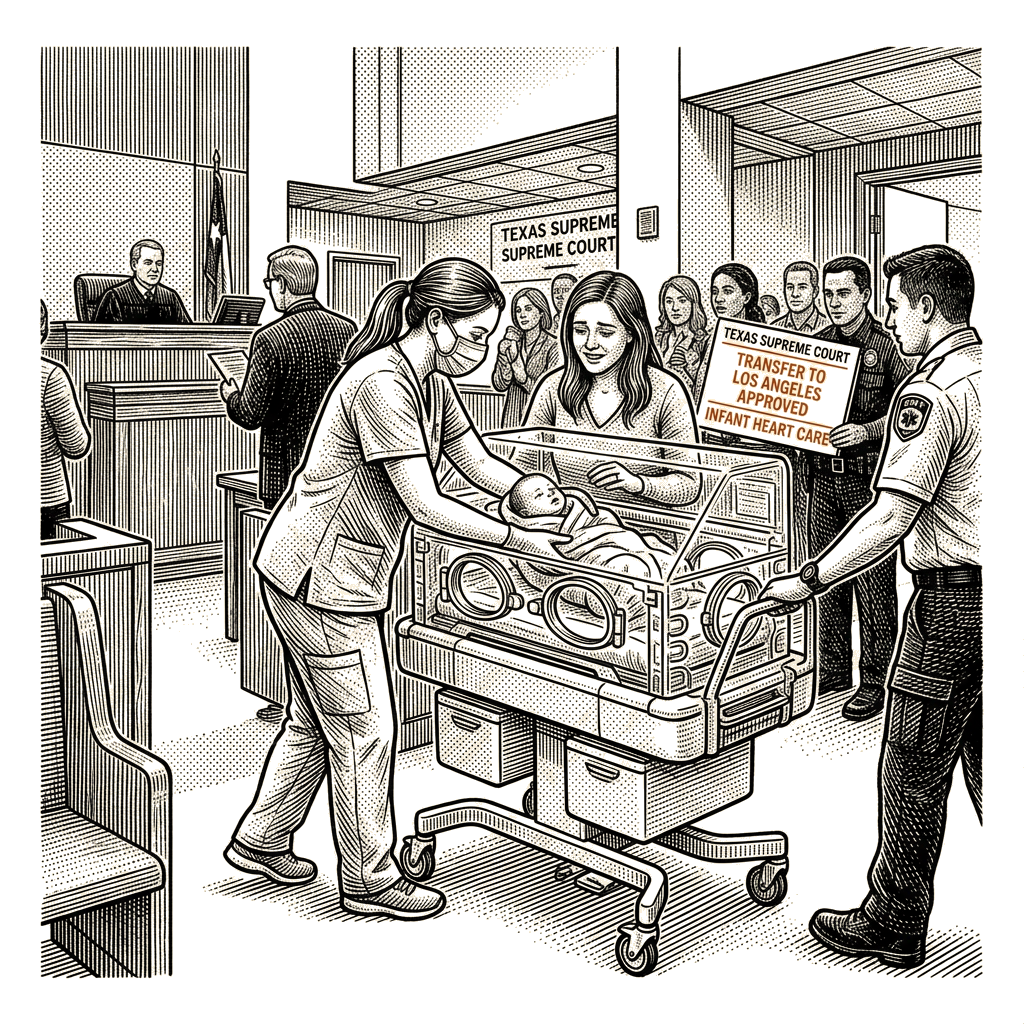
Surrogate traveled to Texas after couple asked her to terminate
The Texas Supreme Court’s Thursday order said “sustaining the life of the medically fragile child is the paramount concern in this time-sensitive matter,” referring to the baby’s rare severe heart defect. The court cited testimony from the infant’s Texas physician, who described the window for an ICU-to-ICU transfer as short and “ripe now.”
The infant, named Rumi by his biological parents, has hypoplastic left heart syndrome, a condition that impedes blood flow and requires extensive surgery. Without treatment, the defect can be fatal.
The condition was detected when the baby was a fetus, prompting Gilkar and Ahmed to ask West to terminate the pregnancy. West, who resides in Alaska, traveled to Texas, where abortion is illegal, to deliver the child.
West had attempted to block the biological parents from removing the child from Texas and taking him to a hospital in Los Angeles where the couple live. West’s legal team maintains that the couple attempted to force her into having the procedure, while lawyers for Gilkar and Ahmed said West initially agreed to the abortion before blindsiding them with the legal battle for custody.
Texas Attorney General Ken Paxton elevated the dispute’s national profile when he intervened to ensure the baby would receive medical care after his birth. West subsequently appealed to the U.S. Supreme Court, suggesting Gilkar and Ahmed would put the baby into end-of-life care at a hospice rather than continue treatment for the heart defect.
“There is simply no truth whatsoever” to the hospice claim, the couple’s attorneys responded in a court filing. They argued that if the court sided with West it would sow confusion over who had authority to dictate and consent to medical decisions for the child.
West’s lawyers, in their own filing, wrote that “ordinarily, MW would have been deemed [the baby’s] mother under Texas law by virtue of giving birth to him. But because of the unlawful California judgment, she has been dismissed with prejudice from the Texas proceedings and denied any information,” referring to their client by her initials. According to court documents, West was seeking to be informed about the baby’s medical status and to “advocate for her rights.”
At an August hearing in Dallas, Gilkar described her son as “the most beautiful person” and said, “He’s the love of our lives. He’s suffering a lot.”
West’s attorneys did not immediately respond to a request for comment about the Thursday ruling.
The case has stoked enormous debate around abortion and parental rights, particularly in conservative media.