States weigh wildfire liability rules after California bill fails
Salem Abraham made his fortune trading stocks and commodity futures from the high plains of the Texas Panhandle. The self-described data junkie has spent the past two years on a different pursuit: the wooden poles that carry Xcel Energy’s power lines across the eight states the utility serves.
Abraham is fighting in court to obtain and publicize Xcel’s pole inspection records, files he believes will show the utility was negligent ahead of the February 2024 Smokehouse Creek Fire — the largest wildfire in Texas history. An aging pole snapped in high winds about 60 miles from his ranch and sparked the blaze, which killed two people and an estimated 15,000 head of cattle. Abraham lost an estimated 3 million to 4 million trees at his ranch near Canadian, Texas.
“I can’t get my trees back,” Abraham said. “We’ve got a bigger problem, which is this is everywhere. The world needs to know this is dangerous, and it’s going to get worse.”
Over the past two years, Abraham has driven hundreds of miles crisscrossing the region, through back alleys and along highways, tallying the condition of poles by reading the metal tags nailed to them that indicate when they were last inspected. He has also fought in court for the inspection records covering more than 200,000 miles of electric distribution lines in eight states served by Minnesota-based Xcel.
“I’m just trying to figure out a puzzle here,” Abraham said. “And when there’s data involved, I’m pretty good at figuring out the puzzle.”
Abraham thinks the records will show Xcel had fallen behind in inspecting its equipment ahead of the disaster. Xcel has said its equipment was likely involved in igniting the blaze, but the utility disputes that it was negligent in maintaining and operating its infrastructure.
Texas Attorney General Ken Paxton sued Xcel in December, alleging that inspections in the weeks before the fire showed some of the poles were deteriorating. In some cases, the poles had been in service since 1936. Abraham is a donor to Paxton, who is running for U.S. Senate.
As part of a temporary injunction, Xcel agreed to inspect 35,000 wooden poles annually in Texas and replace the most damaged poles as quickly as one day after inspection. The company has said it replaced thousands of poles in Texas and New Mexico in 2024 and is current with its replacement queue.
Pole ownership is not straightforward. While most wooden poles are owned by the utility, some belong to phone or cable companies.
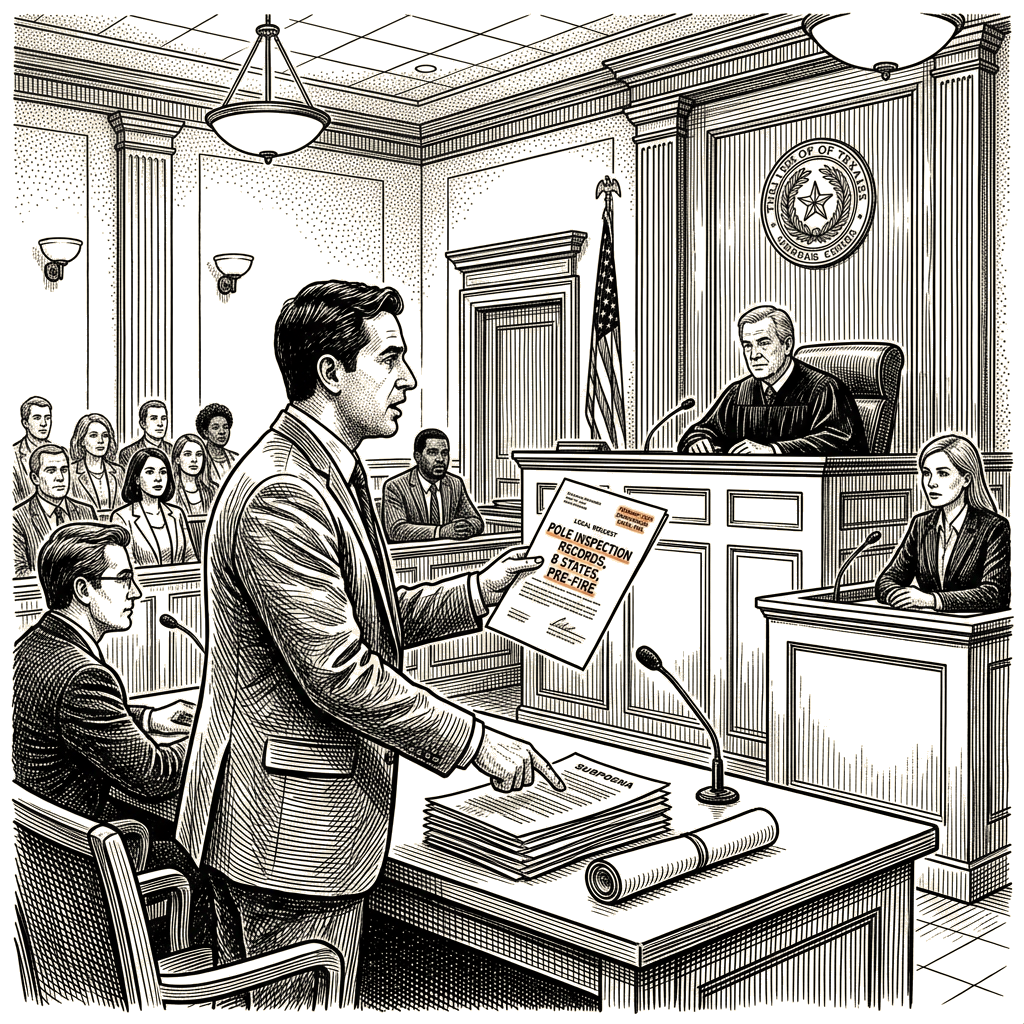
On a recent afternoon, attorneys for Xcel and Abraham argued over pole inspection records in the Wheeler County Courthouse in the Panhandle. Xcel said it does not have a problem providing them but wants the records kept confidential. A judge agreed with Xcel that the inspection records will stay under a protective order for now. Abraham’s attorneys received the files, but he wants to share the data with Panhandle towns and “whoever wants to see it.”
Abraham has organized a coalition of 10 towns to press for safety improvements. Mike Borger, the mayor of Pampa, Texas, one of the towns in the coalition, said the group’s formation has produced visible results.
“Suddenly we’re seeing poles being replaced in our area everywhere,” Borger said. “I’m glad they’re doing it, but that also says, ‘Oh, wow. These guys are on to us. We better make a showing here.’”
Abraham’s larger goal is to drive Xcel out of the region entirely. He would prefer to see a local rural electric cooperative or a smaller publicly traded company in Amarillo take over the service. Xcel said it is focused on delivering safe, reliable and affordable electric service and strengthening the system. “We have longstanding, positive working relationships with our communities,” the company said.
Ousting a utility would be unusual. Scott Hempling, who teaches utility law at Georgetown University Law Center and has written three books on utility regulation, said there is little precedent for communities to follow.
“I can’t claim to be an expert on replacing utilities because nobody is — because it doesn’t happen,” Hempling said, calling it a gap in regulation.
The Smokehouse Creek Fire is part of a broader conflict confronting utilities and their customers across the country. America’s electric grid is under mounting strain, much of it built in the years after World War II and ill-equipped to meet the soaring power demands of the AI era. Extreme weather conditions are wrecking equipment and challenging reliability, and wildfires such as the one in Texas are becoming more common, no longer restricted to the West Coast and Hawaii.
In response to the growing wildfire threat, Xcel’s recent actions include creating a 60-person mitigation team, deploying hundreds of weather stations and cameras, and undergrounding more power lines over the past two years.
“It’s not a matter if we’re behind,” said Michael Lamb, Xcel’s executive vice president and chief delivery officer. “It’s a matter of learning from a rapidly evolving risk that is new to the world and to our industry.”
Lamb said the conditions that can create large wildfires are worsening and moving east, and all utilities in North America should prepare.
“Get your house in order because it’s coming to you soon,” he said.
The utility estimated losses for the Texas fire of at least $460 million and has paid nearly $400 million in settlements through June. In Colorado, Xcel disputes its equipment was involved in the ignition of the deadly 2021 Marshall Fire in Boulder County but settled litigation for $640 million, without admitting fault.
The debate over utility wildfire liability is loudest in California, where an attempt by Gov. Gavin Newsom to limit utility liability for wildfires failed to make it through the state legislature. Shares of PG&E and Edison International, the parent company of Southern California Edison, are down about 20% since the bid failed. Other states are also wrestling with how to manage wildfire risks. Michigan regulators have told utilities to come up with plans for shutting off power in targeted areas when wildfire risks are high. Missouri is asking utilities for wildfire mitigation plans. A recent Kansas law would cap punitive wildfire damages against electric utilities at $5 million per claim. Utah now allows utilities to establish wildfire funds to help manage liability risk and caps the value of some fire-related claims.