Argentine president pairs sovereignty demand with Vaca Muerta investment pitch
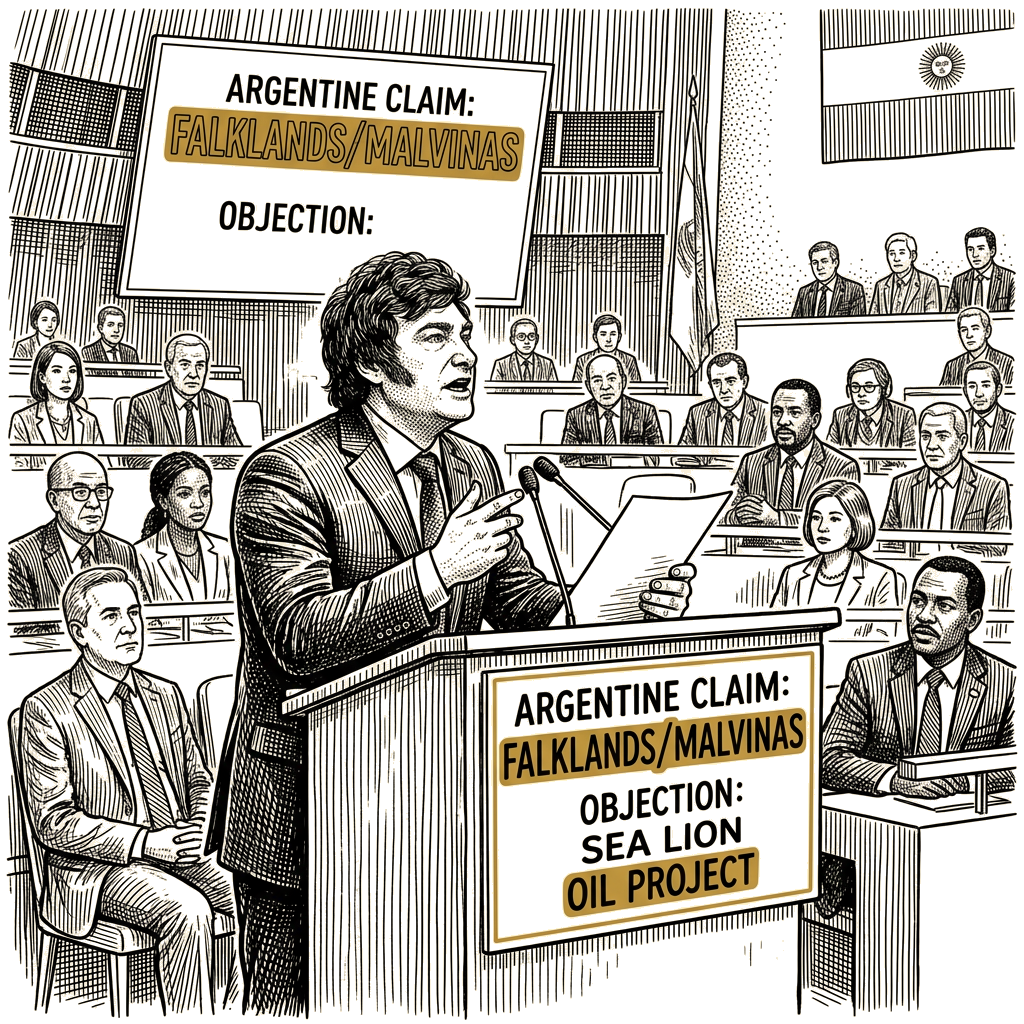
Argentine President Javier Milei used his address to the U.N. General Assembly on Wednesday to renew Argentina’s sovereignty claim over the Falkland Islands, accusing the international body of letting a resolution on the dispute half a century old remain “powerless in the face of reality.” Milei devoted the opening minutes of his speech in New York to the territorial dispute with Britain — using Argentina’s name, “the Malvinas” — and to British-administered oil activity in the surrounding waters.
Milei recalled that 50 years ago the General Assembly adopted Resolution 3149, which calls on the parties to refrain from unilateral changes while the sovereignty question remains unresolved. “Fifty years later, the situation has not changed, but the unilateral changes continue,” he told the assembly.
His central target was the Sea Lion oil project, which is moving toward crude production in the North Falkland Basin under British-issued licenses. Argentina considers those licenses “illegal and illegitimate,” and Milei said any activity in the area not authorized by Buenos Aires constitutes an illegal act under Argentine law and, according to his government’s position, international law.
“What good is a resolution if, for decades, the other party can act contrary to it while that resolution remains intact in the archives but powerless in the face of reality?” Milei asked.
The president said his administration has adopted a more active posture toward economic activity on and around the islands than its predecessors, listing formal protests, available legal measures, sanctions imposed on companies involved in the licenses and their suppliers, and legislation sent to Argentina’s Congress as concrete steps.
Milei also renewed Argentina’s call for Britain to resume negotiations aimed at a peaceful resolution of the sovereignty dispute and proposed talks on the exploitation of natural resources in the area.
The sovereignty demand was paired with a pitch for foreign capital. Milei highlighted the potential of Vaca Muerta, the country’s vast shale oil and natural gas formation located primarily in Neuquén province, and invited international companies to invest.
“Come, invest, develop, do it with us,” he said. “But this invitation has a limit. We will not remain indifferent to those who exploit resources under foreign occupation.”
The sovereignty dispute sat inside Milei’s broader critique of multilateralism. Milei accused the United Nations of abandoning some of its original objectives and criticized the body’s record on international security, human rights and sovereignty.
He also defended Argentina’s alignment with the United States and Israel, saying his government seeks to strengthen the country’s economic, political and military influence. “We aligned ourselves unambiguously with the West,” Milei said. “We did so with the United States and Israel, countries with which we share a deep affinity of values and strategic complementarity.”
In a separate section of the address, Milei devoted attention to artificial intelligence, rejecting preventive regulation of the technology and positioning Argentina as a destination for its development. He argued that the technology should be approached as a tool for transforming productivity rather than as a threat that justifies “excessive controls,” and warned against applying to it the same kinds of intervention he had criticized in health, environmental and economic policy. Milei said Argentina has the critical minerals, energy and human talent needed to participate in the artificial intelligence value chain and proposed a framework that would include limited liability for companies operating AI agents and tax incentives.
“On artificial intelligence, Argentina will position itself at the forefront of freedom,” Milei said.