OECD also flags government bond yields and AI market confidence as downside risks
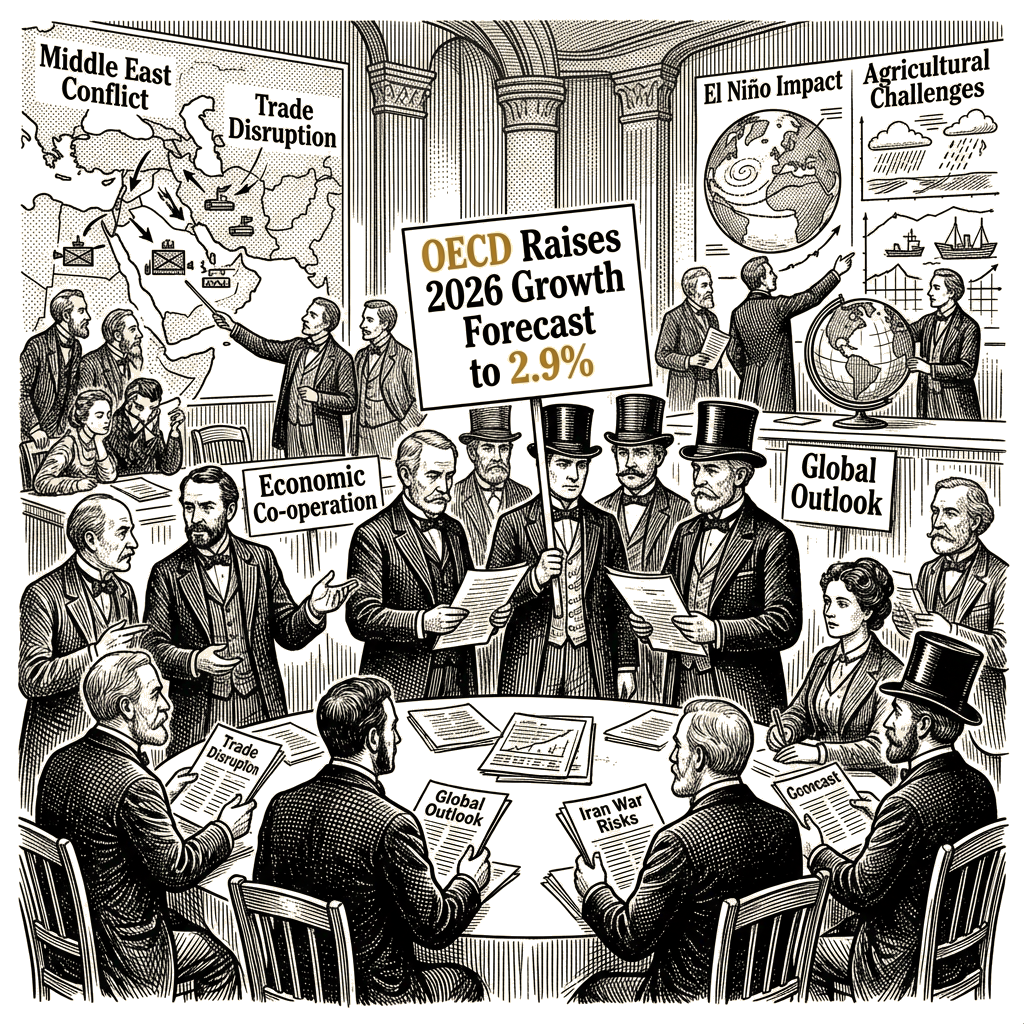
In its interim economic outlook published Wednesday, the Organisation for Economic Co-operation and Development said the global economy had withstood the strains of the Iran war better than first feared when the US-Israeli war on Iran began in late February.
The OECD pointed to the release of global oil stockpiles, a sharp decline in energy imports by China, and the switch to other fuels including coal as factors helping to cushion the economic impact of limited Gulf oil supplies. However, it said the recent resurgence in oil and gas prices posed risks for the coming months.
“Global economic prospects remain heavily dependent on whether a durable resolution to the Middle East conflict is achieved,” the OECD said in its quarterly forecast update.
The OECD now expects global economic growth of 2.9% this year, a modest upgrade from the 2.8% it forecast in June. At the same time it trimmed the outlook for next year slightly, to 3% from 3.1%.
Oil prices fell back below $100 a barrel on Tuesday amid hopes of a potential agreement between the US and Iran, the OECD noted, but the continued standoff between the two sides has sent energy costs soaring in recent weeks. The OECD warned that while more oil supplies were expected to resume as hostilities eased, “renewed or more persistent disruptions could result in both higher inflation and weaker growth.”
The OECD singled out the record-breaking El Niño weather system — expected to be the strongest in 1,000 years — as a “significant downside risk” to the global economy, warning that it could hit agricultural production and push up food prices. Other risks include a further increase in yields on government bonds, which have risen in response to fears of higher inflation, and a loss of market confidence in the value of AI companies.
AI investment has helped to offset wider economic weakness, especially in the US economy, the OECD said. “In the United States, countervailing forces are at work, with strong underlying momentum and further expansion of AI investment, but consumer spending that is increasingly constrained by declining purchasing power, softer labour force growth and depleted household savings,” it said.
For the UK, the OECD significantly cut its inflation forecast for this year, from 3.7% to 3.1%, after prices rose less dramatically than expected. The OECD forecast UK economic growth of 1.1% for 2026, up from the 0.9% it had forecast in June and 0.7% in March, “with consumption expected to be supported by newly announced government support measures.” Growth is expected to be weaker than the 1.4% reported last year and is forecast to dip slightly next year to 1%, down from the 1.1% forecast in June.
In response, Chief Secretary to the Treasury Emma Reynolds said: “Despite unprecedented pressures and conflict in both the Middle East and in Europe, the UK economy is showing strong resilience. We will face these challenges together and we are already giving families space to breathe. We had the fastest growth in the G7 in the first half of the year and we are starting the big, long-term changes needed to create good jobs and growth in every postcode.”
Andy Burnham announced a cut in VAT on electricity bills as one of his first policy measures on coming to power in July, and has suggested there may be more measures to give consumers “breathing space” in next month’s budget. Burnham and his chancellor, John Healey, have seen UK borrowing costs rise sharply amid turmoil in global bond markets as ongoing conflicts have disrupted the oil supplies, driving up inflation.
Separately, IMF Managing Director Kristalina Georgieva told the BBC the world’s advanced economies had been warned they need to take action to reduce their borrowing and bring down debt levels at a time of surging government borrowing costs. Global economic shocks had been “pushing debt levels up like a staircase not to heaven” despite governments taking “no action to contain that service cost. [It’s] time to take that action,” Georgieva said, adding that courage was needed by politicians to take the necessary steps.