Consular services and migration at center of New York talks
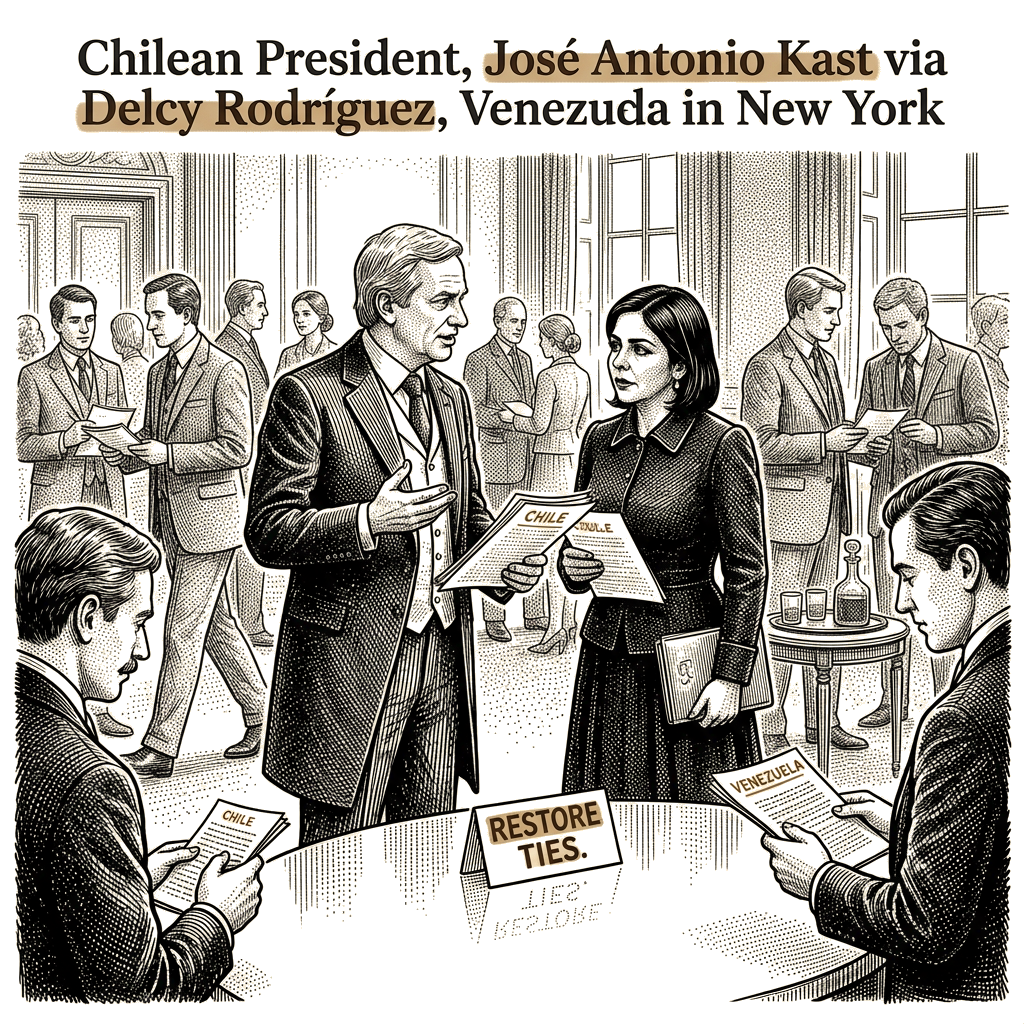
Chilean President José Antonio Kast met Venezuelan acting President Delcy Rodríguez in New York on Wednesday to discuss restoring diplomatic relations between the two countries, according to United Press International. The meeting, held on the sidelines of the 81st United Nations General Assembly, marked another step toward rapprochement after Venezuela severed ties with Chile under former President Gabriel Boric, whose government had questioned the transparency of Venezuela’s 2024 presidential election.
After the meeting, Kast said the normalization process would move gradually, beginning with consular relations. “This will move forward step by step. First, the issue of consular relations, and we also hope to have diplomatic relations in the coming months,” Kast said at a news conference with Chilean reporters.
The talks addressed the situation of Venezuelans living in Chile who have faced difficulties obtaining or renewing documents because of the absence of Venezuelan consular services, and the documentation required for migrants seeking to return to Venezuela. “She [Delcy Rodríguez] is very aware that there are Venezuelans who want to return to their homeland. She told me that 35,000 of her fellow Venezuelans have already returned to the country,” Kast said.
The Venezuelan migrant population in Chile has grown sharply in recent years. A study by the Economic Context Observatory at Diego Portales University estimated that 510,740 Venezuelans lived in Chile in 2025, accounting for 5% of the country’s total labor force. In 2017, Venezuelans represented just 0.4%.
Asked whether Chile supports Rodríguez’s administration as Venezuela’s acting government, Kast focused his response on the country’s institutional recovery. “We are supporting Venezuela’s recovery. Today, she is the acting president, and steps will be taken in the coming months to fully restore the functioning of Venezuela’s institutions,” Kast said.
Kast said he expects Venezuela to gradually open space for broader political participation. “We hope that, over time, as the president said, channels of dialogue will open with people who legitimately want to participate in electoral processes later on, as this process becomes consolidated,” Kast said.
Migration has been a central focus of Kast’s government and a major plank of his presidential campaign, which included a pledge to expel foreign nationals living in Chile without legal status. His administration suffered a setback in Congress this week when the Chamber of Deputies rejected a constitutional amendment that sought to extend from five to 30 days the period authorities could detain migrants subject to administrative expulsion orders.
Kast criticized the vote and said his government would seek to revive the proposal, either through the Senate or by introducing new legislation. “Today Chile lost in the face of a situation that could have been improved quickly. Some did not want to do it, and I hope I can convince them,” Kast said.
Kast defended the proposal as a necessary tool for carrying out deportations. “Those who came in through the window have to leave. We say that no one enters Chile unless they come through the door,” Kast said.