27 leaders back Finland-Norway AI safety initiative
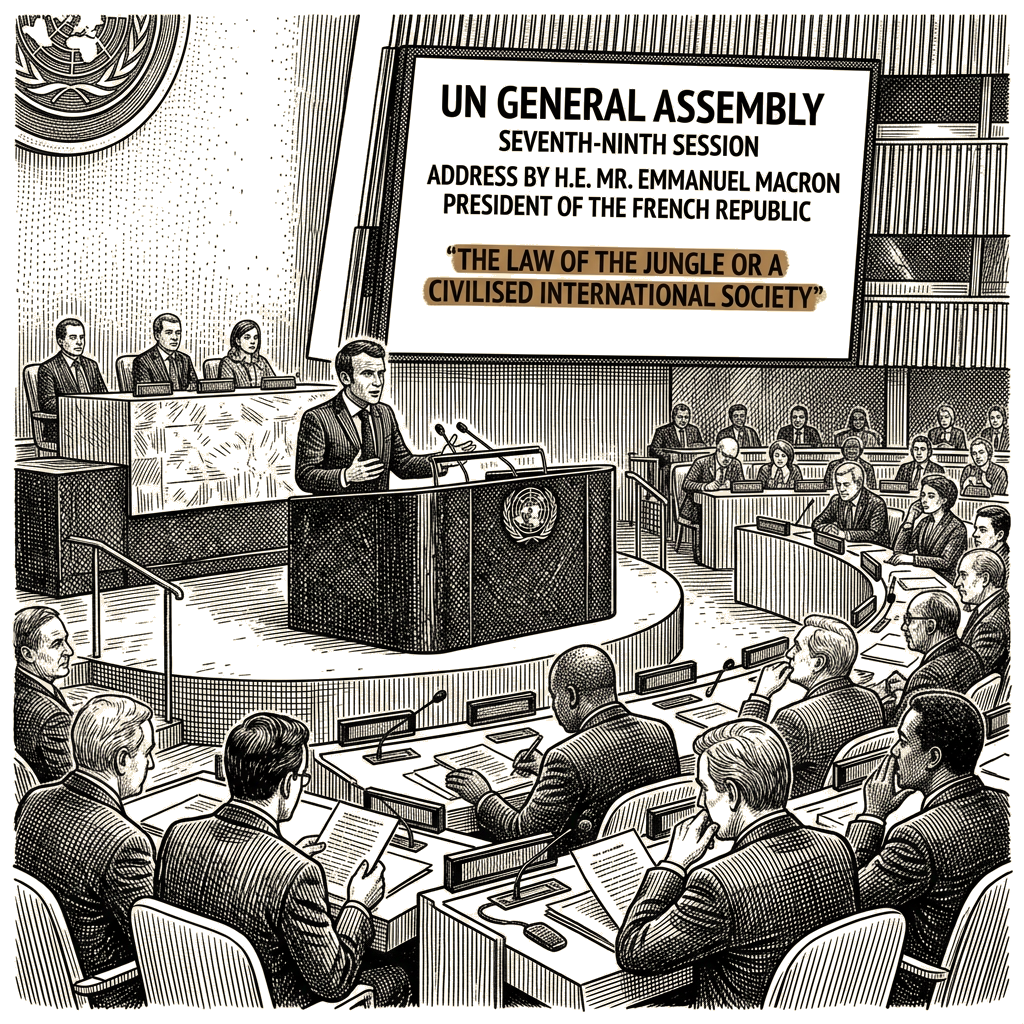
French President Emmanuel Macron used his address to the UN General Assembly on 22 September 2026 — expected to be his final speech before he steps down as president next spring — to defend international law and the rules-based order, framing the moment as “a new era of barbaric acts,” according to a column by Guardian opinion writer Steve Bloomfield.
Hours earlier, US President Donald Trump had taken the same podium. Bloomfield described Trump’s speech as “disturbingly familiar” and characterised its contents as “a litany of false boasts and odd tangents, peppered with grim military threats against a variety of nation states.” Bloomfield wrote that in Trump’s view, the world is “there to be ruled — and ruled only by the US.” In the speech, Trump described the US economy as “the envy of the world” and the US military as “the most powerful on Earth,” Bloomfield reported. Discussing his seven-month war with Iran, Trump mused over whether to “annihilate the Islamic Republic and do it quickly,” Bloomfield reported.
Macron, whose remarks were “clearly aimed at Trump” without naming him, told the assembly: “They say might is right … but we will not yield.” He asked whether the world wants to live under “the law of the jungle” or “in a civilised international society,” and directly criticised Russia and Israel. He also acknowledged what he called the West’s “permanent temptation to espouse double standards,” saying: “How many times have we heard that people’s sovereignty has value in Europe, but if we look at the Middle East and Africa, it is less valuable. No, that is unacceptable … A life is a life. Peace and security are indivisible, and everyone has a right to them.”
Bloomfield wrote that Macron has “consistently been one of the only western leaders with a morally intelligent analysis of what Europe and the world should look like.” Bloomfield characterised Trump, Russian President Vladimir Putin and Israeli Prime Minister Benjamin Netanyahu as having “ushered us into an age of impunity,” and said Macron, in response, has defended the rules-based order and “in recent months, been at the forefront of attempts to forge new alliances to support the crumbling old ones.” Macron has pushed the idea of European strategic autonomy more than anyone else, Bloomfield argued, understanding that while Europe is an economic power, it is yet to fully realise its potential as either a military or geopolitical force. During Trump’s first term, Macron was the only major leader willing to publicly acknowledge that NATO could no longer rely on the United States, a stance Bloomfield characterised as leaving the alliance “all but dead.”
Bloomfield traced the constraints on Macron’s tenure to the circumstances of his arrival. Macron came to power in May 2017, Bloomfield wrote, “as the new world order was crumbling. The EU was in crisis: one of its largest members had just voted to leave, while the remaining member states were still fatally split over the fallout from the eurozone crisis earlier in the decade and the migration wave in the summer of 2015.” France’s two biggest European allies have been on the slide during his time in office, Bloomfield added. Macron has had to work with three German chancellors — the most recent two less popular than their predecessors — and is now on his sixth British prime minister. Trump had taken office four months earlier than Macron, Bloomfield wrote, “signalling the start of the break up of the rules-based order that had guided the west since the end of the second world war.”
Macron’s domestic position has compounded those constraints, Bloomfield reported. The French president has been without a parliamentary majority since his 2024 snap election, leaving him “in effect … a lame duck for the past two years,” Bloomfield wrote. His previous big speeches have rarely led to substantial change — his 2017 call for EU reform was in essence scotched by then-German Chancellor Angela Merkel, who praised his “passion” and “verve” but failed to back the substance, Bloomfield added.
In the days that followed Macron’s address, leaders of so-called middle powers delivered speeches that defended UN principles. Many of those who would have been scared of speaking out a year ago feel more emboldened now, Bloomfield wrote. Australian Prime Minister Anthony Albanese said “the UN mission cannot be entrusted solely to the great powers, or the biggest countries, or even the loudest voices alone.” Spain’s Prime Minister Pedro Sánchez said he sought to “defend what so many are trying to destroy” and called on countries to come together to fight “political actors and governments that want to take us back to a dark past.”
Bloomfield reported new multilateral initiatives emerging during the assembly. Finland and Norway launched a call for an international body to oversee the safety of artificial intelligence models. Bloomfield described the initiative as “a direct challenge to Trump, who has called concerns about AI safety a ‘hoax.’” Twenty-seven world leaders signed on, including Macron, Canadian Prime Minister Mark Carney, German Chancellor Friedrich Merz and Albanese. The United Kingdom formed a new coalition of middle powers to impose sanctions targeting Israel’s unlawful occupation of the West Bank, and the European Union and Canada discussed the idea of “associate membership,” Bloomfield reported.
What links these efforts, Bloomfield wrote, is the concept of “values-based realism” — an argument first put forward by Finnish President Alexander Stubb and echoed by Carney, whom Bloomfield said arguably “lit the ‘middle powers’ spark in Davos earlier this year” when he spoke of the “rupture” in the world order caused by Trump.
Bloomfield’s column left open questions for British politicians Andy Burnham and Ed Miliband about which emerging groups the United Kingdom should join. The UK has so far not joined the Finnish-Norwegian AI safety initiative, Bloomfield reported, “perhaps for fear of invoking Trump’s wrath.” Another unresolved issue, Bloomfield added, is how to respond to Trump’s reported desire to invite Russian President Vladimir Putin to the Group of 20.