Strategists see unchecked executive action as final refuge
Donald Trump stood before the United Nations on Tuesday and threatened to “annihilate” Iran, according to remarks reported by The Guardian. Yet even as the 80-year-old president projected military strength, his political standing showed fresh signs of erosion from multiple directions.
Heading into the UN building in New York, Trump was questioned by CNN anchor Kaitlan Collins. “I’m surprised that CNN is here covering me,” Trump said, according to Collins. “You should not be here covering me.” The exchange followed a White House ban on CNN, MS Now and Politico from the campus after critical coverage; a federal judge has since blocked the ban, ordering the administration to “immediately return, reinstate and restore” their access.
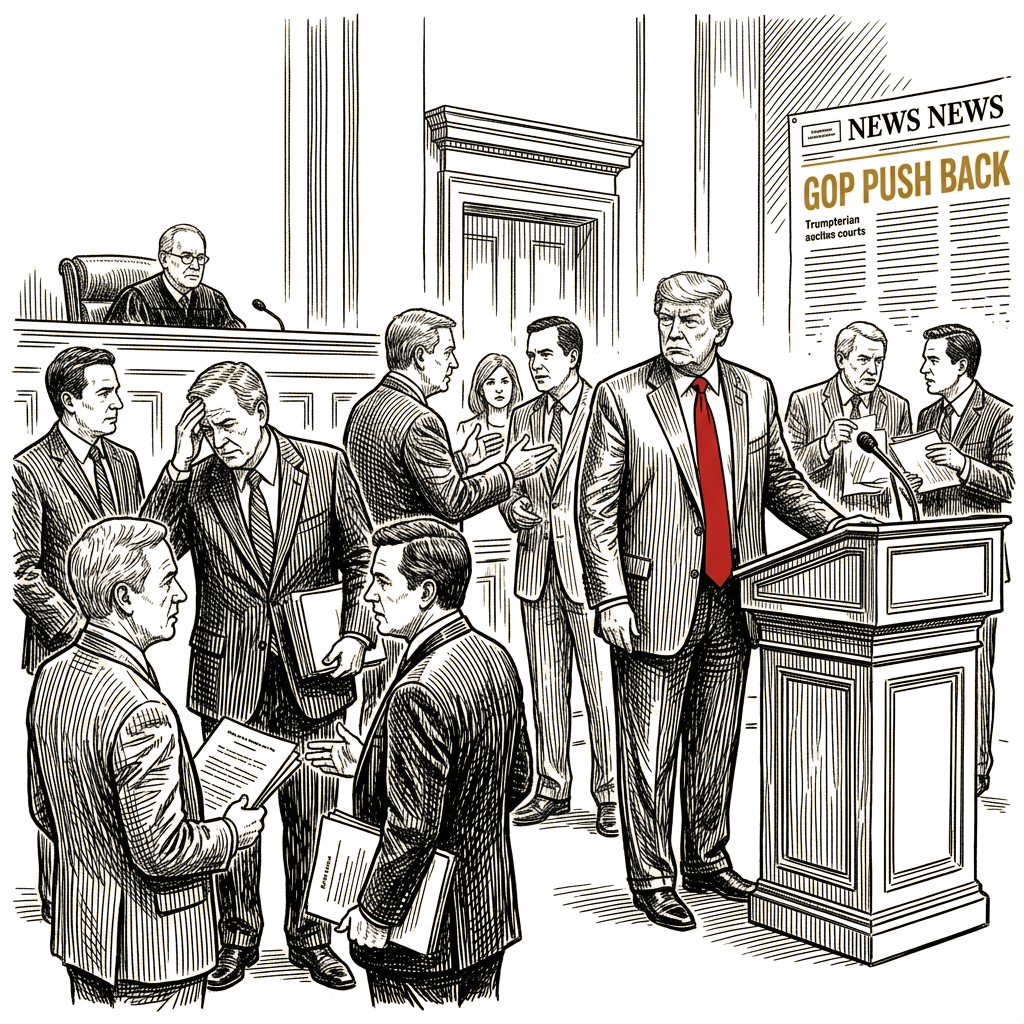
Federal courts have moved against Trump on several fronts. The Federal Reserve defied him on interest rates. The Supreme Court blocked his administration’s attempt to impose new restrictions on mail-in ballots for November’s midterm elections. One judge prevented Trump from adding his name to the Kennedy Center, prompting him to threaten the national arts complex with demolition. The Guardian reported a widening gap between the president’s self-perceived invincibility and the reality of his waning influence.
Trump’s self-belief has not wavered through past trials. He faced four criminal cases and two assassination attempts before winning the 2024 election. He has lived by a mantra of “it will all work out well in the end” while his supporters wear hats that state: “Trump was right about everything.”
Now even Trump’s dependable power base is showing cracks. In Florida, his home state, Republican gubernatorial candidate Byron Donalds quietly scrubbed most Trump references from his campaign website. Rep. María Elvira Salazar ran advertisements declaring that federal immigration enforcement had gone “too far” and asserting that Latino voters “feel betrayed.”
For nearly a decade, elected Republicans maintained a posture of submission, fearful of drawing a primary challenger or a scathing post on Truth Social. With the elections looming and control of Congress hanging in the balance, self-preservation is rapidly overriding loyalty to the president, The Guardian reported.
Rick Wilson, a co-founder of the Lincoln Project and a longtime Republican strategist, prophesied: “This is the beginning of the end. This is the decline. As powerful and transgressive as he’s been, the country does not have a positive outlook right now. In fact, the negativity and pessimism among voters has reached a point that is unparalleled since Jimmy Carter.”
Wilson described the mood among congressional Republicans with a wildlife analogy. “It needs a David Attenborough voiceover,” he said. “It’s like the gazelles wandering the savannah. They’re sniffing the wind now and they smell something in the wind. They know it’s a predator but they don’t know what to do about it yet. What they haven’t realised is that the predator has been among them all along. The risk factor that they face now is Trump.”
Wilson said the political calculation has shifted. “Now it’s reached the point where the magic doesn’t work any more,” he said. “There’s no political upside from a president who is at 29% approval rating in some polls, has presided over a disastrous war, and has ended up raising energy prices and food prices – all the things that they can’t spin away.” Voters now associate Trump with the war, with gas prices and with grocery prices, he added.
Bill Galston, a senior fellow at the Brookings Institution and a former domestic policy adviser to Bill Clinton, said the inevitable shift of focus toward potential 2028 candidates — Vice President JD Vance or Secretary of State Marco Rubio — will be a source of friction. “Nothing will drive him crazier than the shift of the spotlight away from him,” Galston said. “The prospect of passing the torch, giving up the spotlight, is intensely painful for him. It’s his oxygen. Will he be able to breathe, spiritually and emotionally speaking, without it?”
Allan Lichtman, a history professor at American University and author of a new book, “Great American Presidents: The Twelve Who Transformed the Nation,” said second terms have historically been difficult. “Second terms have been remarkably difficult for presidents,” Lichtman said. He described Trump’s motivation. “He cannot stand not being the centre of attention and that’s dangerous,” Lichtman said. “I don’t care much about his verbal lashing-out; I don’t think that helps him at all. But who knows what crazy things he might do to reassert attention on him? And that’s frightening.”
Lichtman expanded on the threat. “Never underestimate the power of the president. Just because Republicans are criticising him, his poll numbers are low, prospects for Republicans look dim, doesn’t mean he doesn’t have enormous power – and he is certainly quite willing to use that power unconstrained. He doesn’t care about the courts and doesn’t care about the Congress,” Lichtman said.
From that vantage point, Trump’s last refuge will be the unchecked use of executive authority, a politicised Justice Department and a sweeping pardon power. With nothing to lose in his final two years, he could go out all guns blazing, The Guardian reported.
Charlie Sykes, a conservative author and broadcaster, said: “Donald Trump fears irrelevance more than anything and he’ll rage against it as long as he can. The notion that he will go quietly would be incredibly naive. We’re headed for a collision between a lame duck who has no respect for the constitutional norms and an opposition that may have some power to hold him accountable. The paradox is the weaker he gets, the more dangerous he gets.”
The White House rejected suggestions of declining influence. Davis Ingle, a White House spokesperson, said in an emailed statement: “President Trump is the unequivocal leader, best messenger, and unmatched motivator for the Republican Party, and he is committed to maintaining Republican majorities in Congress.” Ingle listed what he described as the administration’s accomplishments, including tax cuts, lower prescription drug costs, border security, reduced violent crime, an energy revolution, job creation and record-high 401(k) balances.
If Democrats gain control of the House next year, they plan to launch investigations into how Trump has allegedly abused his office to enrich his family, grant favors to supporters, hollow out the federal government and carry out expensive construction projects, The Guardian reported.
Wilson argued that Trump’s behavior creates a vicious circle. “The more he becomes a liability, the more he acts out,” Wilson said. “The more he demands loyalty from people and doesn’t get it, the more he demands loyalty from people and doesn’t get it. Everything was handed to him for a decade by that party and, now that they’re paying the price, they’ve decided this has got a little too hairy.”
Trump is not the first president to run into trouble after winning re-election. From Richard Nixon’s Watergate downfall to Bill Clinton’s impeachment and George W. Bush’s war in Iraq, second terms have historically served as a graveyard of presidential ambition. Lichtman called it a “second term curse.”