FoI requests reveal Torridge council held closed Xlinks discussions from March 2025
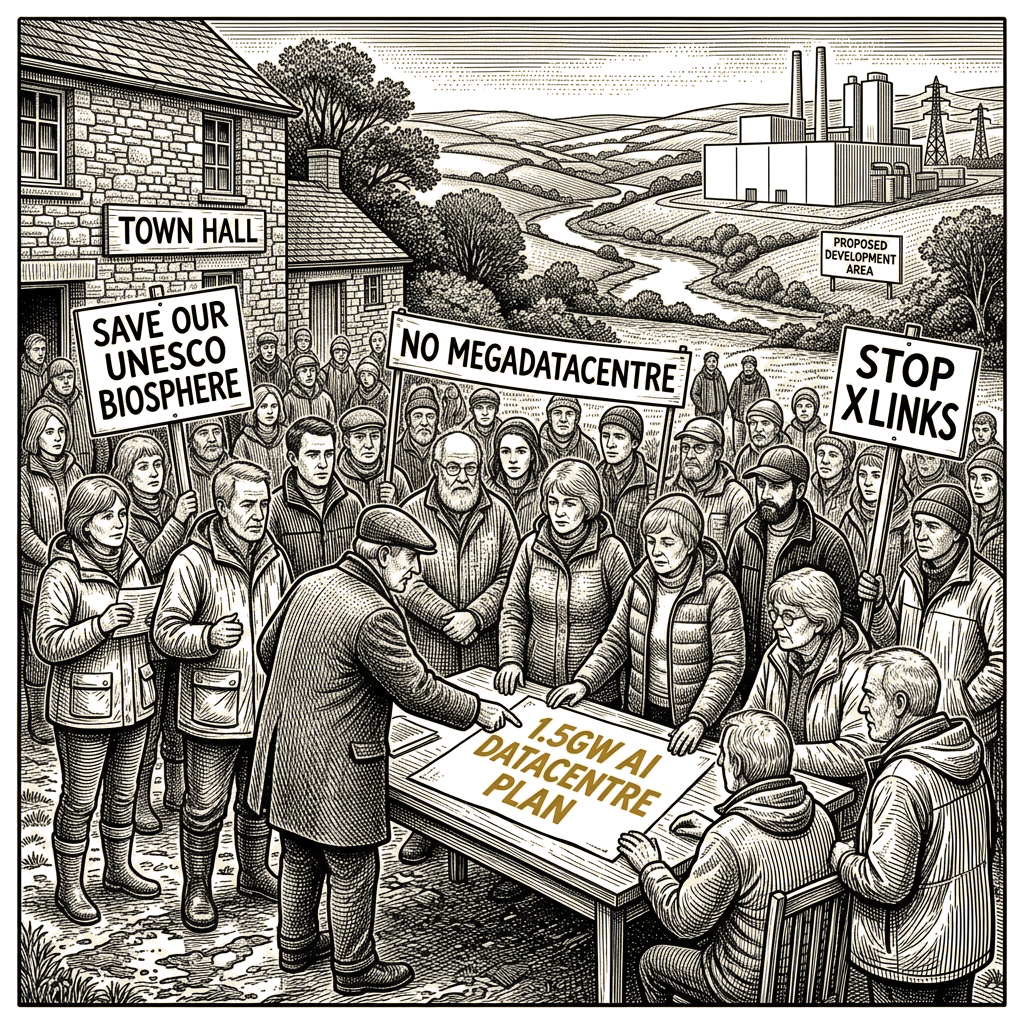
The 344-hectare campus Xlinks wants to build sits inside a UNESCO biosphere reserve in the rolling countryside around Great Torrington, a small town whose history includes a 1646 battle in the first English civil war. Five buildings, ranging from 50 to 130 feet in height, would rise from land that is currently pasture and woodland. The two largest structures would each measure 335 metres by 267 metres and cover a ground footprint of approximately nine hectares — large enough, campaigners said, to house Exeter Cathedral 18 times over. A 1.8GW battery energy storage system (BESS) involving 1,720 containerised units would accompany the datacentre, dwarfing the largest operational BESS currently in Britain, such as the 100MW Bramley facility in Hampshire.
The proposal was first announced to the public this summer with a call by Xlinks for a collaborative approach. Adopting the tactics of veteran US campaigners like Brockovich, members of the Devon Datacentre and BESS action group took to their keyboards — researching, rallying and requesting more information in a series of freedom of information (FoI) applications. The Guardian reported that the campaign has drawn in tens of thousands of people and, according to campaigners, uncovered evidence of secret deals.
Freedom of information requests filed by the action group uncovered documents showing that council officials and Xlinks began closed discussions in March 2025. In April 2025, the council issued a letter of “in-principle support” before any environmental statement or public consultation and more than a year before the company publicly announced the project. In an email dated 18 December 2025, council officials and the developers discussed creating links with a sixth form college in Exeter and a stakeholder engagement plan. “Who do we all feel it is critical to get onboard and when both locally and further afield?” the email asked. A Torridge district council spokesperson told The Guardian the pre-application process was standard practice and confidential, and said it was not confirmation of any proposal but was intended to offer guidance on whether a proposal was acceptable in principle in planning terms.
Emily Clark of the Devon Datacentre and BESS action group said the email exchanges and private meetings spanning the past 18 months revealed some officers treating the project as a foregone conclusion. “How can the largest and most costly infrastructure proposal in the nation be conducted almost exclusively in secret?” Clark said. Clark also said: “We’re facing the biggest construction proposal of its kind in the UK, and for that matter, in Europe. It would not only annihilate 850 acres of prime north Devon farmland and breathtaking countryside — an ecological gem — but have massive repercussions for the entire region. At their sole public town hall meeting in June, Xlinks assured residents they intended to work collaboratively with our community. Regrettably, genuine dialogue has been nonexistent.”
Tensions flared this week when protesters rallied and demanded answers about secrecy and due diligence outside a Torridge district council meeting. Doug Bushby, the chair of the council, responded by threatening to call the police over “unsubstantiated and unfounded allegations, abuse, harassment and intimidation”. Bushby said that when planning applications were received, “they will be dealt with within the same legislative, professional and operational boundaries that exist for all planning applications”.
The opposition has drawn in voices from outside Devon. A recent public meeting in Great Torrington was hosted by Elizabeth Humphreys of the US campaign group Not in My Valley, who was one of the forces behind achieving a permanent datacentre ban in Coachella, California, over concerns about air pollution, water and energy use. “We’re fighting the largest companies that have ever existed in the world, and that is scary but we are all fighting this together,” Humphreys said. “This is a global issue; we are all connected. People across the world are standing up and fighting back.”
Xlinks is no stranger to Great Torrington. The company was behind a 2024 plan to bring wind and solar energy to the UK from Morocco through subsea cables that would come ashore on the north Devon coast, but the government declined to support that project, saying it was not in the UK’s national interest. Xlinks said its £13.8 billion AI and BESS project would bring significant economic investment, between 600 and 1,200 jobs and clean energy infrastructure to the region. “We will ensure that the Devon data campus is designed sensitively for local people and the environment,” the company said in a statement. “We are carrying out nature and wildlife surveys on site. We must legally improve biodiversity by at least 10%, and plan to exceed this by some margin. Buildings will be sited to minimise visibility, through topography, landscaping and the existing treeline.”
The campaign has gained national traction. In the last few weeks, 30,000 people have signed a petition launched by Cheryl Cottle-Hunkin, the cabinet member for rural affairs for Devon county council, calling on the government to pause all datacentre and BESS plans outside designated AI growth zones. “Proposals like this outside AI growth zones are highly problematic, because they may seek to evade regulation and government scrutiny,” Cottle-Hunkin said. “We need an urgent national conversation on AI and associated infrastructure to make sure it’s on the right scale and in the right place.”
Opponents have raised concerns about water consumption, wastewater runoff potentially containing PFas — known as “forever chemicals” — air pollution, background noise, and the safety and fire risks associated with a battery storage facility of this scale. After the hottest summer on record, north Devon remains under a hosepipe ban. Xlinks said the data campus will be self-sufficient in water terms, recirculating water to absorb heat and topping up mainly from rainwater. A freedom of information response, however, revealed that under extreme conditions — such as severe heatwaves and serious droughts — annual water consumption could reach approximately 2.9 billion litres. Xlinks told The Guardian that the design on which that water consumption estimate was based had been superseded by a new design that would be released during public consultation and in the planning application.
The broader policy backdrop is unsettled. The UK government estimates the country requires 23–27GW of battery capacity by 2030 to meet its clean power goals, which it describes as a “very significant level of increase”. According to research by the House of Commons Library, the government does not hold data on the projected land use required for the expansion, has no specific policies for location, and has no definitive estimate of the number of operational BESS facilities or their current total capacity. Campaigners in Devon said this creates a “regulatory wild west”. A spokesperson for the Department for Energy Security and Net Zero said: “Every battery storage facility we build helps protect families from future energy shocks. We have commissioned the national energy system operator to develop the first ever strategic spatial energy plan, which will support a more actively planned approach to energy projects, to bring good jobs to communities and help to lower bills.”
The opposition has also taken aim at how Xlinks is engaging with local parish councils. Coast Communications, a public relations firm representing Xlinks, sought a closed meeting with Monkleigh parish council on 18 September. Councillors said the minutes should be made public and a recording released, but this was refused. “As a result … Monkleigh parish council will not be accepting the invitation from Coast Communications on behalf of Xlinks to a closed meeting with them and therefore no meeting will be taking place,” the council said.
A spokesperson for Torridge district council said Xlinks had planned to undertake a public consultation in July, but this was postponed until later in the year: “When any proposals are received these will be validated and details will be published on the council’s planning portal … We appreciate that this proposal will understandably continue to generate a lot of local interest.”
Xlinks said an environmental impact assessment was under way and any mitigation required would be built into the design and secured through planning conditions. The company said the campus’s listed buildings would be relocated and transformed into a visitor centre. On the site’s footprint, Xlinks said its proposals cover about 344 hectares but only a third would be developed; the majority of land would be open to the public or used for new habitat creation to support wildlife.