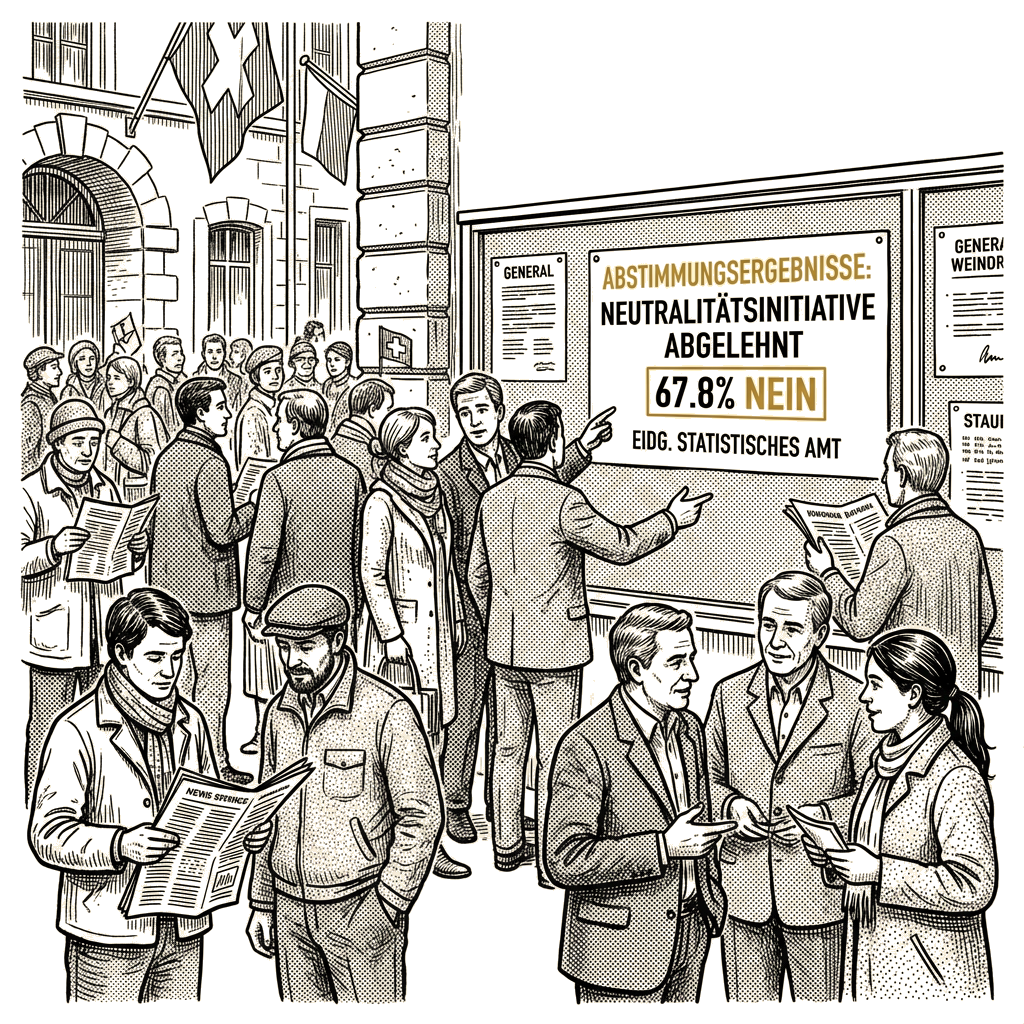
All cantons, about 70% of voters opposed measure, final results show
Swiss voters decisively rejected a proposal to write a strict definition of neutrality into the country’s constitution, final results from the Federal Statistical Office showed. About 70% of voters opposed the measure, and all cantons voted against it.
The rejected initiative, promoted by the Swiss People’s Party—which The Guardian described as far-right—would have enshrined the principle of “perpetual and armed neutrality” in the constitution. It would have barred Switzerland from joining any military alliances and from imposing sanctions on warring states unless mandated by the United Nations.
Although the defeat had been expected, the outcome will be a relief across Europe, where governments have been working to maintain EU unity on sanctions against Russia amid increasing strains. Switzerland’s centuries-old neutrality was formally recognized after the end of the Napoleonic wars in 1815. Critics of current government policy argue that status has been eroded by Switzerland’s decision to mirror EU sanctions against Russia after the full-scale invasion of Ukraine in 2022.
The result is a heavy defeat for the SVP’s billionaire backer Christoph Blocher, who was a prominent supporter of the initiative. Bloomberg reported that Blocher spent 2 million francs (€2.1m, £1.8m) on the campaign.
Opponents of the measure welcomed the result. “Voters understood what the SVP wanted: it wanted Switzerland to isolate itself internationally and shirk its responsibilities when international law is being trampled on,” said Sibel Arslan, a lawmaker for the Green party.
The Swiss government, along with most political parties, had opposed the measure. They argued that “Switzerland would cease to be a reliable partner in international security policy,” leaving the country less secure in the event of an attack and heavily restricting its ability to cooperate with NATO.
Although Switzerland is not a member of NATO, it has cooperated with the transatlantic military alliance for 30 years. Analysts said the result showed Swiss people were content with how the government interpreted Swiss neutrality.
“The people have spoken: they accept that neutrality is an instrument that can evolve, leaving the government with room for manoeuvre to adapt its application faced with geopolitical upheavals,” wrote Katy Romy, a correspondent for SwissInfo, the online service of the Swiss Broadcasting Corporation. Romy also wrote that the yes campaign was unable to shed perceptions it was acting in Russian interests.
Russia’s foreign ministry had praised the initiative, while criticising Switzerland’s adoption of EU sanctions and claiming the country was abandoning neutrality.
The SVP accepted the defeat and said it had no current plans for further action.