Ambulance request cancelled and not dispatched again for five hours
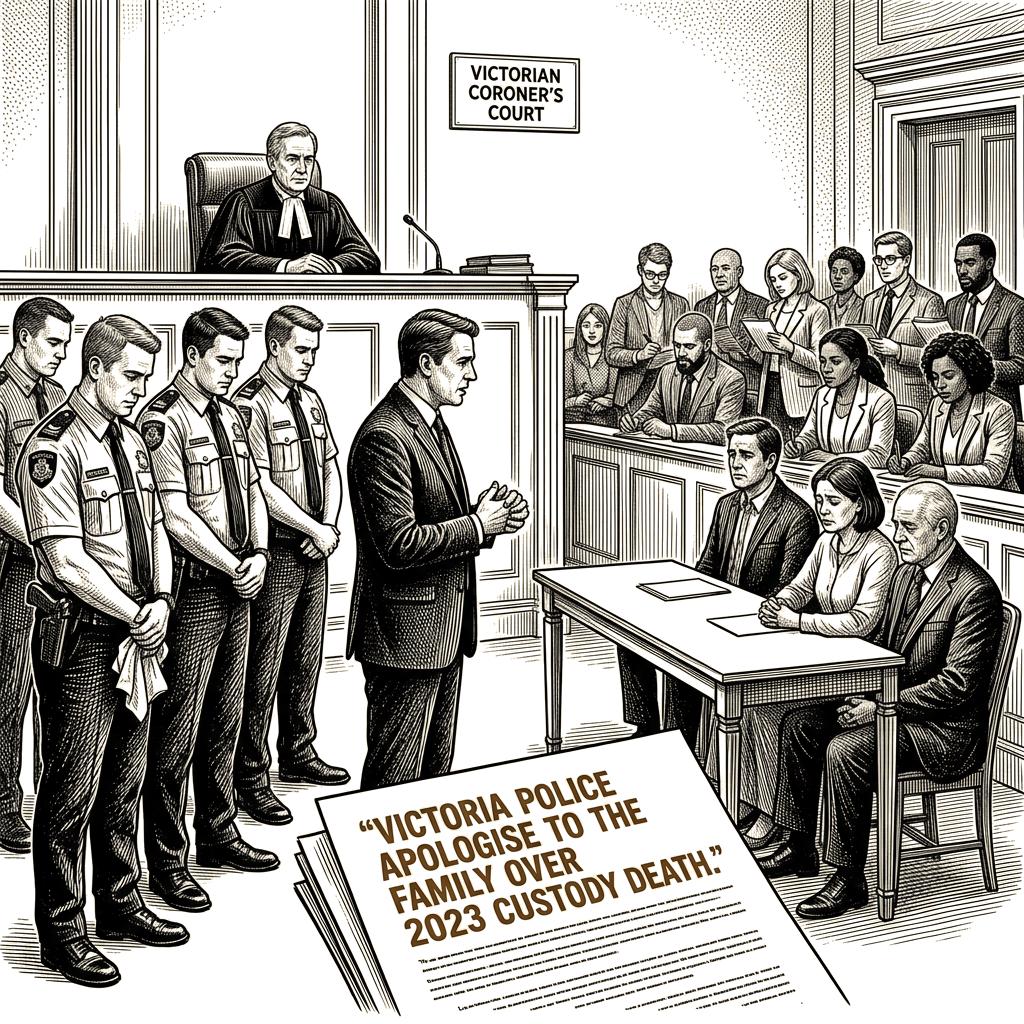
Victoria Police have apologised to the family of a 58-year-old man who died after being held for five hours in a Broadmeadows police cell without medical treatment for a significant head injury, the Victorian coroner’s court heard on Monday.
John Makai, a father of 10, died in 2023 from serious head trauma that went untreated despite him being unresponsive in the cell, the inquest was told. On the first day of the inquiry before coroner Paresa Spanos, footage was played showing Makai being dragged from a divisional van into police cells and repeatedly failing to respond when officers checked on him through the cell door.
Counsel assisting Rachel Ellyard told the court that officers twice claimed Makai had responded to their checks during the night in custody, despite CCTV footage of the incident showing no such physical response.
The apology came through Andrew Imrie, a lawyer for Victoria Police Chief Commissioner Mike Bush. Imrie told the inquest that Makai’s care “was not at the standard that … any member of the Victorian community is entitled to expect,” offered sincere condolences to the family, and said it was “a situation Victoria police and all its employees work tirelessly to avoid.” Imrie said there had been a failure to complete a medical checklist when Makai arrived at the Broadmeadows station, as well as failures to notice his deteriorating condition, to complete a risk assessment, and to conduct adequate checks. He said disciplinary action had been taken against officers “where a basis was available,” though it remained unclear at that stage whether the shortcomings would have made any difference to the outcome.
The court heard how Makai came to be at the station. An ambulance had been initially called to a house in Sunbury where Makai had been drinking with two of his sons and a friend, but the request was cancelled after one of his sons punched him twice. Police attended the house and, in footage shown to the court, could be seen watching as Makai struggled to stand and then collapsed into a bookcase while trying to sit down.
Officers supported Makai to walk to a divisional van and could be heard telling him to “get his legs up.” When the van arrived at Broadmeadows police station about 20 minutes later, Makai could no longer stand and was dragged out by his legs, his head striking the floor and walls of the van. He was then placed seated on the ground, lifted under the arms and dragged into a cell, where he was placed in what is known as a “coma position.” He made no verbal response during the transfer or at any time at the station, the court heard.
At 1:25am, police requested another ambulance, telling dispatchers that Makai had a minor facial injury and was in a very deep sleep because of his state of drunkenness, and that they would like him to be checked by paramedics. Ambulance Victoria told police they were struggling with workload but would dispatch paramedics when they were available.
“What was interpreted as deep sleep was in fact the increasing effects of traumatic brain injury and bleeding into the brain,” Ellyard said.
The court heard that because of an issue with Triple Zero Victoria, the job was not logged as outstanding and an ambulance was not dispatched until the same police officer requested another five hours later. That fresh call came after police entered Makai’s cell and could not get him to respond verbally.
“I’ve got a guy been in custody a number of hours, he’s breathing, trying sternum rubs, all sorts of … we can’t get any verbals out of him, we’d like an urgent check on his welfare,” the police officer said in a recording of the call played to the inquest. “This request’s made since midnight, and for some reason it’s been cancelled at your end … I’m the custody sergeant, this guy’s breathing but we can’t raise any verbals from him.” When asked about his breathing, the sergeant responded that Makai had been snoring heavily but not responding “since he came in, since midnight.” The Ambulance Victoria operator replied: “Unconscious? And you haven’t had any response for six hours?”
The sergeant told the operator that his officers had been checking on Makai every 15 minutes. Ellyard said this was proven incorrect in a review of the footage.
When paramedics finally responded, Makai was found to be showing signs of a brain injury. He was transported to hospital, where he was diagnosed with a non-survivable brain trauma, and died two days later.
The first witness, Ryan Goon, director of operations support for Triple Zero Victoria, told the inquest that the dispatcher had wrongly cancelled the police request for an ambulance. The cancellation stemmed from an issue with “multiple associated events,” as the first person to call for an ambulance at the Sunbury house had later cancelled their own request.
Ellyard said the scope of the inquest — expected to run for two weeks — would consider the cause and circumstances surrounding Makai’s death, including what treatment he could have received had he been taken to hospital rather than to the police station. It will also examine any changes to policies and reviews completed after his death. The inquest before coroner Paresa Spanos continues.