Holmes faced November re-election; opponent’s court section eliminated
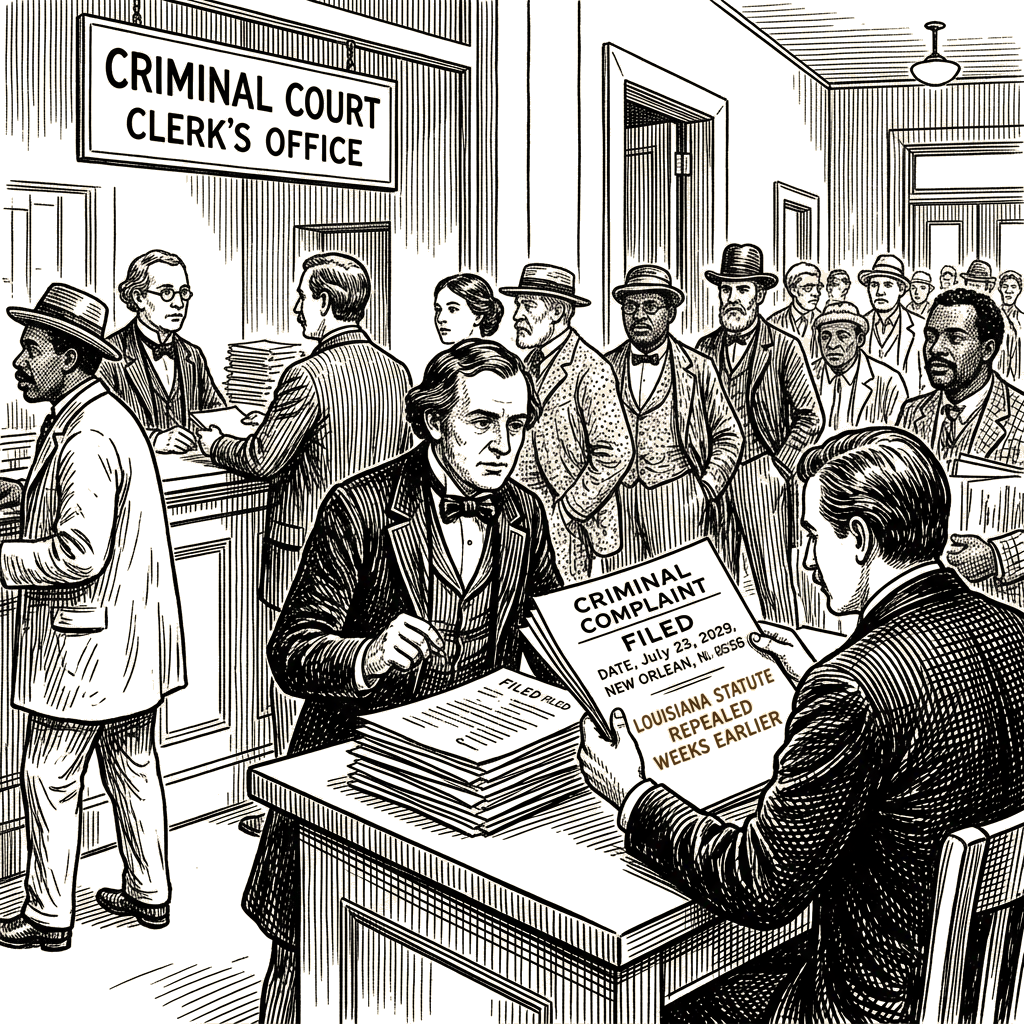
New Orleans criminal court judge Kimya Holmes filed the criminal complaint with the New Orleans Police Department on Sept. 11 against WWL Louisiana for allegedly “revealing her home address and vehicle information,” according to Hammer, whose station is a Guardian reporting partner.
Hammer had published a story on Aug. 24 detailing how a $765,000 home was donated to Holmes in 2025 by Allen, an accountant to whom she was engaged at the time. Allen had been criminally charged weeks earlier with fraudulently collecting more than $712,000 in taxpayer-funded COVID-19 pandemic relief, according to Hammer’s report. Holmes told Hammer she did not start dating or become engaged to Allen until four years after he had committed the crime for which he was charged, and that she did not learn about his charges until close to the time he pleaded guilty in April — after the couple had broken up.
Hammer’s report on Holmes, Allen and the gated-community home he donated to her — in which she continued to live while he paid the mortgage — arrived as she prepared for a 3 November re-election race against a fellow judge whose section of court was eliminated by a new law.
On Sept. 10, a little more than two weeks after Hammer’s story, the New Orleans criminal courthouse’s judicial administrator, Robert Kazik, sent WWL a letter demanding the outlet remove a public record showing the address of the home Allen gave Holmes, as well as images of the license plate number of a Corvette leased by Allen that had been photographed by a station source while it was parked in the courthouse garage in August. Kazik’s letter also requested that WWL reveal who photographed the Corvette, Hammer reported.
Kazik’s letter cited a Louisiana law that gave third parties, including news media, three days to unpublish certain kinds of personal information about a judge once a judicial administrator requested it. The law also made violations a misdemeanor punishable by up to 90 days’ imprisonment and a $1,000 fine. However, the Louisiana legislature had repealed both the portions requiring news outlets to remove published information and making noncompliance a misdemeanor, with the repeals taking effect Aug. 1 — before Hammer’s reporting and before Kazik’s letter.
Hammer reported that WWL reacted to Kazik’s letter by taking down videos containing the information the judicial administrator mentioned on the morning of Sept. 11, then reposting them later that day with the address and license plate numbers blurred. WWL refused to disclose who photographed the Corvette, he said.
WWL sought comment on the police complaint from New Orleans media lawyer Scott Sternberg, who lobbied for the repeals that took effect in the beginning of August. Sternberg, who represented the Advocate newspaper against state Supreme Court Justice Jeff Hughes, said he believed the repeals were necessary because those portions were “wildly unconstitutional,” with press freedom being a fundamental U.S. right.
“I can’t imagine a public official filing a criminal complaint in response to reporting that, based on my own opinion of it, seems to be accurate,” Sternberg said. “I mean — it was a real estate transaction.”
Hammer confirmed that the accuracy of his reporting on Holmes and Allen was never challenged, prompting Sternberg to say “it wouldn’t warrant a criminal complaint” even if it had been inaccurate. Sternberg added that neither Kazik’s letter nor the police complaint “had any force or effect and that’s probably why … NOPD isn’t coming down here to arrest you — because there hasn’t been a crime.”
Hammer said WWL asked Holmes’s campaign spokesperson what the legal basis of the criminal complaint against the station was, and whether Holmes knew that her complaint relied on a section of law that was no longer on the books. The spokesperson replied with an email forwarded by Holmes that in part had an out-of-date version of the relevant law attached to it. That version of the law — still carrying the criminal penalties — came from Louisiana’s legislative website, which had not been updated according to records from the state legislature’s most recent session.
A state legislature spokesperson told WWL that updating laws on the legislative website can take “many months.” The spokesperson also pointed to a website disclaimer that made “no guarantee … to its accuracy” — and said “these provisions and annotations have not been edited for publication and are not official or authoritative.”
The email forwarded by Holmes originally came from state appellate court judge Tiffany Gautier Chase on Aug. 26, two days after Hammer’s report, and notified judges of “protections against the dissemination of certain personal information.”
WWL’s attorney, Mary Ellen Roy, wrote to the NOPD to ensure the detective assigned to Holmes’s complaint was aware of the updated law, and said WWL expected the investigation “to be closed, forthwith.” The NOPD said on Tuesday that its investigation into WWL was continuing.
The complaint was the latest in a series of high-profile matters pitting Louisiana journalists against members of the state’s court system. In July, deputies at the New Orleans criminal courthouse handcuffed Hammer’s WWL Louisiana colleague, investigative producer Danny Monteverde, and an attorney for their station, Elana Beiser, while they covered an indictment filed against the state’s attorney general, which was ultimately dismissed. In August, a state court jury awarded a $300,000 verdict to Louisiana Supreme Court Justice Jeff Hughes, who sued the Advocate newspaper for libel over an editorial — an outcome some U.S. press freedom defenders said could weaken the “actual malice” legal standard that has long governed such cases.