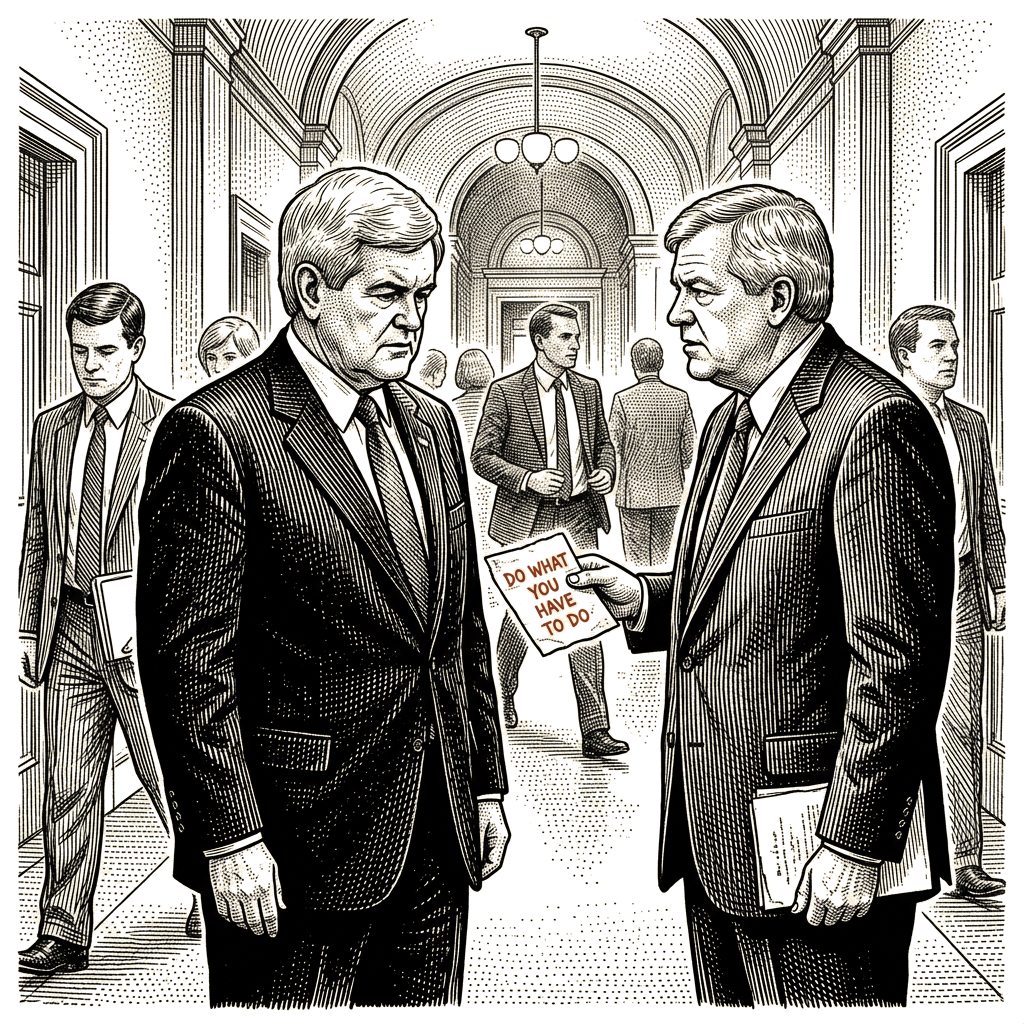
Memoir quotes Gingrich saying, “Well, I’ll make them support me”
In his memoir, “Speaker: Lessons from 40 Years in Coaching and Politics,” Dennis Hastert wrote that he confronted Newt Gingrich about dissatisfaction in the Republican ranks, telling Gingrich it was unlikely he could hold his post. “Well, I’ll make them support me,” Hastert quoted Gingrich saying of the Republican rebels. Told that was unlikely, Gingrich asked Hastert what to do, and Hastert wrote that he replied, “Do what you have to do.” Gingrich stepped down as speaker the next day and left the House. The public knew nothing about Hastert’s past when Republicans lost seats in the 1998 midterm elections.
Hastert, the longest-serving Republican US House speaker, died over the weekend at his home at age 84, Kendall County Coroner Jacquie Purcell said Monday. Purcell said he died of natural causes. Hastert was speaker from 1999 until 2007.
In the late 1990s, Hastert was a little-known Illinois lawmaker with a reputation for congeniality that had helped him ascend the ranks of congressional leaders. Republicans elected Hastert to succeed Gingrich after the latter lost support because of ethics violations and the party’s showing in the 1998 midterm elections. Hastert’s path to the speakership was cleared when Bob Livingston, a Louisiana congressman who was considered a lock to replace Gingrich as speaker, resigned after acknowledging several extramarital affairs.
In his first weeks in the chair, Hastert presided over the House while the Senate conducted Bill Clinton’s impeachment trial. After Republicans reclaimed the White House, Hastert shepherded much of President George W. Bush’s agenda into law, including large tax cuts and a measure that amounted to a huge expansion of prescription drug benefits, described as the biggest change in Medicare in decades.
Hastert’s legacy was thrown into doubt in 2015, when he was accused of evading banking regulations as part of a plan to pay hush money to conceal unspecified “prior misconduct.” Nearly a year later, prosecutors filed court papers describing what media reports had suggested for months: that the misconduct involved the sexual abuse of teenage boys on Hastert’s high school wrestling team in Yorkville, west of Chicago.
During a 16-year coaching career that included a state championship and a national coach-of-the-year honor in 1976, prosecutors alleged, Hastert sexually abused at least four team members from 1965 to 1981. The person Hastert was paying, identified in court papers only as Individual A, said the abuse occurred in a motel room when he was 14 on the way home from wrestling camp. Hastert allegedly touched other wrestlers in a locker room after saying he would give them massages; two wrestlers said Hastert performed sex acts on them. Prosecutors described a recliner where Hastert often sat in the locker room with a direct view of the stalls where the boys showered.
Hastert pleaded guilty to evading banking laws. In all, he paid more than $1.7 million of the $3.5 million he had promised to Individual A, sometimes in lump sums of $100,000 in cash. At his 2016 sentencing, where he received 15 months in federal prison, the visibly angry judge called Hastert a “serial child molester.” A former wrestler struggled with his emotions as he told the court about his “dark secret” from adolescence. The conviction made Hastert, a former history teacher, one of the highest-ranking US politicians ever ordered to prison.
In his own statement, Hastert said he was “deeply ashamed” and admitted that he “mistreated” some of his athletes, but he did not refer directly to sexual abuse.
Hastert lived his entire life in Chicago’s suburbs, primarily in the Yorkville area, where he helped his father with the family feed business while growing up. Survivors include his wife, Jean, and two adult sons.