New York AG opens criminal probe as Hochul requests independent review
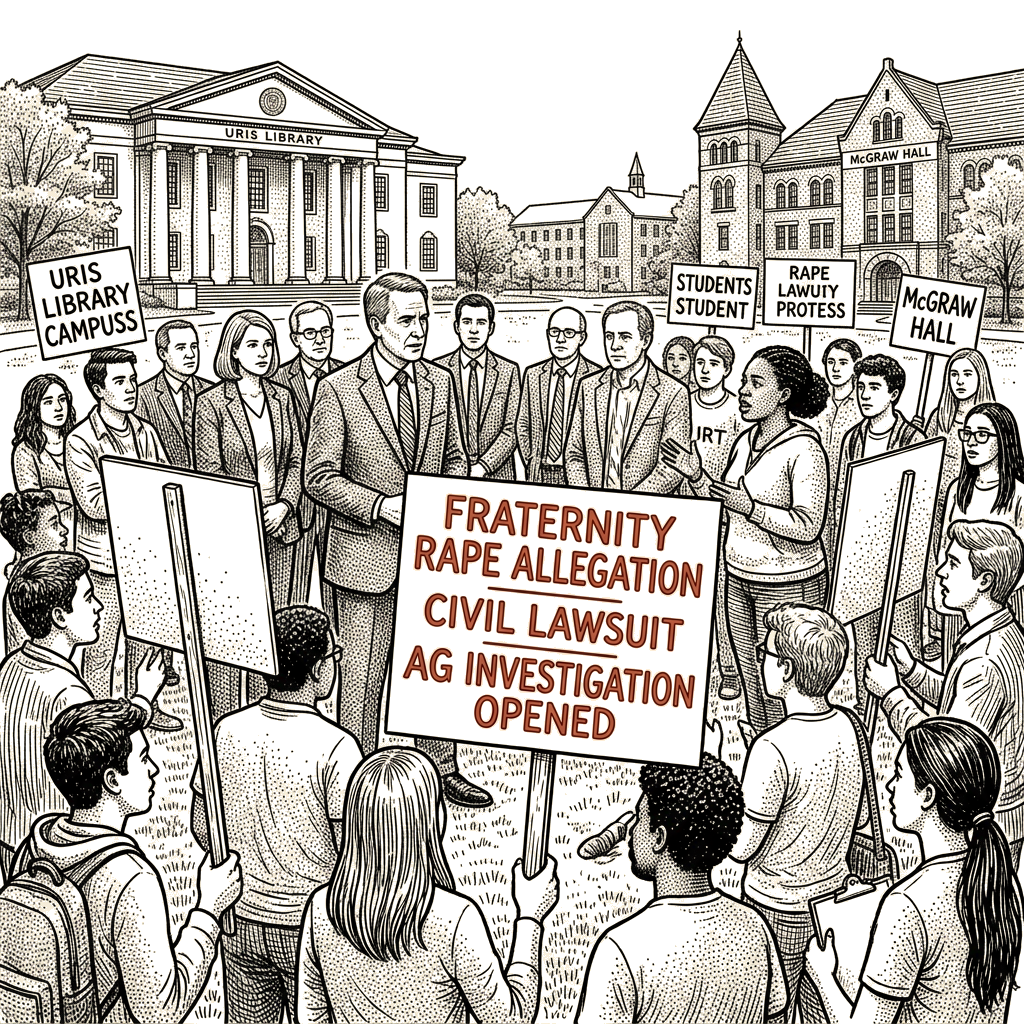
Cornell University President Michael Kotlikoff, 75, is contending with a civil lawsuit and criminal investigation into a 2024 fraternity allegation that have drawn hundreds of student protesters, a Day Hall vandalism, and a threatened NAACP-led class boycott — a new crisis in his two-year tenure atop the pro-Palestinian protest controversies and federal funding disputes that have marked his time as Cornell’s leader.
The lawsuit alleges an undergraduate was gang raped and drugged at a Cornell fraternity house in 2024 and that the university failed to adequately protect her. The accuser is identified in court filings as Jane Doe. The New York Attorney General’s office has opened a criminal investigation into the claims. At Gov. Kathy Hochul’s request, Cornell’s board plans to appoint an outside law firm to lead an independent review of the school’s response.
In an eight-minute video message to the community over the weekend, Kotlikoff said, “I want to acknowledge something that can be difficult for an institution to say. We don’t have all the answers.” He called the moment “a defining moment in Cornell’s history” and pledged to be more transparent about the investigation. On Greek life, he added: “We owe it to Jane Doe.” Kotlikoff declined to be interviewed for this article through a spokeswoman.
Monday’s response began with a march of hundreds of students from the campus clock tower. On Tuesday, the gender and sexuality studies program is sponsoring a town hall. For Wednesday, Cornell’s NAACP chapter is asking students to boycott classes and join a seven-hour sit-in — the duration of time for which Jane Doe says she was sexually assaulted, according to the lawsuit.
Also on Monday, activists vandalized the entrance to Day Hall, the campus building that houses Kotlikoff’s office. A glass door was shattered and messages were scrawled in red paint on the exterior walls: “SMASH THE PATRIARCHY” and “AT CORNELL RAPISTS ARE PROTECTED PROTESTORS ARE EXPELLED.” University spokesman Kyle Kimball said the school is investigating the incident.
Kotlikoff’s path to the Cornell presidency runs through decades of academic administration. Before ascending the ranks of academia, he demonstrated against the Vietnam War and earned a literature degree at the University of Pennsylvania. Weeks before he graduated in 1973, women occupied the school’s College Hall to protest leaders’ response to a series of reported rapes. Kotlikoff grew up in South Jersey outside Philadelphia, where he attended a Quaker high school. After earning his bachelor’s, he graduated first in his class from Penn’s veterinary school. A professor of molecular physiology, he rose to chair of the department of animal biology before coming to Ithaca, N.Y., in 2000 to build a new department in biomedical sciences at Cornell’s College of Veterinary Medicine. He became a dean at Cornell in 2007 and provost in 2015. He is the oldest president to lead Cornell.
Colleagues describe him as a good listener who is personable in private meetings, and measured in his decision-making. Classics professor Courtney Roby, who met with Kotlikoff regularly over six years on a faculty committee that liaises with administrators, said, “Everything he says is very careful; he doesn’t want to get out over his skis.” Some students now find that caution frustrating, Roby added: “He just doesn’t want to get ahead of things, even though there’s tremendous appetite for him to do that. They want details, they want fast-moving action, they want definitive and explicit descriptions of what’s going on.”
Kathryn Boor, who has worked with Kotlikoff as both an administrator and a professor, said he was the right man for the moment. “I feel like he has had the steadiest hand on this through some very rough waters, that any human could be expected to do,” she said.
Kotlikoff became interim president after his predecessor stepped down in 2024 amid controversy over the handling of pro-Palestinian protests on campus — protests that had broken out following the Oct. 7, 2023, attacks on Israel by Hamas. At one point during that period, a student threatened online to stab and sexually assault Jewish students, an incident that set the tone for a polarization Kotlikoff has been trying to bridge ever since. Soon after taking the interim role, students spray-painted an administration building with messages including “Israel bombs, Cornell pays” and “Blood is on your hands.” The Trump administration later accused the university of antisemitism and liberal excess and disrupted federal funding, prompting a $60 million settlement with the federal government to restore research funding and resolve allegations of civil-rights violations.
In April, Kotlikoff delivered remarks at a Cornell Political Union debate on the Israel-Palestine conflict. In the parking lot afterward, he said, students confronted him and began banging on his car windows in what he described as harassment and intimidation. One student said Kotlikoff ran over his foot when he pulled away. The university’s board of trustees investigated and cleared Kotlikoff of wrongdoing; the student, now graduated, was banned from campus for a year.
Kotlikoff earned $1.4 million in the year ended June 2025, according to Cornell’s tax returns. He had earlier told the student newspaper that he would finish his two-year stint as interim president and then “almost certainly retire.” Instead, the board confirmed him as permanent president over the objections of an influential alumni organization, the Cornell Free Speech Alliance, whose founder Carl Neuss said concerned alumni had come to believe Cornell had become intolerant of conservative viewpoints and beholden to diversity initiatives.