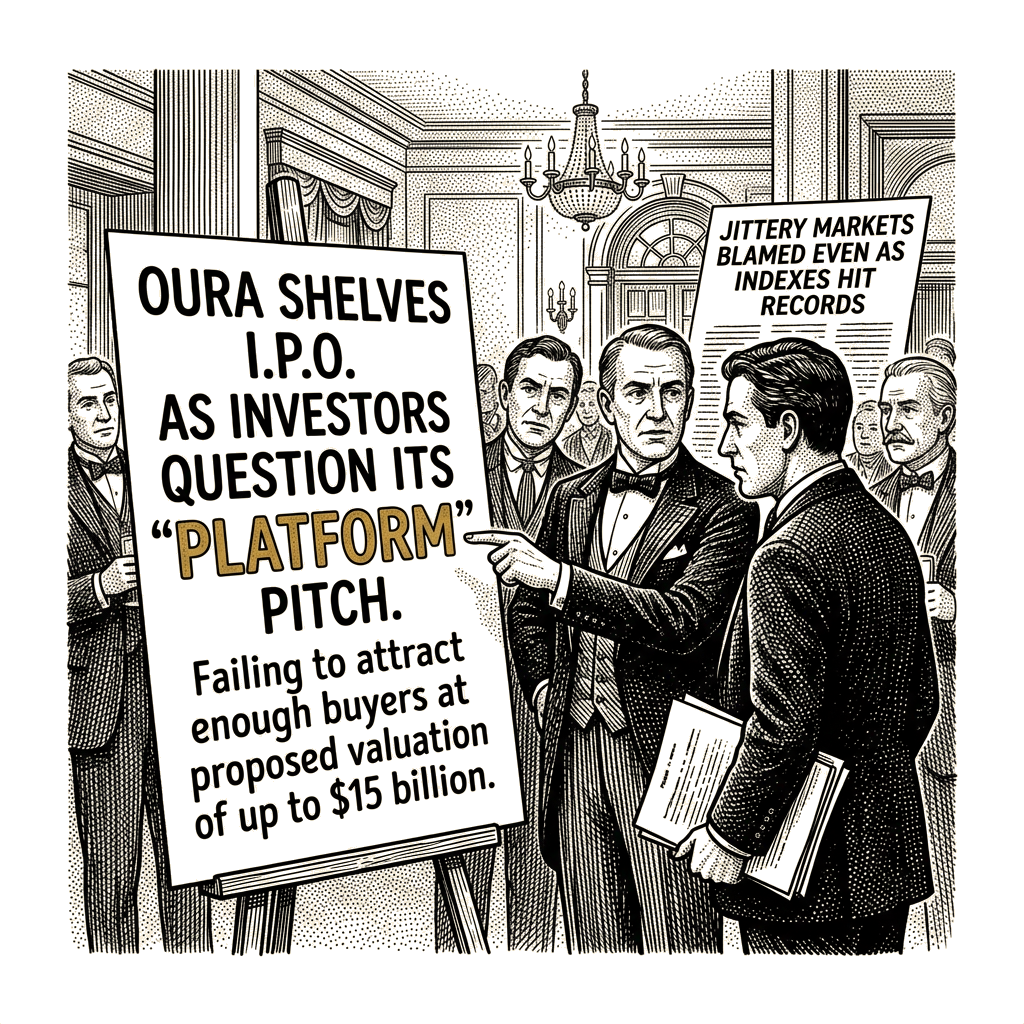
About 80% of Oura’s revenue still comes from ring sales, not subscriptions
Oura shelved its initial public offering in late September after failing to attract enough buyers at a proposed valuation of up to $15 billion, the company said at the time, blaming jittery markets. A Wall Street Journal Heard on the Street analysis published Tuesday identified a different obstacle: a mismatch between how the smart-ring maker pitched itself and how prospective investors saw the business.
Oura described itself in its prospectus as a “health intelligence platform” built on more than 40 billion hours of biometric data, with potential to layer software and artificial intelligence on top. Many investors, the analysis found, saw a consumer wellness product instead. The analysis argued the distinction is more than semantic: technology platforms can scale exponentially and cheaply, while gadget makers must keep convincing customers to buy the next version. Surging Treasury yields were “certainly part of the problem,” the analysis added.
The analysis framed the skepticism as rooted in a pattern established by earlier buzzy single-product consumer brands. Peloton, Fitbit, Casper Sleep and GoPro all built recognizable brands quickly and then encountered the same constraint: revenue growth required continuously selling more hardware. “The consumer wallet,” said Stephanie Davis, a health-tech analyst and adviser, “is a very quick adopter of solutions and a very quick abandoner of solutions.”
Academic research backs the pattern. Jay Ritter, a University of Florida professor who studies initial public offerings, tracked 13 single-product consumer companies that went public between 2005 and 2024. Five years after listing, their shares had lost about 32% on average from the IPO price, while the broader market rose 49% over the same period. More than 1,200 other IPOs in Ritter’s sample gained 68% on average over their first five years.
Oura’s current business mix illustrates why investors might apply that discount. About 80% of the company’s revenue still comes from selling rings, and just 20% from memberships, according to the analysis. Its overall gross margin is about 55%, well below what digital-health software companies typically earn. Yet Oura was asking for about 10 times trailing revenue. Fitbit, by comparison, was sold to Google for less than two times revenue.
“Hardware-centric businesses naturally demand a lower sales multiple,” said Robin Boldt, chief investment officer at Rock2 Capital, a healthcare-focused hedge fund. “The ability to sustain and even accelerate subscription growth would make public investors more comfortable.”
Oura does have a recurring component. More than five million members pay about $6 a month, and the company says 85% stick around after a year. But successful platforms tend to be built on dependence, the analysis noted. Developers make a living on Apple’s App Store; drivers and restaurants rely on Uber. Leave Oura, and a subscriber loses little more than their sleep history. The company therefore has to keep spending heavily on marketing — about a fifth of revenue — to sell new rings each year.
The analysis outlined three potential paths for single-product companies to break out of that cycle. Garmin was best known for car GPS units, a business smartphones largely destroyed, before pivoting to fitness watches, outdoor gear, and aviation and marine electronics. Roku, the only single-product maker in Ritter’s sample to beat the market, sells its streaming players at thin margins and makes money from advertising and a cut of subscriptions; Fox Corp. agreed to acquire Roku in June in a $25 billion deal. The most promising route for Oura, and for other wellness startups such as Whoop, is to get someone other than the consumer to pay: patients receive ResMed’s CPAP machines and Dexcom’s glucose monitors largely because insurers cover them, and Hinge Health, which offers app-based physical therapy for back and joint pain, is paid mostly by employers and health plans.
For Oura, the analysis identified the third path as the most promising. The company already has several healthcare partnerships — its temperature data feeds Natural Cycles, a fertility app, and employers spend heavily on fertility care — but it still has to show payers that wearing the ring actually improves health outcomes, not just that it measures them accurately.
The analysis described a sale as potentially the easiest route for shareholders. A tech company could theoretically buy Oura, the analysis noted, but a healthcare giant might be the more natural owner. Eli Lilly invested in Oura before the IPO and had indicated interest in acquiring more. Lilly could see value in knowing whether patients on its weight-loss drugs Zepbound and Mounjaro are sleeping better, moving more and improving other health measures.
The analysis concluded that Oura does not need to become the next Apple or even the next Garmin. It needs to prove that the data it collects is valuable to someone other than the consumer — and that it does more than sell expensive rings.