More than 50 countries now developing weather modification programs
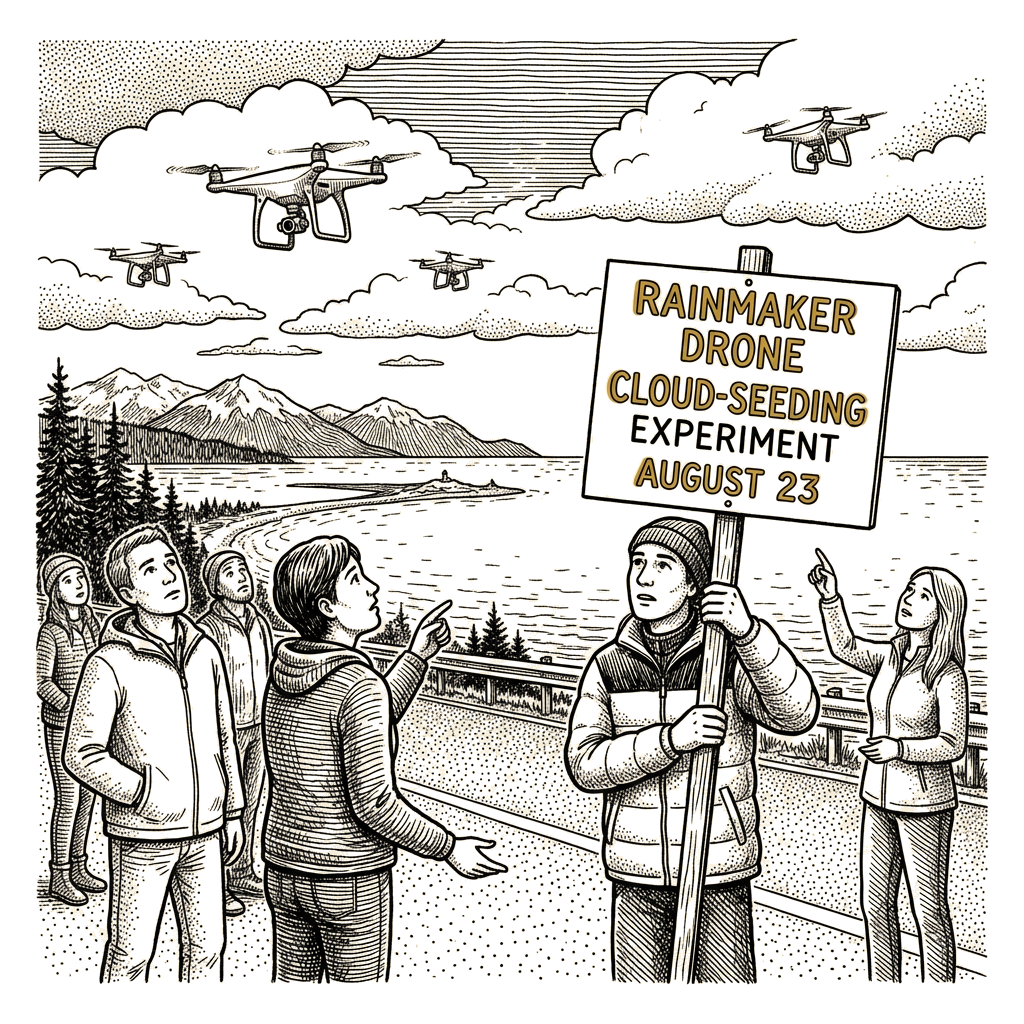
Rainmaker, a San Francisco drone startup, conducted a cloud-seeding experiment over Homer, Alaska on August 23 without widely alerting local residents, the Center for Biological Diversity said. Cooper Freeman, the group’s Alaska director, said the company dispersed silver iodide into clouds above the community and that he had seen no evidence of downstream environmental monitoring. The company said its three-hour test produced the equivalent of 19 million US gallons of water in the sky.
The Alaska experiment comes as global water stress intensifies. United Nations Secretary-General António Guterres said in July that the world is using freshwater faster than it can be replenished, and reports note the past five years have produced the driest period for global rivers in more than three decades. More than 50 countries are now developing weather modification programs, and a surge of startups are working to commercialize cloud seeding.
Freeman’s concerns center on what was released and how it was tracked. “It doesn’t appear that there was any downstream monitoring to verify that this silver iodide didn’t impact the environment,” he said. He added that cloud seeding does not address the underlying drivers of water scarcity. “Having a company come in to do this seeding isn’t going to solve our water woes, and it feels like a distraction from solving the urgent issues related to water conservation,” Freeman said.
Rainmaker founder and CEO Augustus Doricko defended the safety of the compound. He said Rainmaker releases silver iodide at 20 grams per flight, distributed across thousands of square kilometers, and that the resulting concentration on the ground is in the parts per quadrillion. “The resultant increase in concentration on the ground is in the parts per quadrillion, way below the threshold laid out by the FDA on what is allowable,” Doricko said.
He pointed to one of the key limits of cloud-seeding processes: without clouds, “we can’t do anything.” Cloud-seeding sessions have to wait for clouds to form to try to coax them into precipitation. The company’s drones carry silver iodide flares that, when lit, atomize the compound so it can stay suspended in freezing cloud for hours before forming crystals and falling as precipitation, Doricko said.
The 19 million US gallons Rainmaker said it generated translates to roughly 0.01 inches of rain across 100 square miles, underscoring the narrow margin by which cloud seeding can augment a storm. Cloud-seeding technology, more than 80 years old, uses planes and drones to disperse compounds such as silver iodide into clouds to form ice crystals. Those crystals eventually grow large enough to fall as rain or snow, depending on temperatures below. The technique essentially accelerates the natural process of water vapor condensing inside clouds, and the technology works best in mountainous or cold regions such as Alaska.
The field dates to 1946, when researchers from the General Electric Research Laboratory used dry ice as the first seeding agent. A year later, silver iodide was found to be more effective because dry ice quickly turns to gas. A landmark 2017 study using radar and precipitation gauges was one of the first to observe cloud seeding in action and to confirm that silver iodide worked as expected. Rainmaker now operates in Idaho, Utah, Colorado, and parts of the Middle East, including Jordan, where Doricko said residents “often only have water for hours per week from their utility because of how scarce water is, and it’s a privilege to try to help this storied region.”
The efficacy ceiling of the technology is modest. “With the right conditions, cloud seeding squeeze out about an extra five to 10% of precipitation,” said Jon Meyer, an assistant state climatologist with the Utah Climate Center. Meyer said drone-based systems such as Rainmaker’s “present this new avenue” and “offer a more targeted nature to these clouds we hope will be responsive.” He predicted continued growth in demand. “We’re going to see more demand for these services as so many regions are experiencing water demand, and they’re going to be looking for ways to help bridge that gap,” Meyer said.
Researchers are also working on alternatives to silver iodide. Recast Systems, another San Francisco company, is experimenting with a protein made from amino acids found in soil, according to CEO Olivia Li. The compound, currently being tested at Texas A&M University, “is safe, biodegradable and nucleates ice at a higher efficiency than silver iodide,” Li said. Recast currently uses silver iodide to seed clouds in several U.S. states while it develops the protein-based alternative.