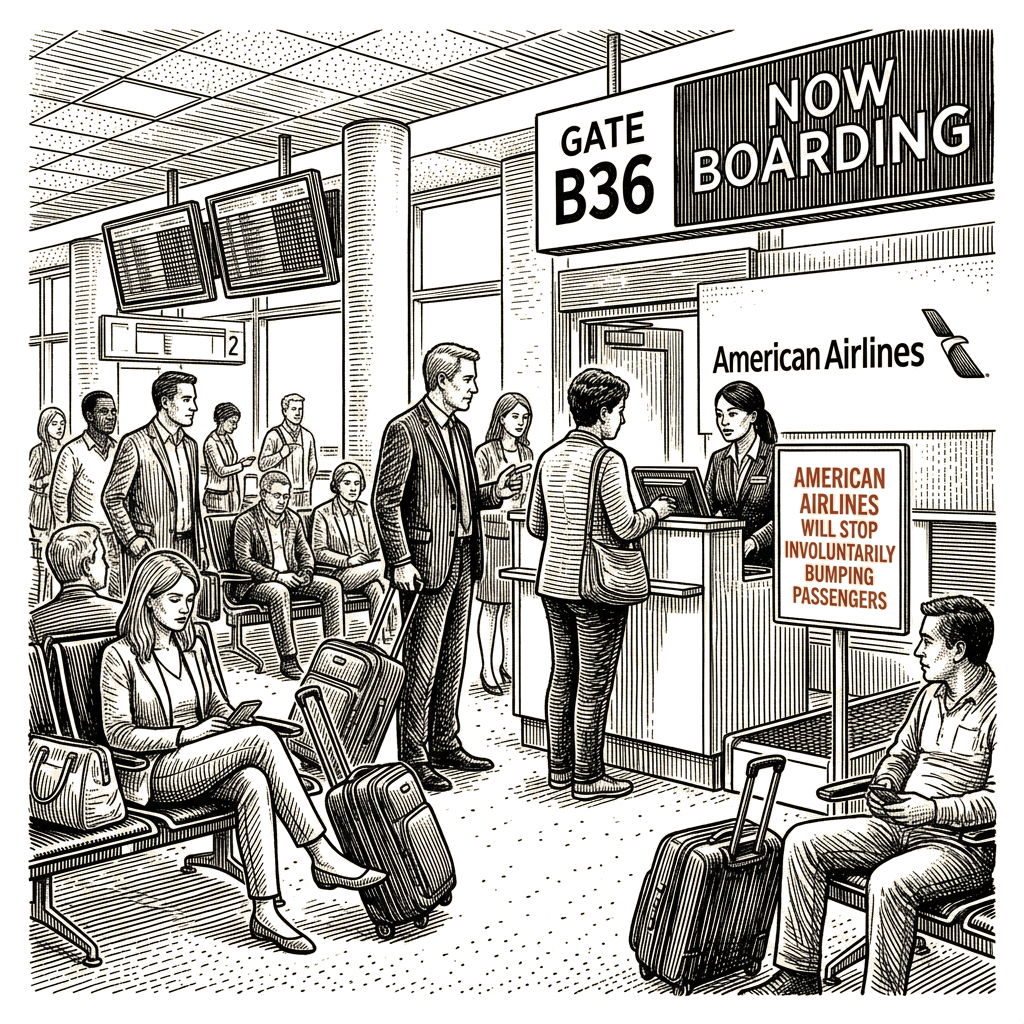
Carrier accounted for 60% share of last year’s involuntary bumpings
American Airlines said it will stop the practice of involuntarily bumping passengers from oversold flights, a shift that follows years in which the Fort Worth-based carrier was one of the worst offenders at the practice, accounting for 60% of involuntary bumpings on U.S. flights last year alone.
Chief customer officer Heather Garboden said the airline’s updated technology and processes mean it no longer needs to remove ticketed passengers against their will. “We’ve improved technology and improved process. And now I think we feel we’re to the point where we do not take an ‘involuntary denied’ boarding,” Garboden said. The new approach was first reported by View From the Wing, an aviation blog.
American was responsible for 60% of passengers who were involuntarily bumped from U.S. flights last year, according to government data cited by the Wall Street Journal. Only budget carrier Frontier Airlines bumped passengers at a higher rate, which Frontier said is “something we are currently working on.” Delta Air Lines has also worked to eliminate involuntary bumping and bumps virtually no passengers, according to the same government data.
Bill McGee, a consumer advocate and senior fellow for aviation at the American Economic Liberties Project, said American was catching up to peers rather than innovating. “This is a case of American doing what their rivals have already been doing,” McGee said.
For years American had been one of the worst offenders at the practice, while rivals moved to curb the bumping of fliers years ago, spurred on by a high-profile 2017 incident in which airport police forcibly dragged a doctor off a United Express flight, igniting a firestorm of criticism. American became an outlier after other carriers managed to tamp down on the practice. Some travelers have reported offers worth thousands of dollars in recent years after carriers including United Airlines and Delta Air Lines boosted maximum payouts in the wake of that 2017 incident, according to the Journal.
American has restructured how it solicits volunteers. The airline said it is being more proactive about asking volunteers to give up their seats on overbooked flights ahead of time, reaching out to travelers through its app and email notifications long before they arrive at their gates, asking those with flexible plans to give up their seats in exchange for cash, vouchers, or accommodations. Gate agents now start making announcements earlier when a flight is oversold, including explaining why the flight is oversold and mentioning compensation options right away for volunteering to take a later flight.
A memo viewed by the Journal instructs employees that eliminating involuntary bumping is now a requirement, not a goal. American has instructed employees to keep trying to get customers to agree to an offer, even if it means a brief flight delay. Gate agents can guarantee volunteers a seat on the next flight to their destination — not just the next flight with empty seats, and local leadership can authorize a bigger payout without approval from another team at headquarters.
The new procedures have produced measurable results, according to the airline. At airports where American tested new technology and procedures this summer, involuntary bumping was eliminated. The airline has slashed its rate of involuntary bumping since the start of the year, reducing those situations by 55% in the second quarter from a year earlier and by 85% in the third quarter.
Involuntary bumping is relatively rare across the industry. Fewer than 25,000 people were involuntarily bumped last year on U.S. airlines out of the millions who flew, and most of the time, offers of cash, travel vouchers, and accommodations can persuade passengers with flexible plans to give up their seats voluntarily.
The Department of Transportation requires airlines to compensate passengers who are bumped because of oversold flights. Airlines have to pay as much as $2,150 when bumped passengers face lengthy delays, but they can also offer more than that to encourage volunteers.
The change is part of a broader push by American to close a financial gap with its biggest competitors and burnish its premium travel bona fides, with new lounges and more high-end seating. The airline announced Thursday that it plans to expand its rollout of Starlink internet to its entire mainline fleet, embracing the fast wi-fi that has become a popular passenger perk.
American said it has also been trying to do a better job handling weather disruptions and has worked to address other practices that annoy customers, such as rolling delays. The carrier’s overhaul comes against a backdrop of decades of flight overbooking: some passengers simply do not show up, leaving a seat empty at takeoff that could have been sold to another customer, and it is not always the case that airlines have intentionally sold more tickets than seats. Planes are often substituted during disruptions, which can mean swapping in a smaller plane with fewer seats available, and unexpected weight restrictions can crop up due to weather, runway changes, or fuel requirements.