Guterres warns of ‘most dangerous nuclear moment’ since 1989
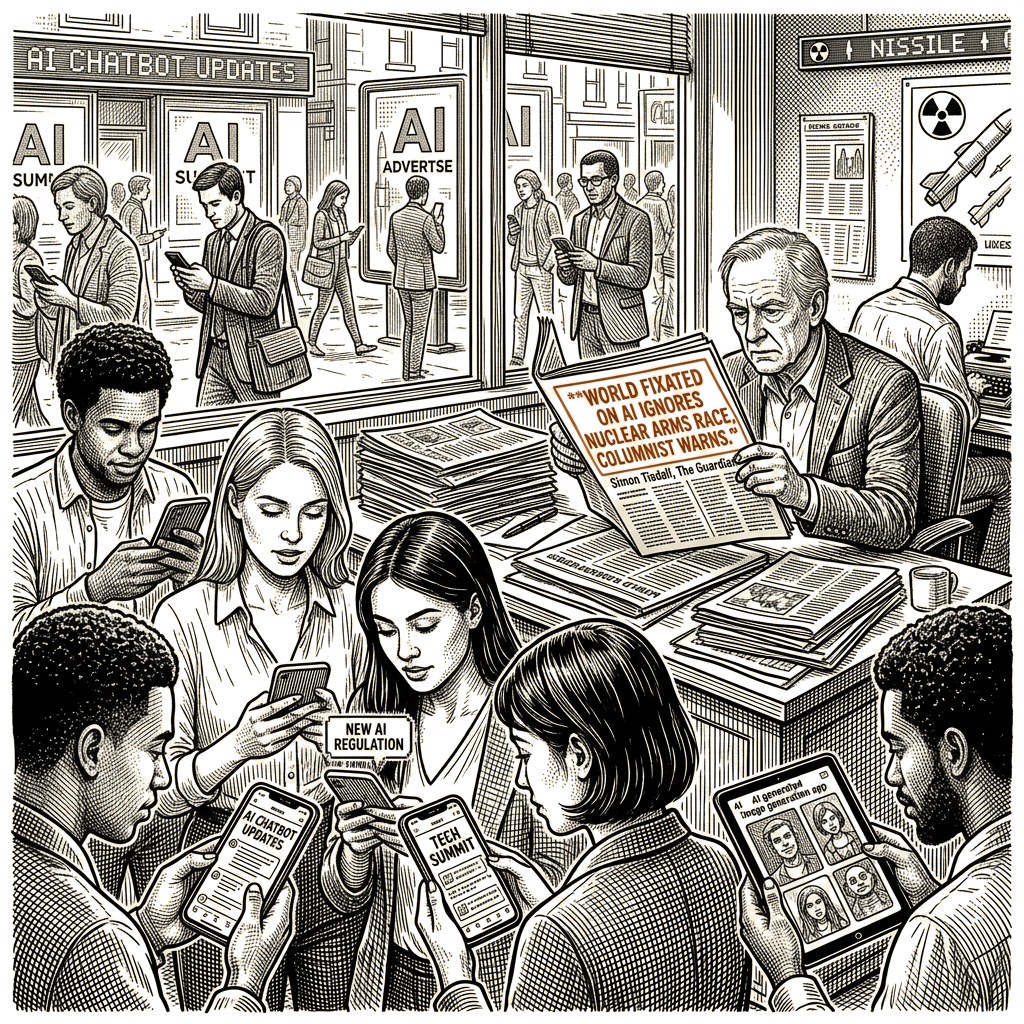
Simon Tisdall, foreign affairs commentator for The Guardian, argues in an opinion essay published Oct. 11 that the world’s fixation on artificial intelligence has obscured what he calls the most pressing and proven human-made threat to life on Earth: the accelerating proliferation of advanced nuclear weapons. “The question increasingly is not ‘if’ but ‘when’ limited or full-scale nuclear warfare will erupt,” he writes. “Eighty-one years after Hiroshima, how much longer can our luck hold?”
Tisdall opens with religious end-times prophecy — the Book of Revelation, Islam’s day of judgment, the Christian evangelical rapture — and writes that worldly scepticism about such warnings “does not mean a universal cataclysm is less likely. It may make it more probable.” He notes that in Robert Harris’s 2019 novel “The Second Sleep,” a fictional scientist’s fears of devastating climate change, pandemic disease and a giant asteroid collision go largely unheeded, and what destroys civilization instead is a global digital and internet meltdown. Existential AI risks, including the possibility that large language models gain “the power to delete humanity,” remain “open to mitigation,” he argues — in contrast to the “extraordinary complacency” he says surrounds nuclear weapons. “This is no scoffing matter,” he writes.
The essay points to recent Russian nuclear threats. Tisdall writes that Vladimir Putin recently threatened to deploy Russia’s entire nuclear arsenal, comprising about 4,400 warheads, against Nato countries if they activated a supposed plan to invade the Baltic exclave of Kaliningrad. He acknowledges that frequent Kremlin nuclear sabre-rattling since its full-scale invasion of Ukraine has diminished Moscow’s credibility, but argues that disbelief invites miscalculation: “To work, nuclear deterrence relies on an adversary believing the threat is real.” He adds that Putin’s inability to halt Ukraine’s conventional drone and missile attacks deep inside Russia may be edging him toward low-yield tactical, or “battlefield,” nuclear weapons.
Tisdall writes that President Donald Trump’s justification for the US-Israel war on Iran rests on what he calls Trump’s “wilfully mendacious” claim that Tehran was weeks away from obtaining the bomb, and he cites Trump’s threat at the UN to “annihilate the Islamic Republic” as implying a possible US nuclear attack. He calls Trump’s hypocrisy “stunning”: the US is upgrading a nuclear arsenal of 3,700 warheads and may resume nuclear tests, “unreservedly supports” Israel’s nuclear weapons programme, and is pursuing a civilian nuclear technology deal with Saudi Arabia that Tisdall says could be repurposed to make weapons — a prospect he says has prompted Turkey and Egypt to consider going nuclear.
Across Asia, Tisdall writes, Kim Jong-un has gained de facto international acceptance of North Korea’s status as a nuclear weapons state, with South Korea saying in August that Pyongyang possesses up to 120 warheads. He writes that the twin principles that underpinned the west’s postwar Korea policy — reunification and denuclearisation — have been “all but discarded,” and that Trump, whom Tisdall says calls Kim a friend, is again seeking a summit with the North Korean leader. “As long as I’m around, he [Kim] is going to be fine,” Tisdall quotes Trump as boasting. Japan and South Korea, he writes, both debate acquiring nuclear weapons in self-defence, while China’s Xi Jinping is “reportedly building nukes like there’s no tomorrow – which, at this rate, there may not be.”
Tisdall cites Secretary-General António Guterres telling the UN general assembly that the world has reached “the most dangerous nuclear moment” since 1989. Global military spending reached nearly $3tn last year and annual spending on nuclear weapons is up by 20%, the UN was told, while AI is increasing uncertainty over nuclear command-and-control, according to the essay.
The essay also draws on a new paper by the Arms Control Association, whose head in Washington, Daryl Kimball, bemoaned the absence of high-level disarmament talks between the main nuclear powers and the lapsing of strategic arms limitation treaties. “The nuclear sword of Damocles still hangs over all of us,” Kimball wrote, warning that “in the absence of new arms-control breakthroughs, we are headed for an unprecedented three-way buildup of Chinese, Russian, and US nuclear forces.”
Tisdall places the warnings against what he describes as the fragmentation of the rules-based international order, “forever wars” in Palestine, Iran, Ukraine, Myanmar, Yemen and Sudan, and a fast-developing contest for control of space. He writes that the 1967 Outer Space Treaty, under which more than 130 countries agreed the moon is no one’s property, is “routinely flouted,” and that Russia is reportedly developing an orbiting nuclear-armed anti-satellite weapon.
The essay closes by criticizing public complacency, describing a “deafening public silence” and an absence of large-scale protest in much of the world. “If and when a final reckoning comes, individuals who stayed silent will be complicit in their own undoing,” Tisdall writes. “Hiroshima is not a shrine. It’s the future.”