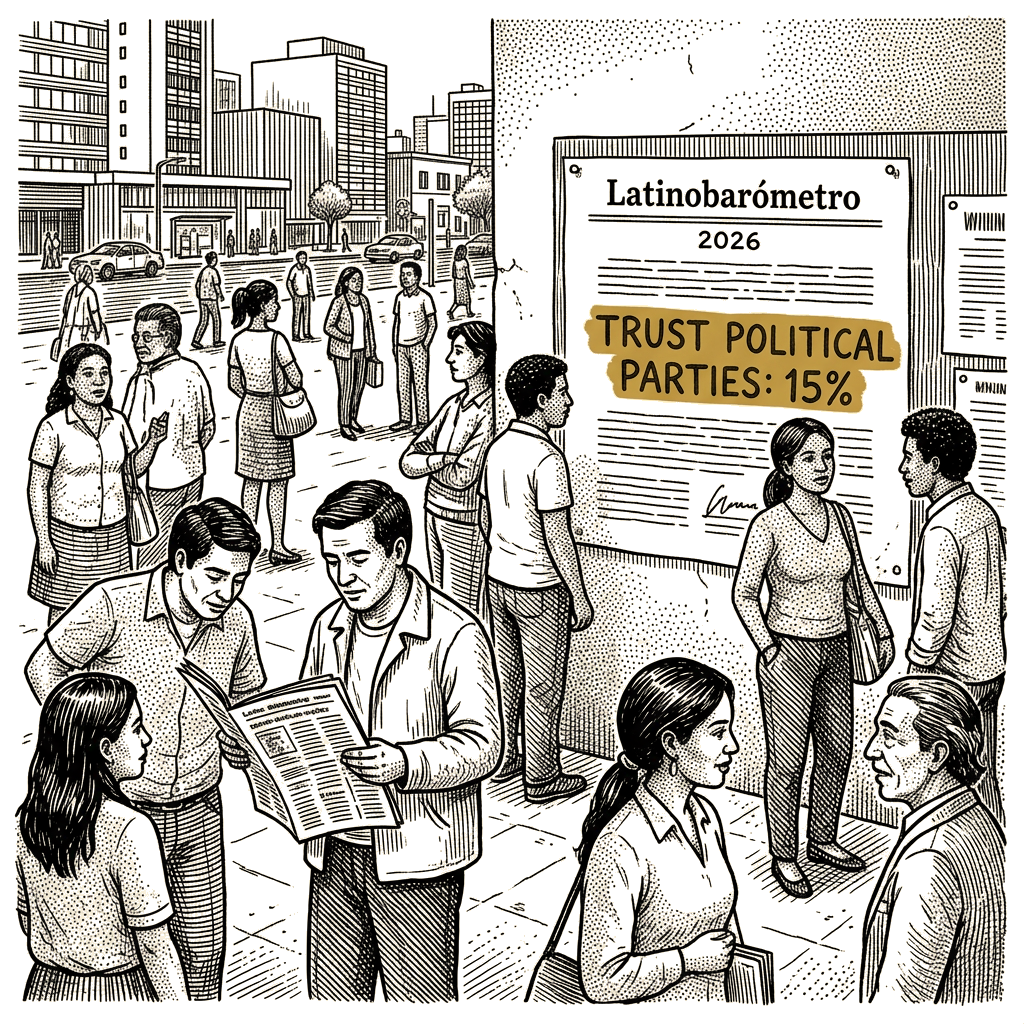
Survey finds 63% agree ‘mano dura’ is ‘not a bad thing’
Latinobarómetro’s 2026 survey documented that 63% of respondents agreed a “mano dura,” or heavy hand, is not a bad thing, up from 59% in 1995. Ojeda read that finding as showing how dissatisfaction with government can coexist with an appetite for firmer authority, without amounting to a rejection of democracy itself.
The trust figures arrive against a backdrop of rapid political turnover. Latinobarómetro counted 12 presidential elections in the region since 2024 with seven changes of governing party. The organization’s analysts read the recent rightward shift as pragmatic fatigue rather than ideological conviction, characterizing it as “a vote for an alternative to everything already tried.”
In Peru, the survey was published months after Keiko Fujimori’s July swearing-in, ending a decade of extraordinary presidential turnover. Brazil’s Lava Jato, or Car Wash, investigation, which began in 2014, exposed an international bribery and money-laundering network that penetrated political systems in Peru, Colombia, Mexico, Ecuador and elsewhere. Chile and Colombia have experienced upheavals over inequality and the commercialization of basic services, and governments across the region have struggled to contain organized crime.
Ojeda, an academic at the International University of La Rioja in Spain, opened his commentary by distinguishing between authority and leadership. “Authority comes with office,” he wrote; it is the formal right to command. “Leadership, by contrast, is earned through conduct and empathy.” It is the capacity to influence and inspire others, he argued, and embodies an implicit contract in which a community entrusts its future to those who can offer it security and a path to progress.
The current leadership crisis is not simply a shortage of charisma or technical ability, Ojeda wrote. It is, he argued, “a visible symptom of something deeper, the erosion of the social contract that helped organize modern society.” The problem, in his reading, is no longer only that leaders lack recognition. “Increasingly, there is outright contempt,” he wrote, “born of a crisis of legitimacy and a declining quality of life.”
The pattern extends beyond Latin America. The World Economic Forum’s Global Risks Report 2026 described an “age of competition” in which half of the experts surveyed expect the next two years to be turbulent or stormy, rising to 57% over the next decade. The World Justice Project reported a decline in the rule of law in 68% of the 143 countries and jurisdictions it assessed in 2025, a pattern Ojeda described as “multipolarity without effective multilateralism.”
Ojeda identified three fractures he said explain citizens’ growing disenchantment. The first, he wrote, is the widening distance between what people were taught to expect and what they actually experience, with the social promise that effort and respect for the rules would bring mobility and security no longer holding. When hard work no longer guarantees even a minimum degree of stability, he added, disappointment can turn into a sense of betrayal, with those who own assets often becoming wealthier while many who depend primarily on wages struggle to keep pace.
The second, he said, is the weakening of community. A healthy democracy requires a balance between private prosperity and public goods. Schools, hospitals, parks and safe neighborhoods create spaces where people can encounter one another as equals, regardless of income. When those shared spaces deteriorate, those who can afford to do so move toward private alternatives. “Society becomes divided by purchasing power,” Ojeda wrote, “the sense of a common destiny weakens, and leadership itself loses meaning when citizens hold less and less in common.”
The third, he added, is the expansion of market logic into areas once regarded primarily as social goods. Citizens become customers. Housing ceases to be principally a family refuge and becomes an investment asset. Education, once a pathway toward advancement, can become a source of long-term debt. When essential public goods become prohibitively expensive, Ojeda wrote, “political leaders can appear powerless or, worse, willing to facilitate the process.”
Ojeda also wrote that politics itself has been hollowed out. Ideals such as social justice, freedom and equality, he argued, “too often become marketing slogans.” Parties that once mediated between society and the state can turn into “machines for preserving leadership groups and their access to power.” Latinobarómetro’s 15% figure is, in Ojeda’s reading, “the arithmetic of that decline.” When parties with opposing rhetoric implement similar policies, he added, citizens understandably ask what purpose politics serves if their lives keep deteriorating.
Ojeda described the consequences as erupting in the streets, as they did in Santiago in 2019, Sri Lanka in 2022, Bangladesh in 2024 and Nepal in 2025. They also appear more quietly, he wrote: many young people postpone marriage and parenthood, homeownership increasingly seems out of reach, and debt and precarious employment can create “a form of economic servitude without visible chains.” Without strong public goods to support them, he added, individuals detach from civic life and freedom is reduced to choices in a consumer marketplace.
The WEF, Ojeda wrote, proposes pragmatic responses including coalitions of willing countries, smaller multilateral agreements and public-private partnerships. “But the deeper challenge is ethical,” he argued: no leadership style can restore legitimacy while collective decisions remain subordinated to short-term financial interests.
“The leaders who earn public trust again will be those who protect the common ground citizens share and narrow the distance between social promises and lived reality,” Ojeda wrote.
UPI published Ojeda’s commentary on October 13, identifying it as the views of its author.