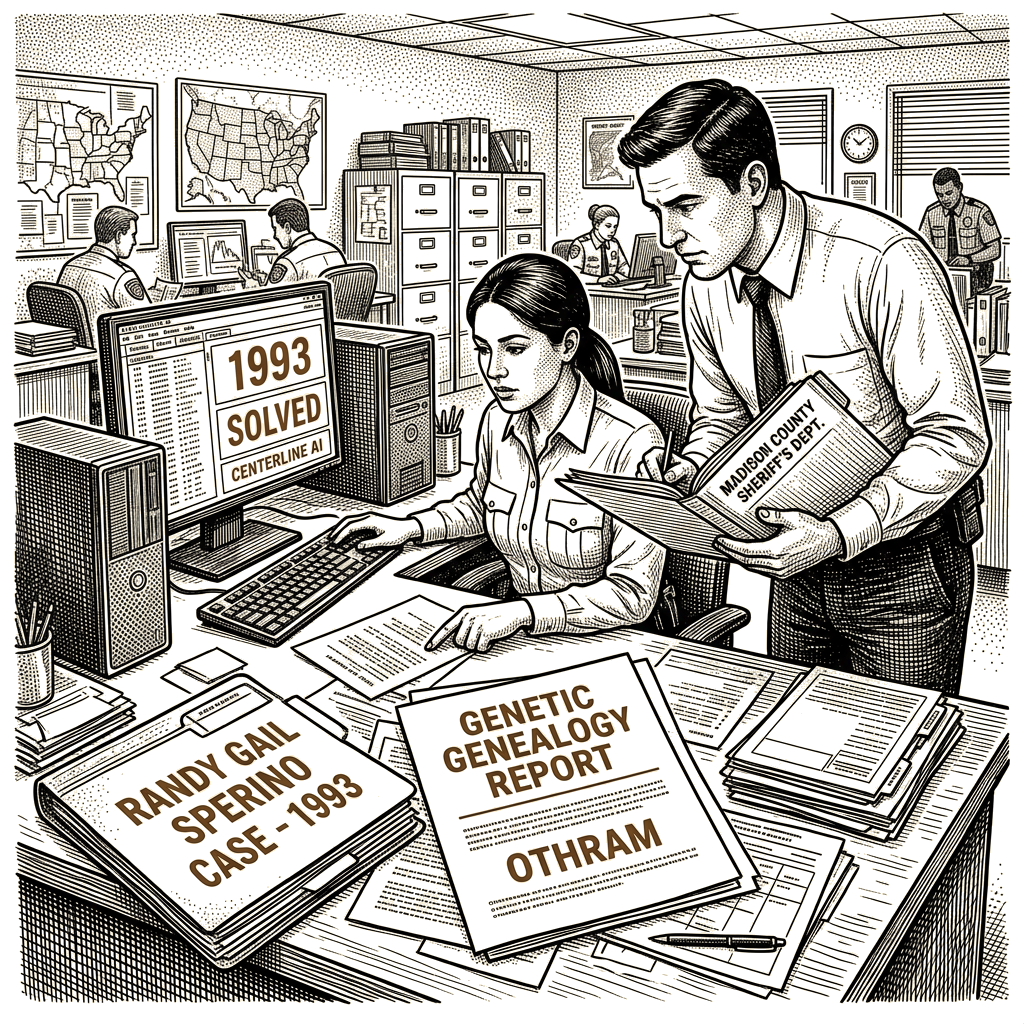
Centerline AI helped reconstruct timelines and organize witness information
Detectives with the Madison County Sheriff’s Office used Othram’s investigative genetic genealogy and CentralSquare’s Centerline AI in the 1993 murder of Randy Gail Sperino. Othram’s analysis produced a lead to a male family member, while Centerline AI analyzed more than 2,000 pages of accumulated records. Albert “Buddy” Zigler, 70, later confessed to the murder and was charged in May.
Sperino, 34, was last seen alive on the evening of 9 November 1993 as she got into a pickup truck in Granite City, Illinois. Her body was found hours later in a nearby field, and she was the victim of blunt force trauma. Madison County investigators spent three decades pursuing leads and interviewing hundreds of people. DNA evidence from the scene produced no matches in standard law-enforcement databases. More broadly, crime-scene evidence is often not enough on its own to identify suspects.
The case looked as though it would remain one of more than 250,000 unsolved homicides in the US. Last year, detectives sent the genetic evidence to Othram, a Houston-based company that uses DNA technology to identify perpetrators in cold and current cases. The detectives drew on the method used to identify the Golden State Killer, Joseph James DeAngelo, in 2018, when investigators constructed a family tree from DNA data relatives had submitted to commercial databases, similar to consumer ancestry platforms.
Unlike traditional forensic DNA testing, which generally compares evidence with a known person, investigative genetic genealogy can identify distant relatives of an unknown person. The killer’s own DNA profile was unavailable in Sperino’s case, but profiles submitted by his extended relatives allowed Othram to identify a male family member.
“That lead broke the case open,” said Captain Tim Lawrence of the Madison County Sheriff’s Office. The clue led detectives to Zigler, who then confessed. He was charged in May. At a press conference, Sperino’s son, Wes Sperino, said: “I finally get closure and I finally know who did this.”
Beyond the Sperino investigation, the BBC reported that investigative genetic genealogy has been highly successful in helping solve cases involving unidentified human remains and identifying suspects in longstanding investigations.
Othram says the technique has helped solve thousands of cases. Company chief executive David Mittelman likened investigative genetic genealogy to a GPS system: “The DNA profile is the GPS signal and it says ‘you belong here.’ But to understand where ‘here’ is, you need a map.” Public records, obituaries and census data provide that map, allowing Othram scientists to establish how different family trees connect. Othram’s laboratory work can include preparing bone for DNA extraction.
Mittelman said DNA technology can only go so far before “a cascade of investigative steps” is needed. “It can’t solve every case. If you have no DNA, you can’t really use this technique,” he said. He nevertheless described the method as more powerful and more likely to produce identities than relying on the chance that a match would appear in a database.
AI addressed a separate challenge: the volume of evidence detectives had accumulated since 1993. Centerline AI, a platform from Florida software company CentralSquare, analyzed more than 2,000 pages of records and identified evidence for DNA testing. It also helped reconstruct timelines and organize witness information.
“It’s so much easier than having a detective have to read through 2,000 pages,” Lawrence said. His team could interact with the system like a chat bot.
Detectives also queried the AI while preparing to interview Zigler, using it to help “figure out if Zigler was being truthful,” Lawrence said. He said the technology is “only as good as the investigator.” At some point, he said, “where you leave the technology behind and you have to go track people down and talk to them.”
The use of ancestry-platform data raises consent questions. Firms like Othram use such data only where users have consented to law-enforcement matching, but a person who opts in may have relatives who did not consent. Denise Syndercombe Court, a professor of forensic genetics at King’s College London, said, “There are significant privacy concerns.”
Funding is another limitation. “Every law enforcement agency wants to do it. There’s just not a lot of funding for it,” Mittelman said. Some cases receive support through donations or crowdfunding, and Othram operates a website where members of the public can help fund cases.
Investigative genetic genealogy has been adopted in Sweden, Denmark and Australia, but not yet in the UK. The Home Office is conducting a study on whether to adopt it and did not respond to a request for comment. Syndercombe Court said the UK already has an effective DNA system: “We have such an efficient DNA database that if you can get any DNA out of a crime scene, you’ve got over a 65% chance of putting a name to that person, which is enormously powerful.”
The Sperino investigation shows how genealogy analysis and AI can narrow a three-decade inquiry without replacing investigators’ work. DNA genealogy supplied a family connection, AI analyzed old records, reconstructed timelines and organized witness information and assisted questioning, and detectives tracked down Zigler before obtaining his confession.