Johnson avoids execution amid increasing doubts about conviction
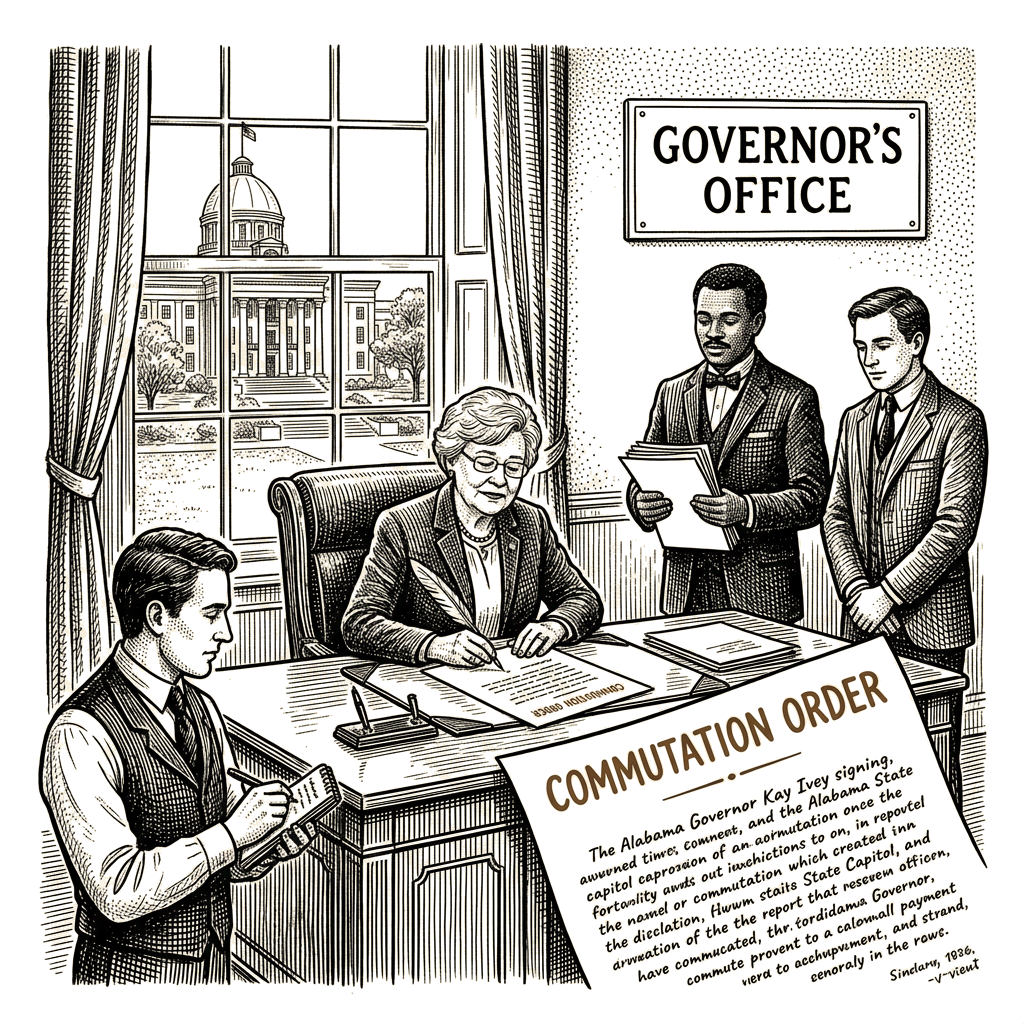
On Tuesday, Alabama Gov. Kay Ivey commuted death row inmate Toforest Johnson’s sentence to life in prison without parole, ending his prospect of execution. The Guardian reported that the decision came amid increasing doubts about Johnson’s conviction. Ivey, a Republican, said the commutation did not determine Johnson’s innocence. Johnson was sentenced to death in 1998 for the 1995 murder of Jefferson County deputy sheriff William Hardy.
An undated photograph provided by the Johnson family shows Toforest Johnson, right, posing with his son, Robby Foster. Photograph: Johnson Family/AP.
Johnson has long maintained his innocence, and several former public officials, as well as Jefferson County District Attorney Danny Carr, have argued that he should receive a new trial. In a statement, Ivey said, “When presented with Mr Johnson’s case, I had concerns there was not enough direct evidence to carry out the most serious punishment – death,” and added, “My decision is not a determination of innocence, but a recognition that the circumstances of this case justify commuting his death sentence to life imprisonment, without possibility of parole.”
Ty Alper, one of Johnson’s attorneys, said they were grateful to Ivey for “diligently reviewing Toforest’s case and taking action to spare an innocent man from execution”. Alper said the fight to overturn the conviction would continue. The governor’s power in such cases is limited to commuting a death sentence, leaving the effort to overturn the conviction and obtain a new trial to the courts.
“Toforest Johnson is innocent. Now it is up to the courts to overturn his conviction and grant him a new trial. We will keep fighting until he is home with his family,” Alper said.
Ivey has overseen 27 executions during her time as governor and has commuted the death sentences of three death row inmates. Her decision came shortly after Republican Gov. Ron DeSantis canceled a planned execution for the first time earlier that month.
Hardy was shot twice in the head while working off-duty security at a hotel in 1995. Johnson has maintained that he was on the other side of town at the time of the shooting. No physical evidence tied Johnson to the killing, and more than 10 witnesses placed him on the other side of town during the shooting.
The key prosecution witness at Johnson’s 1998 trial testified that, while eavesdropping on a phone call, she heard a man she believed was Johnson admitting to the crime. She was paid $5,000 in 2001 for her testimony, and Johnson’s lawyers argue that the state withheld evidence of monetary motivation for the testimony.
Carr has called for the conviction to be overturned, as has the original prosecutor. Carr said “the foundation of this conviction has disintegrated” and cited multiple reasons to doubt the key prosecution witness. In a 2024 court filing, Carr wrote that the “evidence in this case has unraveled over 20 years”.
A years-long legal effort has sought a new trial in Johnson’s case. Johnson’s case has garnered national attention, including support from Kim Kardashian, and was the subject of a podcast. Former judges and prosecutors have joined the effort. Bill Baxley, a former Alabama attorney general; former state chief justices Sonny Hornsby and Drayton Nabers; and several former judges and prosecutors have submitted briefs or written editorials supporting a new trial.
The Associated Press contributed reporting.
The commutation leaves Johnson’s 1998 conviction in place. His legal team’s effort to overturn it and obtain a new trial continues in court.