Moderna and Merck talk to regulators about next steps for seeking approval
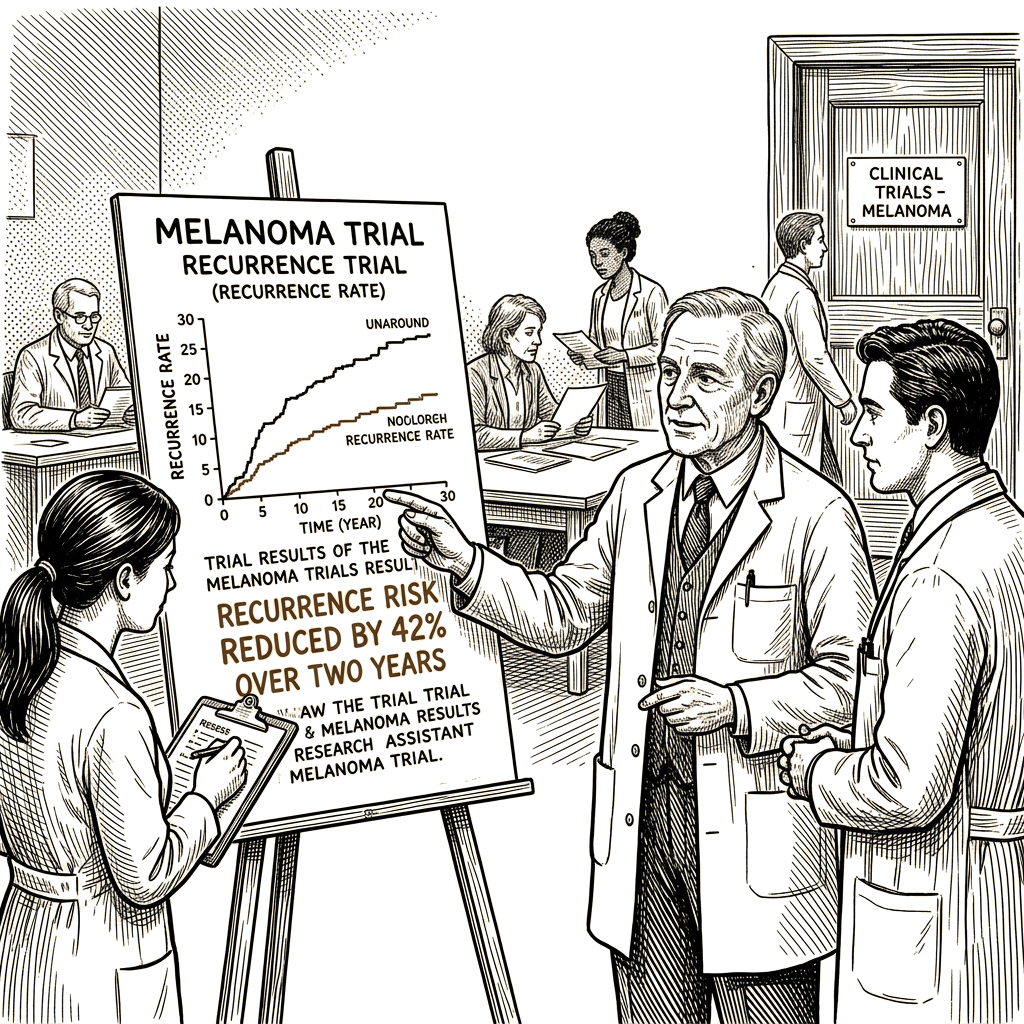
Moderna and Merck released results Thursday from a major late-stage trial showing that intismeran, a personalized mRNA vaccine custom-brewed to match each patient’s melanoma, reduced the risk of recurrence by 42% over two years when added to standard post-surgery treatment. AP characterized the vaccine as a first-of-its-kind cancer vaccine and the research as the most advanced study yet of the strategy for vaccinating against an individual’s cancer.
The international trial enrolled more than 1,100 people whose high-risk melanoma had been surgically removed. Every participant received Merck’s immunotherapy Keytruda as standard follow-up therapy, and researchers randomly assigned participants to also receive customized intismeran doses or a placebo. At two years, 82% of the intismeran group were still living without a recurrence, compared with 70% in the Keytruda-only group. The study will continue tracking longer-term outcomes.
Moderna and Merck had announced in August that the late-stage trial of intismeran was successful, but the detailed results were set for release Saturday at a meeting of the European Society of Medical Oncology in Madrid. Some of the data leaked publicly late Thursday, prompting a full release ahead of the weekend’s scientific presentation.
The vaccine’s personalized target came from the genetic profile of the patient’s own tumor. Scientists looked for gene mutations unique to each melanoma. Those mutations create proteins that should not be in the body unless cancer cells start growing again; scientists referred to these tumor-specific proteins as so-called neoantigens. Intismeran was designed to train the immune system to watch for and attack the neoantigens. The regimen consisted of nine doses given three weeks apart, and AP said intismeran uses the same Nobel Prize-winning mRNA technology that was behind COVID-19 vaccines.
The approach differs from familiar infection-preventing vaccines, such as those for measles or whooping cough. Two existing cancer-preventing vaccines, the HPV and hepatitis B shots, block infection from tumor-causing viruses, and research is underway to prevent some inherited cancers, including Lynch syndrome-caused colorectal cancer. Intismeran instead targets a patient’s removed tumor to prevent recurrence. Experimental personalized cancer vaccines made with mRNA and other approaches also are being tested against lung, kidney and pancreatic cancer.
Experts not involved with the study said its success bolsters the field. Dr. Hussein Tawbi of MD Anderson Cancer Center in Houston, one of the researchers in the international study, said, “The field has been looking for a win and I think this one is a big one.” Karen Knudsen, CEO of the Parker Institute, which helps fund cancer immunotherapy research, said, “This is a new frontier.” Dr. Michael Atkins, deputy director of Georgetown University’s Lombardi Comprehensive Cancer Center, said, “It’s a big step forward for science, for oncology, because this vaccine will apply to many different cancers.”
Tawbi said the vaccine’s side effects were mainly a sore arm, fatigue and other reactions typical of mRNA coronavirus vaccination.
Moderna and Merck are talking with regulatory authorities about next steps for seeking approval of intismeran. AP reported that customized medicines generally are very expensive and that the companies are not discussing what an individualized cancer vaccine such as intismeran might cost.
Manufacturing extends beyond the melanoma study, Moderna President Stephen Hoge said. The company’s special cancer-vaccine manufacturing facility in Massachusetts is providing doses for thousands of people enrolled in multiple studies underway internationally. He said brewing each vaccine takes a few days, but the full process, beginning with analysis of the tumor genetics to develop a patient-specific recipe, can take roughly six weeks, sometimes more. Hoge also noted that the melanoma patients had already started their standard Keytruda, a different kind of immunotherapy.
Tony Hout entered the vaccine trial at MD Anderson in 2024 after a bleeding spot on his ear would not fully heal. Doctors identified melanoma, and the operation revealed that the cancer had begun to spread. Now 62, Hout has moved to Cayuga, Indiana, but returns to Houston every few months for study check-ups. He said, “I want to make sure I’m doing everything I can to be here for my family.” Scans this week showed he was still cancer-free.
The market reaction followed the release. Moderna shares fell 18% Thursday after the full results became public. Even after that decline, the shares remained more than 200% higher than in late August, before investors were first told of the initial results.
Source note: The Associated Press’ health and science coverage receives financial support from the AP Fund for Journalism and private foundations. AP is solely responsible for all content. AP publishes its standards for working with philanthropies, a list of supporters and funded coverage areas at AP.org.