Rivers forecast to crest Friday morning; rain expected to taper overnight
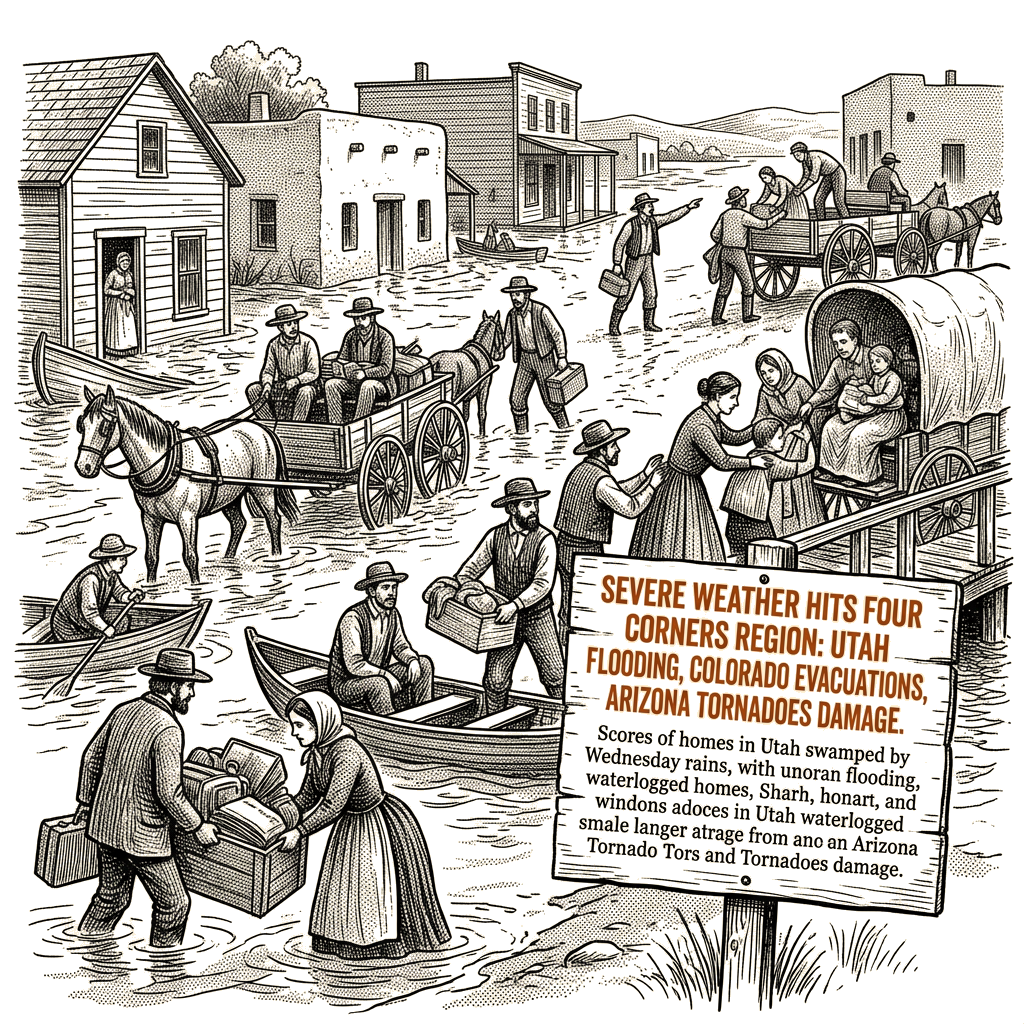
Severe weather struck the Four Corners region on Thursday, with flooding that swamped dozens of homes in Utah and led to evacuations of low-lying areas in Colorado, a day after tornadoes blew off roofs, knocked trees onto houses and downed power lines in Arizona. In Hurricane in far southwestern Utah, reddish-brown floodwater lapped into and around 80 homes in a neighborhood and 50 recreational vehicles in an RV park, and the city declared a state of emergency.
In southern Colorado, rising waters prompted mandatory evacuations along four rivers, including the San Juan River through Pagosa Springs. The resort town, which has riverside hot springs, suffered flooding from a similar weather pattern a year ago. Local officials, including Pagosa Springs Town Manager David Harris, monitored floodwaters expected to crest a foot (30 centimeters) higher than during last year’s flood. Harris said they had “learned a lot” from that previous flood.
In Hurricane, a shipping container drifted slowly down a street. Chelsey Field had just finished dropping her kids off at school when she noticed water rising around her neighbor’s property. “The trucks had water up to the windshield, about halfway submerged,” Field said. “That whole area was covered in water.”
Field’s neighbors were able to pull their horses to safety, using a tractor to move debris. It was the second flood Field had seen in 15 years living in Hurricane, and the last came only two months ago. “It’s pretty crazy to happen again, and I think this time it’s worse,” she said.
People were seen using the floodwaters for whitewater rafting, raising concerns that they would need rescue by emergency crews already stretched thin, Harris said. “There’s a lot of debris,” Harris said. “The last thing we want is to have to perform an extraction.”
The flooding followed two months of heavy rain that ended a summer of drought. While parts of the Southwest are rocky with little vegetation and naturally prone to flash flooding, the recent rains have made flooding more likely everywhere, said Kate Abbott, a National Weather Service meteorologist in Grand Junction, Colorado. “At this point we’re saturated and can’t take too much more without flooding,” Abbott said. “This is the third or fourth round of this kind of moisture we’ve seen in as many weeks.” Rivers were expected to crest Friday morning after rain was forecast to taper off overnight.
National Weather Service meteorologists suspect at least three tornadoes touched down as storms swept across central Arizona late Wednesday. The Wednesday night tornadoes injured at least one person.
The storm hit during Lenna Landy’s yoga routine in Overgaard, Arizona, a community of about 3,000 people located 140 miles (225 kilometers) northeast of Phoenix. Landy had ignored alerts about a possible tornado, but then the storm struck. “It was like Zeus-was-angry kind of level, of thunder cracks,” Landy said. The power went off, her house shook and she could not find her glasses. “If this is my end, I won’t see it coming,” she recalled thinking. “The scariest part was just like, how quickly it came on,” Landy said.
The storm also hit as members of the Overgaard Baptist Church were wrapping up a prayer meeting. Pastor Eric Woods had just led prayers for people to stay safe in the weather when chandeliers started swinging and the power went out. He told everyone to run into the women’s bathroom, which had concrete walls and no windows. “It just came on like a freight train,” he said. “I thought the roof was coming off.” They continued to pray in the bathroom, Woods said. They emerged later to see damage to the church roof and to many trees, including an old-growth ponderosa pine that toppled.
Ryan Bernhart, a weather service meteorologist in Flagstaff, said warm, moist air moving north fuels storms coming in from the California coast. He also said changing winds can make the storms spin, creating conditions for tornadoes. “This is very unusual for this area at this time of the year,” Bernhart said. Tornadoes are somewhat but not exceptionally unusual in Arizona; notable outbreaks happened in 2019 and 2010.
The Associated Press reported an unusually wet fall in the Southwest, a region better known for its heat. The Associated Press attributed the pattern to El Niño, which sent repeated tropical systems from the Pacific into the region and caused flooding in the Grand Canyon and surrounding deserts.
Jessica Hill reported from Las Vegas, and Gruver reported from Fort Collins, Colorado. Associated Press journalists Mikella Schuettler in Phoenix and Kathy McCormack in Concord, New Hampshire, contributed.