Vatican aid effort expands after Oleshky cease-fire takes effect
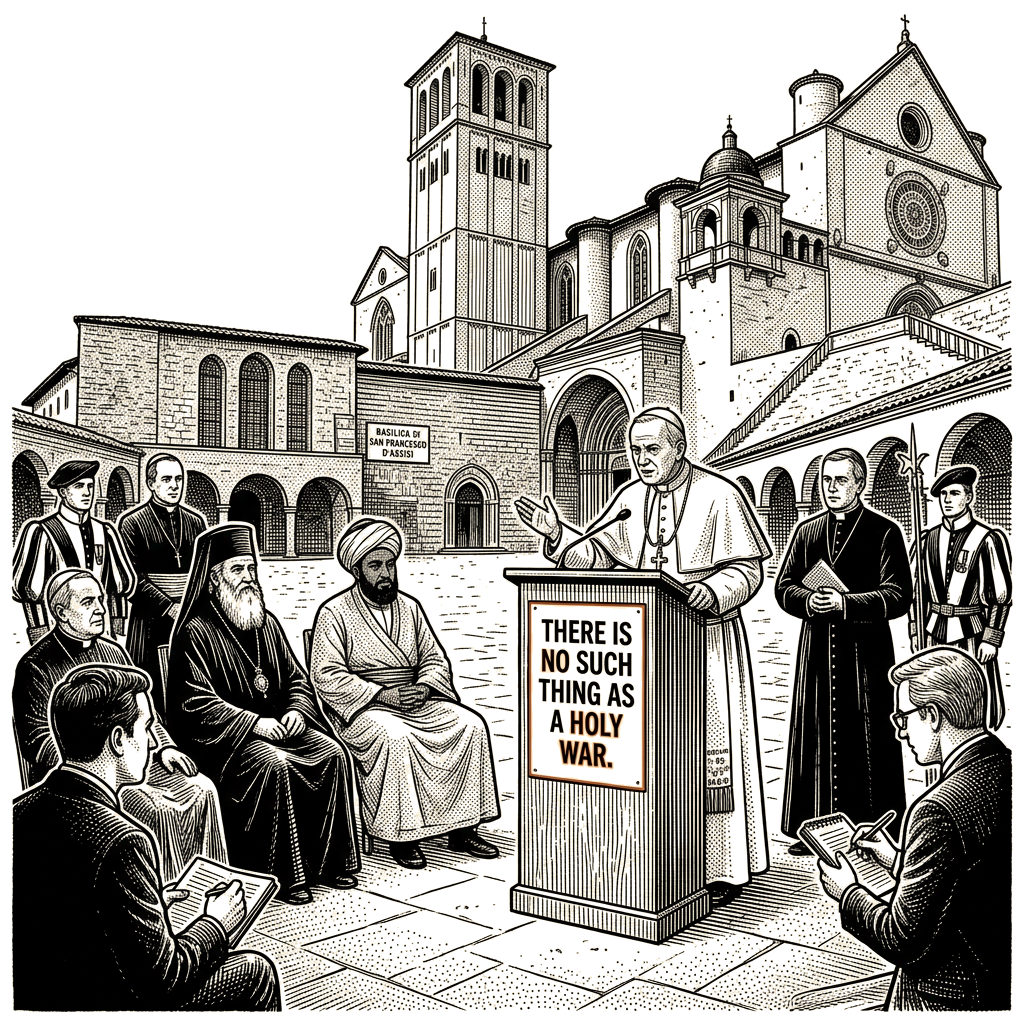
Pope Leo XIV rejected the use of religion to justify war in a video message to religious leaders gathered Tuesday in Assisi, Italy, declaring, “there is no such thing as a holy war.” “Only peace is holy,” Leo said. The American pontiff was scheduled to preside in person but canceled his participation as he recovered from Oct. 13 lung cancer surgery.
Delegates included Archbishop of Canterbury Sarah Mullally, spiritual leader of the worldwide Anglican Communion, along with Muslim, Buddhist and other Christian leaders. They gathered in Assisi, the birthplace of the peace-loving St. Francis, to mark the 40th anniversary of an interfaith peace meeting called by St. John Paul II. The encounter was controversial at the time because it featured leaders of different faiths praying together, and it spawned a movement of interreligious peace appeals and gatherings.
In his message, Leo denounced the “troubling revival of war as an instrument of international politics” and the religious justifications offered by leaders. “Precisely in these times marked by a culture of power, there is a need to cultivate the spirit of Assisi,” he said. “War can never be waged in the name of God,” he said. “We must rebuild peace everywhere, not prepare for more wars.”
The appeal came amid the use of religion to justify armed conflict. Russia’s Orthodox Church has justified Russia’s invasion of Ukraine as a “holy war” against a Western world it considers has fallen into evil. Leaders on all sides of the Iran war have used religion to justify their actions. U.S. officials, especially Defense Secretary Pete Hegseth, have invoked their Christian faith to cast the war as a Christian nation trying to vanquish its foes with military might.
Leo has consistently rejected such justifications as a perversion of religion itself, most stridently in his first encyclical, “Magnificent Humanity.” In that document, he said fighting in the name of religion “means attacking religion itself.”
The Assisi gathering came as the Vatican accelerated its humanitarian efforts for Ukraine following the entry into effect of a localized cease-fire in the devastated southern Ukrainian city of Oleshky. On Tuesday, Leo’s chief almsgiver, Monsignor Luis Marín de San Martín, began a three-day visit to Ukraine and was bringing several trucks’ worth of winter clothes, blankets and food to Kyiv for distribution. Vatican News said he planned to visit Kyiv, Zaporizhzhia, Dnipro and Fastiv.
Leo had called for a cease-fire and the delivery of food and medicine in Oleshky, along with the safe and voluntary evacuation of its people, during an Oct. 16 phone call with Russian President Vladimir Putin that the pontiff initiated from the hospital where he was recovering from surgery. Three days later, back at the Vatican, Leo called Ukrainian President Volodymyr Zelenskyy. According to the Vatican, Leo noted his appeal to Putin and “expressed the hope that cooperation between both parties will allow for the delivery of food and medical aid, and for the voluntary and safe evacuation of the civilian population.”
The White House said the cease-fire in Oleshky had been secured by first lady Melania Trump. Asked Tuesday, Vatican foreign minister Archbishop Paul Richard Gallagher said the Vatican was not aware of the first lady’s role but dismissed polemics over who was ultimately responsible. Gallagher said, “I think it’s one of those situations in which it doesn’t matter who actually brought it about or who takes the credit, it’s the fact that hopefully it is real, it will last, it will allow for evacuation and it will allow the arrival of humanitarian aid to help the people who are left behind.”
The Vatican initiatives came after Italian Cardinal Matteo Zuppi, the papal envoy for the Ukraine-Russia war, finished his third mission to Moscow on Sept. 30, his first under Leo’s pontificate. Zuppi has focused his initiatives on humanitarian issues, especially reuniting Ukrainian children taken by Russia with their families.
Gallagher said that for now neither Russia nor Ukraine wants the Holy See to take on a greater mediation or facilitation role. The immediate initiatives described at Assisi and in Ukraine combined Leo’s rejection of holy-war language with Vatican efforts to bring aid to Ukraine and appeal for a cease-fire and safe evacuation in Oleshky.