Reserve Bank officials more concerned about inflation becoming entrenched than rising unemployment
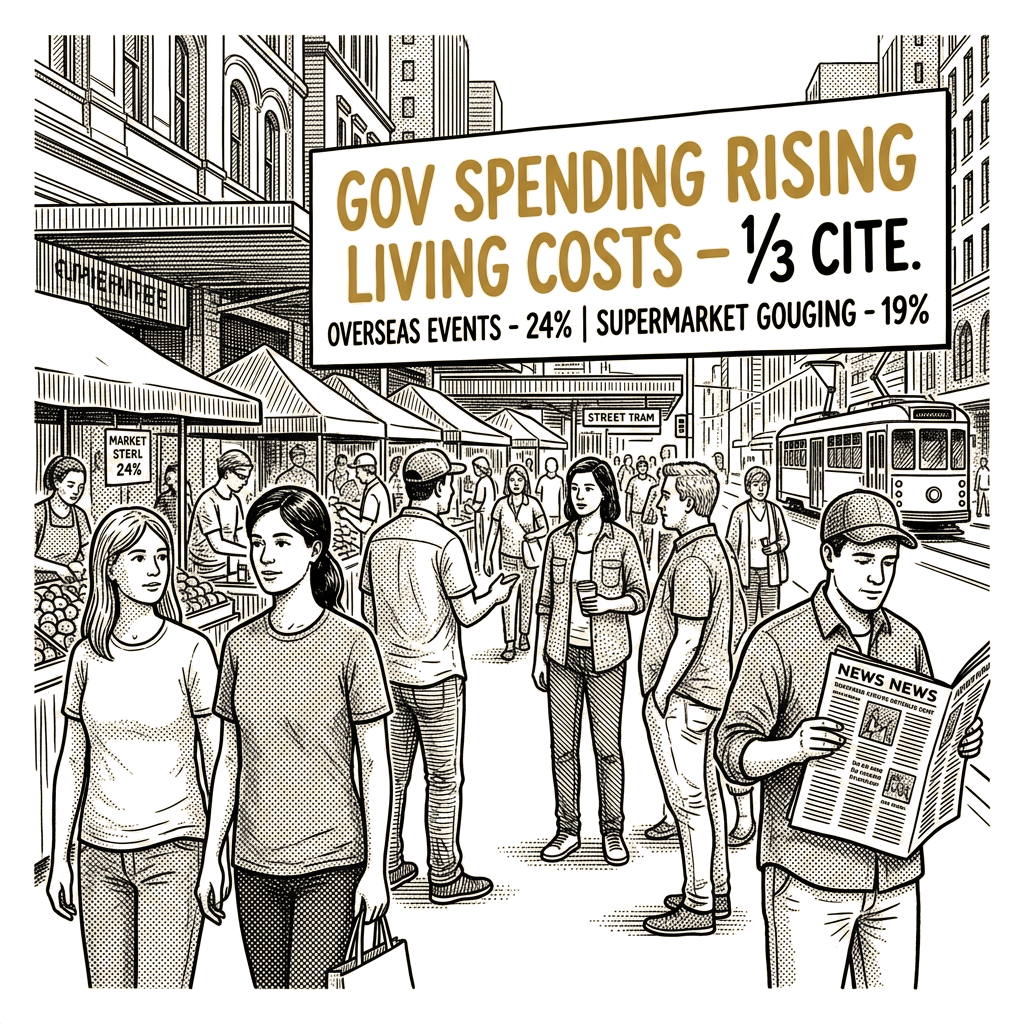
Australian Treasurer Jim Chalmers has blamed the latest inflation figures on the worsening Middle East conflict, and Guardian economics editor Patrick Commins said he had a point. But the Essential poll found that more Australian respondents named government spending than overseas events as the leading cause of rising living costs. Nearly a third named government spending, 24% chose overseas events such as the global oil shock, and 19% named supermarket price gouging. Commins wrote that “Taking the lion’s share of the blame for worsening cost of living pressures may not be completely fair, but it is the price of incumbency – as the latest Essential poll showed.”
The Australian Bureau of Statistics said the 9.4% jump in fuel costs in September was largely responsible for inflation accelerating from 4% to 4.3%. Petrol and diesel prices were on average 24% higher than a year earlier, the data showed. Commins wrote: “We are clearly paying an economic price for Donald Trump’s pointless and damaging war on Iran – and you can’t pin that on the government, whatever your political leanings.”
Earlier in the day, Reserve Bank Governor Michele Bullock said overseas developments were complicating the central bank’s already tough task of bringing inflation all the way back to 2.5%, preferably by the end of next year. Even after removing the biggest price moves, the Reserve Bank’s preferred underlying inflation measure rose from 3.6% to 3.7% in the year to the September quarter.
In Senate estimates before the latest price statistics were released, Reserve Bank officials confirmed they were more worried about inflation becoming entrenched than they were about rising unemployment, which had recently reached a five-year high. Sarah Hunter, the RBA’s chief economist, said there were no signs the economy was “in or heading into a recession in the near term”. Commins disputed that reassurance, writing, “Perhaps, but there is no doubt we are heading into more dangerous territory, and the future is looking darker, not brighter.”
Commins forecast that “Regardless of who or what is to blame, and to what degree, voters are likely to get angrier still next Tuesday when the Reserve Bank surely delivers the year’s fifth interest rate hike.” He said it was “hard to see anything but more pain for mortgage holders come Melbourne Cup day.” The expected increase would bring the cash rate to 4.85%, the highest since the GFC.
Although government spending may not have been the main reason inflation tracked higher since the middle of the year, Commins said it was part of the mix. Economists including Chris Richardson, whom Commins described as the country’s top budget watcher, argued that public spending was too high and was not helping in the battle to bring inflation down. Commins wrote that “Government expenditure as a share of the economy is around record highs.” He said it was hard to reconcile that with Chalmers’s statements that the government had nothing to do with the latest jump in the cost of living, particularly because Reserve Bank officials frequently referred to capacity pressures that existed when the war on Iran started in late February.
Commins described “the sudden boom in spending on datacentres” as “pouring money into an economy that is already struggling to deliver the workers and materials needed to build homes and roads.” He said the spending was “driven by the global rush by tech companies to put in place the infrastructure to power their artificial intelligence revolution.”
Commins said families were approaching Christmas with rates at their highest since 2008, high petrol costs and rising unemployment. He warned: “For many households, it will be a tough summer that will add to an increasingly entrenched pessimism about the future.” The Essential poll also found that the share of Australians saying the country was on the wrong track had been steadily climbing before reaching 61%. Only 25% thought the opposite.
Commins wrote: “The pressure is now on Chalmers to use December’s mid-year budget to somehow change the narrative as the government approaches the third year of this parliamentary term.” He called the task “a tough ask” with “no obvious answers.” He also returned to Chalmers’s position that “the Middle East conflict can’t end soon enough.”