Alaska’s state supreme court upheld the challenger’s ballot access
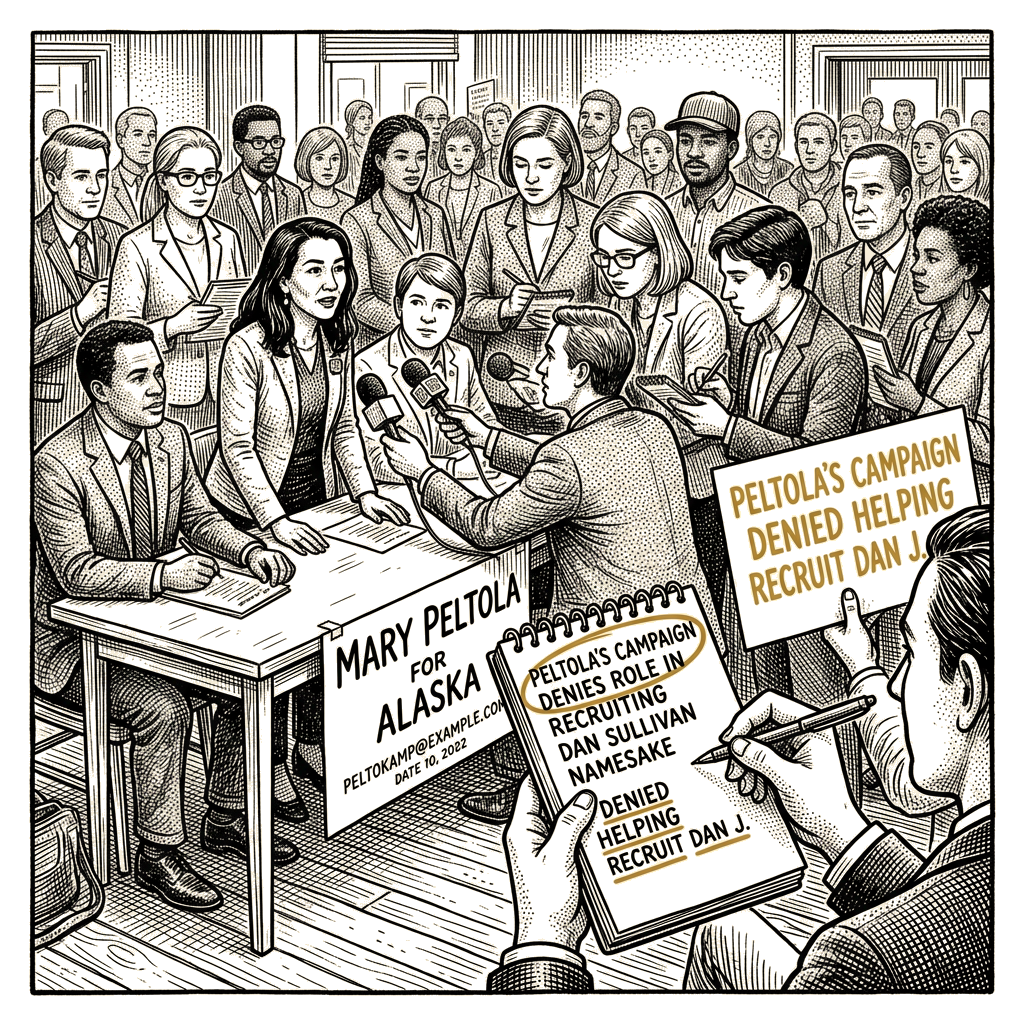
Mary Peltola’s campaign denied involvement in the reported effort to recruit Dan J. Sullivan, a retiree living in south-eastern Alaska with scant political experience. The New York Times reported that Peltola campaign officials and the Democratic Senatorial Campaign Committee worked to find other people named Dan Sullivan in Alaska and encourage them to run. A campaign spokesperson said, “The Alaskans for Mary campaign has no involvement with either Sullivan campaign. Like Mary, our campaign is focused on lowering costs and fixing the rigged system in DC.”
The Times said its reporting was based on interviews with Peltola’s former campaign manager and other sources, as well as documents and text messages related to the recruitment effort. Elisa Rios, whom Peltola fired in August, told The New York Times, “Alaskan voters need to know,” and later tried to retract her interview.
Nate Adams, a spokesperson for Senator Dan Sullivan’s campaign, said, “Alaskans deserve the truth.” Adams said no one involved in the reported operation acted in good faith with Alaska voters. He accused Peltola and her campaign of spending months denying the scheme, adding that Peltola hoped it would remain covered up until after the election.
Donald Trump shared a link to the Times article on Truth Social and called it proof of “election fraud.” Trump said, “I don’t think Mary Peltola, after perpetrating such a terrible scheme, should be allowed to run.” Last week, he acknowledged ordering the Justice Department to file a lawsuit attempting to block certification of the election results if Dan Sullivan loses.
At a rally in Alaska this month, Trump urged the senator’s supporters to vote for the “real” Dan Sullivan and warned that errant votes for the challenger could cost the senator re-election.
The DSCC separately denied involvement. A spokesperson said, “The DSCC is not involved with Dan J. Sullivan,” and accused Republicans of a long history of recruiting and propping up candidates to boost their own campaigns. The spokesperson cited Alaska and Ohio Senate races this year and earlier elections in North Carolina and Montana.
Election authorities in Alaska attempted to disqualify Dan J. Sullivan before the August primary, but Alaska’s state supreme court ruled that he can appear on the ballot. He was one of the top four vote-getters in the nonpartisan primary. On the general-election ballot, the senator is listed as “Sullivan, Dan S. (Registered Republican) Incumbent” and the challenger as “Sullivan, Daniel J. Jr.”
Dan Sullivan’s bid for a third term against Peltola, a former U.S. congresswoman, is one of the most important contests in next week’s midterm elections. Alaska is one of a handful of states with Senate races this year that Democrats are targeting as they seek to regain a majority in the chamber, where they hold 47 seats to the GOP’s 53. Recent polls cited in the reporting have shown Peltola leading.
The Times reported that Democrats began considering ways to put a spoiler candidate on the midterm ballot in the summer of 2025. The DSCC introduced the Peltola campaign to Jerid Kurtz, an Ohio native and political operative who specialized in such activities, which are typically legal. Kurtz unsuccessfully approached another potential candidate who did not share the senator’s name before recruiting the other Dan Sullivan, according to the Times.
Peltola campaign officials also discussed with the DSCC the creation of a rightwing party to field a candidate in the race, but the plan did not proceed, the Times reported. After a second Democrat advanced through the August primary, the operative met with him and convinced him to withdraw. The Democrat was replaced on the ballot by another Republican, Gerald Heikes.
Heikes told The New York Times that he was recruited to run “by a guy from the midwest,” though the person did not resemble the Ohio operative. Heikes is a perennial candidate who has previously run unsuccessfully for governor, U.S. senator and House representative.
The ballot-access question has been decided by the state court, but the reported recruitment effort remains contested. The New York Times placed Peltola campaign officials and the DSCC at the center of the effort; Peltola’s campaign and the DSCC deny involvement, while Sullivan’s campaign has characterized it as a deception campaign intended to split votes. Both Dan Sullivans remain eligible for next week’s election.