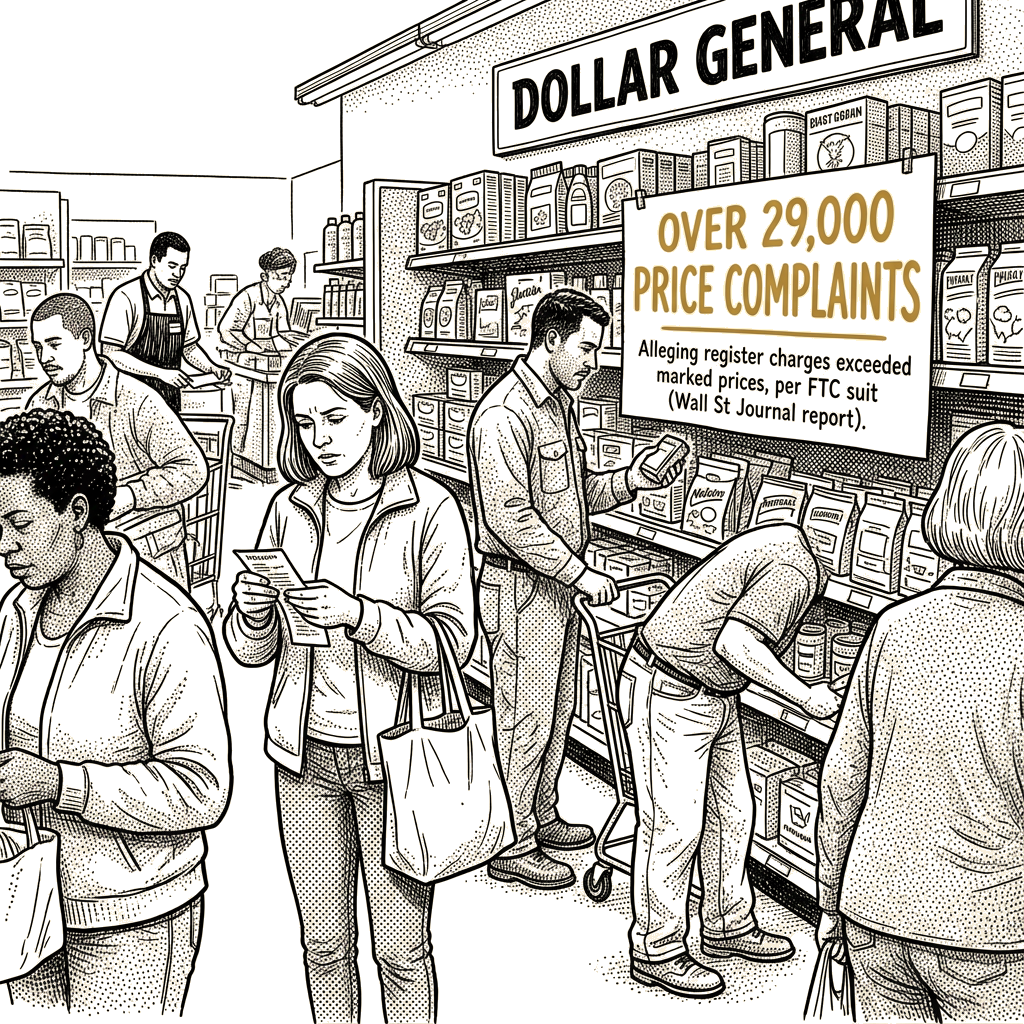
Dollar General has settled seven cases over inaccurate prices since 2018
The Federal Trade Commission, joined by 20 states, has sued Dollar General, alleging the discount chain routinely charges customers more at the register than the prices displayed on shelves and in advertisements. Dollar General received over 29,000 customer complaints about unhonored marked prices between January 2023 and March 2026, in all 48 states where the company operates, according to the lawsuit, which was filed in a federal court in Tennessee and joined by states including Alabama, Arizona and New Jersey.
In the complaint, the agency alleged “pervasive and systemic pricing inaccuracies, rather than isolated or accidental errors,” The Wall Street Journal reported.
Dollar General said it follows pricing practices similar to those of other retailers, but that “despite our policies and procedures, occasional price discrepancies can occur.” The company said it is vigorously defending against the litigation while remaining willing to negotiate.
The federal case arrives after years of complaints from consumers and state lawsuits. Lori Hartline, a 55-year-old who lives in eastern Oklahoma, said her trips to Dollar General several years ago kept costing more than she had tallied in her head, so she began photographing shelf tags and checking them against her receipts. Over three months, she said, she was overcharged on nine of 27 items: Bud Light Cheladas marked at $3 that rang up at $3.15, a loaf of Wonder bread marked at $2.80 that rang up at $3.35, and a container of cat litter marked at $10.30 that rang up at $11.30.
When she pointed out the differences, she said, a clerk told her the store could do nothing because the prices came from headquarters. Another time, she said, staff blamed a printer that was out of ink for shelf prices that could not be updated. Hartline said she complained three times to Oklahoma’s attorney general, and that Dollar General offered her a $10 gift card. “We’re in a rural part of Oklahoma that’s impoverished and they are just taking advantage,” she said. Hartline later sued the company in a class-action lawsuit that has since been settled.
Consumer concern about overcharging has intensified with years of inflation, and the Journal noted that price weariness has made affordability a political buzzword in the midterm elections. Overall prices as measured by the consumer-price index have risen more than 29% over the past six years, according to the report. Federal Reserve Economic Data, the St. Louis Fed’s database, showed the index for all urban consumers up about 3.7% year over year as of Oct. 31, 2026.
Regulators have been scrutinizing pricing practices across retail. McDonald’s, Walmart and other companies have faced what the companies say are unfounded claims that they are using artificial intelligence to maximize how much they can charge customers, and several states have fined Walmart and Family Dollar, another discount chain, in recent years for overcharging related to paper tag information. Also this week, the FTC ordered nine companies — including airlines, ride-share companies and retailers such as Target and Walmart — to provide more information on how they use consumer data to raise prices.
At the center of the Dollar General case is the price tag. Stores have long struggled to keep paper tags updated so shelf prices match register prices, and inflation has deepened the challenge because prices change more frequently than they used to, said Bryan Eshelman, Americas leader for retail at the consulting firm AlixPartners. The task is especially difficult for dollar chains, Eshelman said, because low margins lead them to run stores with as few as one or two workers per shift and to change their selection of goods frequently. “The notion of going around and reticking when prices change is just very difficult operationally for them,” he said.
Dollar General has entered into seven settlements with six state attorneys general and consumer protection agencies over inaccurate prices since 2018, and consumers have also filed a string of civil lawsuits, according to the Journal.
The discrepancies described in overcharging lawsuits are small — often a few dollars on a basket of goods. Yet for Dollar General shoppers, $5 or $10 more per shopping trip can feel massive, according to current and former workers. Customers tend to be low- or middle-income and often on fixed budgets. The chain’s more than 21,000 U.S. stores, often small locations in rural communities, can be one of few sources of groceries and household staples for miles, and Chief Executive Todd Vasos told investors recently that many customers bike or walk to a Dollar General rather than drive to a more distant competitor to limit spending on gas. Vasos said in a 2017 interview that the retailer marks many prices in 5-cent increments to make it easier for shoppers to estimate the total cost of a purchase and avoid the embarrassment of walking away during checkout if the bill turns out to be more than expected.
Nekodah Whipkey, 31, who worked at a Dollar General in South Bend, Indiana, over the summer, said customers abandoned carts full of perishables, cursed at her or issued threats when the price she rang up was higher than an item’s price tag. At times she was the only worker in the store, she said, juggling the register, stocking shelves and helping customers while also counting inventory and checking cooler temperatures. “I can’t tell you how many times I have had customers come up to the register and ring up things that would not match,” she said.
Whipkey said store management told workers to stick to the price on the register, though the manager sometimes reduced the charges. Dollar General’s longstanding policy, a company spokeswoman said, is that store managers can and should match lower shelf-tag prices when a discrepancy is found.
Older pricing technology and limited store staffing have made it difficult for Dollar General stores to keep shelf tags current, according to internal documents made public in past lawsuits and to current and former store workers. “Gaps in tech capabilities” have led to inaccurate prices, the consulting firm McKinsey told Dollar General in a 2023 presentation made public as part of a previous lawsuit. McKinsey told the retailer that fixing the pricing-technology issues would reduce demands on store labor and help it learn more from pricing trends, according to the report.
Dollar General said it has taken several actions to keep prices accurate, including limiting the volume of weekly price changes sent to stores and giving workers shifts before stores open to update prices.
Main Street Independent previously reported that the FTC and 20 states sued Dollar General on Oct. 26 in the U.S. District Court in Nashville, alleging a pattern of inaccurate pricing that the agency said was costing consumers millions of dollars and citing tens of thousands of complaints. The newest reporting adds the company’s internal complaint tally, its record of seven state settlements since 2018 and internal assessments of its pricing technology. The litigation remains unresolved: Dollar General said it is defending against the case while remaining willing to negotiate.