Company earnings and AI spending shape a session lifted by lower oil
U.S. stocks rose Monday, recovering part of the previous week’s sell-off in technology and artificial-intelligence shares. The S&P 500 gained 0.8%, came off a third straight losing week and moved within 2.3% of its all-time high. The Dow Jones Industrial Average was up 547 points, or 1.1%, at 10:15 a.m. Eastern time, and the Nasdaq composite was 1% higher.
On a daily-series basis, Federal Reserve Economic Data records the S&P 500 at 7,743.98, the Nasdaq composite at 26,184.72 and the Dow Jones Industrial Average at 51,770.31 for Nov. 2, 2026, in the SP500, NASDAQCOM and DJIA series, with values as published.
Oil prices and the Strait of Hormuz
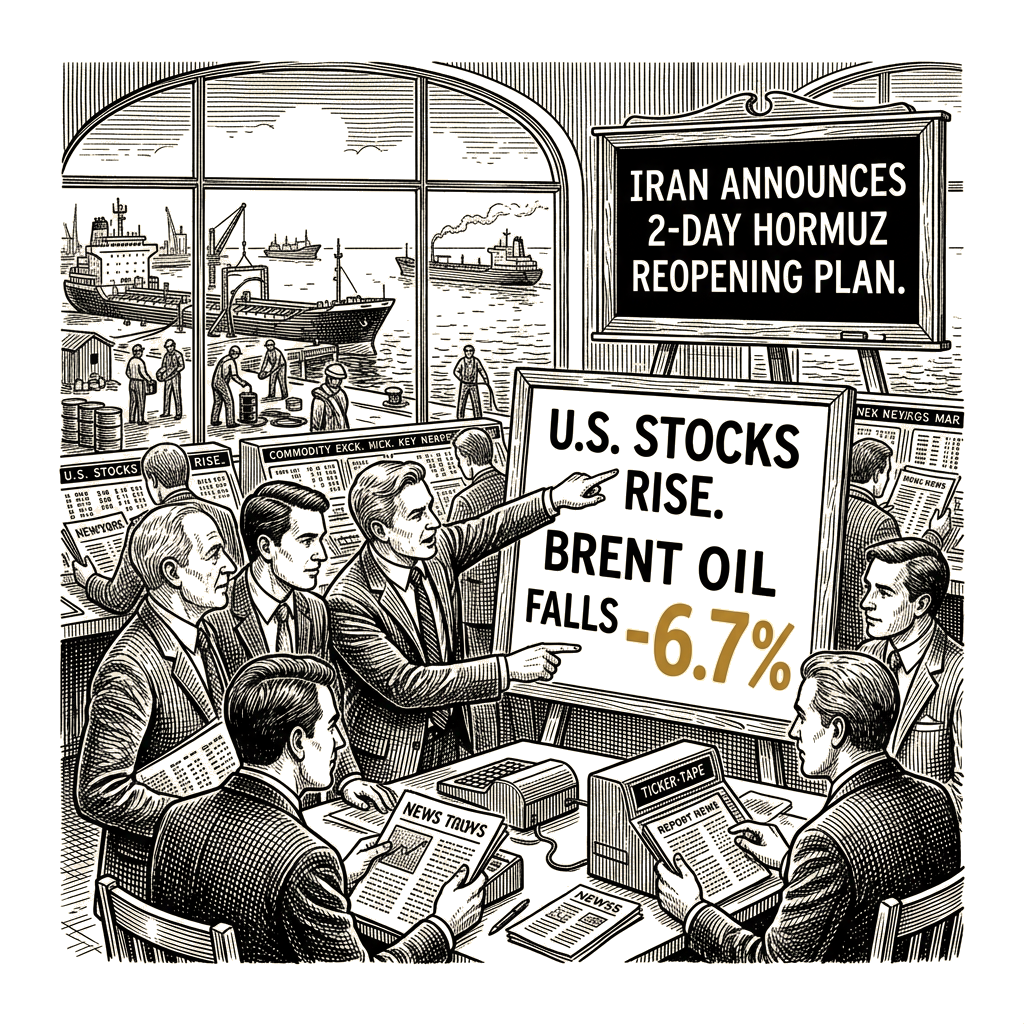
Stocks got a lift from easing oil prices amid uncertainty about when the war with Iran would allow the global energy industry to return to normal. The price of a barrel of Brent crude, the international standard, fell 6.7% to $105.87. The most actively traded Brent contract had been veering between roughly $70 and $120 since just before the war began, and the market had been quick to reverse direction.
Separately, Iran said Monday it had a two-day plan to reopen the Strait of Hormuz, which the country said would help the global energy industry, and resume nuclear talks with the United States. Over the weekend, Iran’s top diplomat said he hoped for “rationality” on the U.S. side as diplomatic efforts sought to avert a return to all-out war.
Earnings, fuel costs and the Marvell transaction
Lower oil prices helped lift companies with large fuel bills: United Airlines rose 6.5%, Southwest Airlines climbed 4.2% and cruise operator Carnival rose 4.6%.
Outside AI and technology, several companies reported better summer profits than analysts expected. Marriott International rallied 4.3% after reporting strength for its hotels around the world. Even in the Middle East, where the war had affected its business, CEO Anthony Capuano said that “trends improved meaningfully” from the spring.
Idexx Laboratories jumped 16.3% after reporting stronger profit and revenue than analysts expected. The company, which sells diagnostic equipment and other products to veterinarians, also raised its forecasts for revenue and profit for the full year of 2026.
Expectations were high for companies to continue posting large profit gains as the U.S. economy continued to expand despite high inflation and interest rates. A Monday report showed U.S. manufacturing growth above economists’ expectations, while an Institute for Supply Management survey measure showed prices rising at a slower pace.
The fuel-sensitive stock gains helped offset a 6% drop for Marvell Technology after it announced a deal to buy Lumentum, which sells lasers and other products that power the networks and infrastructure behind AI and cloud computing. Marvell said it would give 4.5 of its shares for each Lumentum share, valuing Lumentum at roughly $115 billion. Lumentum’s shares dropped 10.6%.
Alphabet rebounds 2.4% as investors assess AI spending and slower search growth
Alphabet rose 2.4% Monday, recovering some of a drop of more than 12% from Thursday, its worst in history. Nvidia rose 1.9% after its 4.2% Friday slide forced it to cede the title of Wall Street’s most valuable stock to Apple, while other technology giants held steadier.
The latest profit reports from Alphabet and other Big Tech companies showed how AI may be dragging on their own businesses. Google’s parent company used more cash during the latest quarter, measured by free cash flow, and reported slower-than-expected growth in its search business, raising worries that AI could cannibalize its cash cow.
Stocks in the artificial-intelligence industry have been shaky for months amid criticism that they surged too high and were in a bubble. Worries were growing that the hundreds of billions of dollars Big Tech companies were pouring into AI data centers would not produce enough productivity and profit to make the investments worth it.
Global markets and China’s new funding program
European indexes were mixed amid mostly modest moves, while swings were larger in Asia. South Korea’s Kospi jumped 2.2% on renewed strength for the technology giants that dominate its market.
In China, indexes rose 1.1% in Shanghai and 0.4% in Hong Kong to recover some of their steep recent losses. Stocks in Shanghai finished October more than 15% below a peak reached in May. The People’s Bank of China said Monday that around 100 billion yuan ($15 billion) would be deployed under a new program that could help support the market.
AP Business Writers Chan Ho-him and Michelle Chapman contributed to this report.