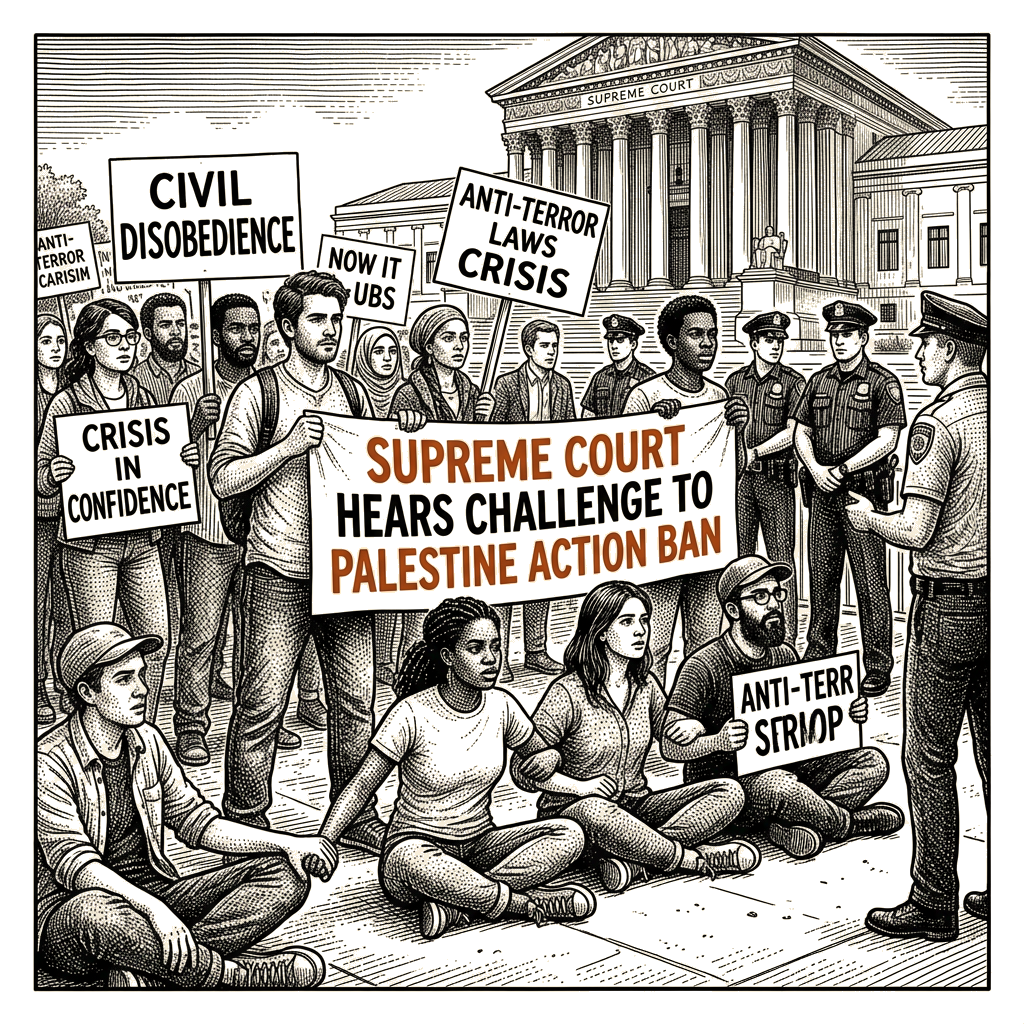
Home Office figures show more than 4,000 supportive-protest arrests
The Supreme Court heard arguments Wednesday in a major legal challenge to last year’s proscription of Palestine Action, brought by lawyers for co-founder Huda Ammori. The lawyers told the five justices that the ban had caused a “crisis in confidence” in the UK’s anti-terrorism laws and had triggered unprecedented civil disobedience from law-abiding protesters. They said no other protest organisation had been treated in the same way.
Ammori’s lawyers said the Supreme Court had never before had to consider whether banning a group under terrorism legislation was compatible with freedom of speech and protest. Their submission said thousands of elderly people, many of them veterans of other radical causes, had been arrested for holding signs supporting the group since its proscription.
Outside the court, the Metropolitan Police said 27 protesters had been arrested as the hearing took place.
Home Office figures seen by the BBC indicate there have been more than 4,000 arrests so far at protests in which people held up signs supporting the group. Many demonstrators have been arrested more than once, and prosecutors have authorized 1,200 charges to date, according to Home Office figures seen by the BBC. Those trials are in limbo until the outcome of the case.
Henry Blaxland KC told the court that proscription had been far from depriving Palestine Action of “the oxygen of publicity” or discrediting its brand — it had the opposite effect. “All it’s done is to pour fuel on to a fire of one of the most publicly-contested issues of our time,” he said. He also submitted that the ban was disproportionate and unnecessary.
During exchanges with the judges, Ammori’s team accepted that Palestine Action could not be described as an ordinary and peaceful protest group. The lawyers said members had carried out “direct action” protests by occupying or vandalising firms linked to Israel’s military. Only three of 385 incidents had been assessed by the Home Secretary as constituting an offence under the Terrorism Act.
The UK’s definition of terrorism includes incidents of serious damage to property for a cause. At least two break-ins at defence firms have been described in criminal courts as having caused millions in damage.
Raza Husain KC said the judges had to set aside allegations of criminality, for which the state had many powers, and consider whether the Home Secretary’s decision to label the group as terrorists was disproportionate.
“Palestine Action was proscribed on the basis of less than one per cent of its actions over five years assessed as falling within the outer limits of a definition of terrorism,” he said. Husain also said the Home Secretary’s own experts had confirmed that the vast majority of the group’s direct actions would not constitute terrorism because damage to property was typically more minor. He identified graffiti, petty vandalism, occupation and lock-ons among the common tactics.
One Palestine Action member has been convicted and jailed for fracturing a police officer’s back with a sledgehammer. But the court was told that the group had never advocated such violence.
The Supreme Court also received arguments from free-speech campaigners, who said the ban interferes with the right to protest. A coalition of Jewish groups argued that Palestine Action was a “sinister” organization intent on attacking its community interests.
Adam Wagner KC, in written submissions for the Jewish communal groups, said the Court of Appeal had rightly concluded that Palestine Action was a violent organization concerned in terrorism with a wide range of targets. Wagner said its activities were often undertaken covertly, with no suggestion of restraint or proportionality, and that the group had an escalating trajectory of seriousness and an expanding focus when it was proscribed.
Wagner said Palestine Action’s “crosshairs” had moved from Elbit, a defence firm with an Israeli parent company, to figures or institutions the group deemed “Zionist”. He said that because most British Jews and Jewish institutions have a connection with Israel, the group’s campaign against institutions its activists considered complicit with Israel was, in practice, a campaign threatening the mainstream Jewish community.
The case continues on Thursday, with judgment expected at a later date.