Military setbacks coincide with southern demands for more government power
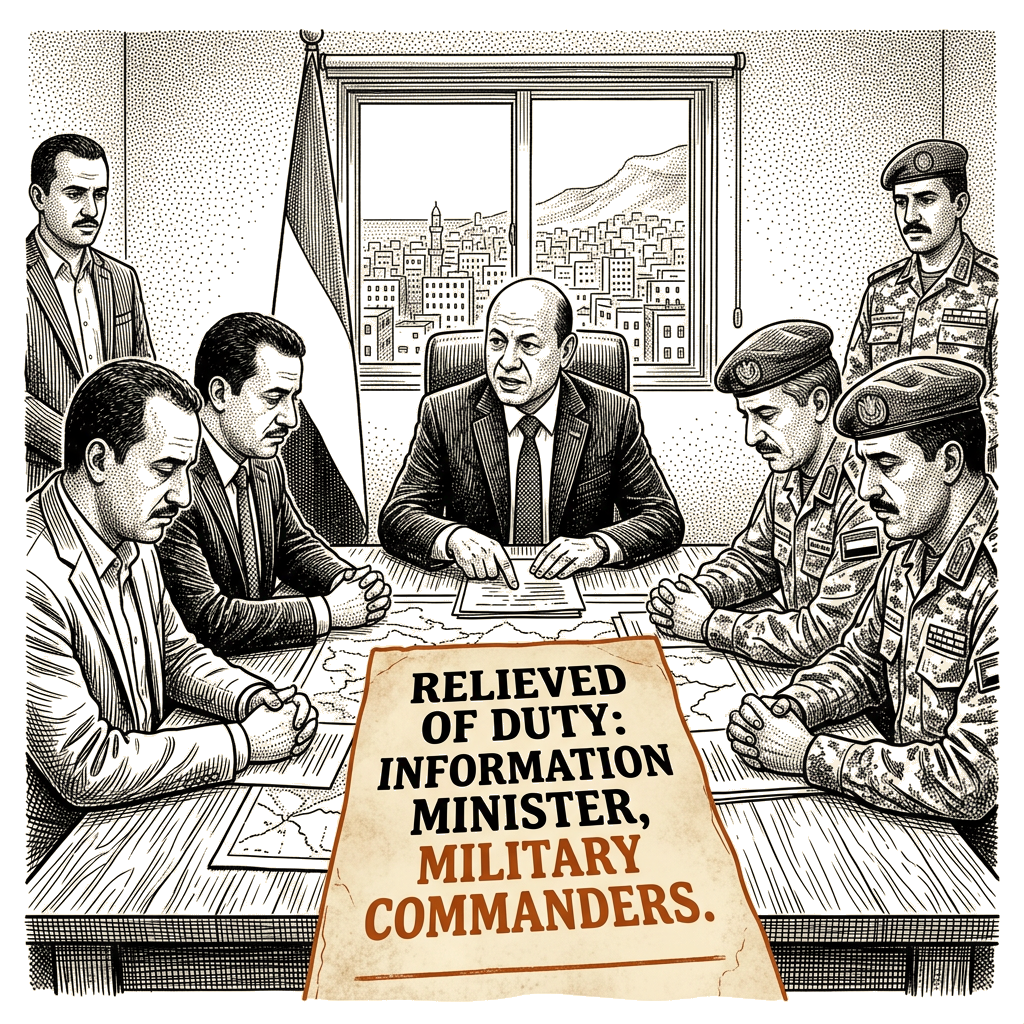
President Rashad al-Alimi dismissed Information Minister Muammar al-Eryani and two military commanders as Yemen’s UN-recognized government confronted Houthi advances and a failed countrywide counteroffensive. The changes placed southern figures in senior government posts and assigned Maj Gen Rashad al-Yousfi to coordinate forces and lift the four-week siege of Taiz.
The UN-recognized government launched the counteroffensive on October 5 to liberate the country from Houthi control. The operation failed amid fighting that left thousands dead on both sides. The Guardian reported that fighting had since moved into the mountains around Taiz after the government lost swathes of territory to the Houthis along Yemen’s west coast.
Saudi Arabia’s air superiority had not translated into progress on the ground, The Guardian said, even as the government’s ally had to fend off near-daily Houthi attacks on its airports and military bases. Reuters reported on Monday that Houthi forces were about 37 miles (60 km) from Aden, the nominal seat of the UN-recognized government.
The Guardian described the shakeup as reflecting military reversals and possibly a perceived need to respond more sensitively to demands from southern Yemenis. The government has become dependent on southern troops to fend off Houthi advances, but those forces insist they will fight only to defend land inside former South Yemen.
Between 1967 and 1990, Yemen was divided in two, and the banned Southern Transitional Council is seeking to restore that division or create a more federated country. The Guardian said not all southern separatists support the organization, which overreached in January, making it easier for Saudi leaders to defer decisions on Yemen’s southern question.
Fresh claims aired this week said STC leaders were coerced by Saudis into dissolving the organization against their will. The Guardian said growing criticism from STC officials reflected their confidence that if the north were lost to the Houthis, Saudi Arabia would have to allow the organization to operate openly.
Some of the UN-backed government’s most senior figures are largely based in hotels in Riyadh rather than operating permanently from Yemen, and the government depends on Saudi money to pay salaries. Critics say the administration has become a “hotel government.” Earlier in the week, its ruling executive, the Presidential Leadership Council, met in Riyadh for the first time in months and addressed the loss of territory along Yemen’s west coast.
In an effort to rebalance the north-south divide in his government, Alimi replaced the long-serving information minister with Salem al-Awlaki, previously a civil service minister and an STC spokesperson from 2017 to 2019. Alimi also chose two other southerners as ministers for local administration and the civil service and appointed new leaders for the civil aviation authority, the Ports of Aden and the ministry of transport.
Alimi dismissed Yusuf al-Sharaji, the military figure responsible for the Taiz front, and Abu Bakr al-Jabouli, a brigadier responsible for the Tor al-Baha axis. Widespread accusations had been made about al-Sharaji’s management of operations, resulting in the fall of several areas and districts to the Houthis.
The task of lifting the siege of Taiz and coordinating forces was handed to Maj Gen Rashad al-Yousfi, a career officer. Part of the difficulty was tension among the different forces fighting on the government’s side.
It had been claimed that Abu Zara’a, the leader of the Southern Giants, had fallen out with the Homeland Shield Forces, which are funded by Saudi Arabia and affiliated with Abdulrahman al-Lahji. The Homeland Shield suffered heavy losses, prompting al-Lahji to file an official report accusing Abu Zara’a of treason and warning that conditions in Dhubab, near the strategic Bab al-Mandab strait, had become extremely dangerous for the government.
Repeated claims that control of the strait had been wrested back from the Houthis were contradicted by the evidence, The Guardian reported. The personnel changes came against a backdrop of disputed control around Bab al-Mandab and a continuing government effort to lift the siege of Taiz.