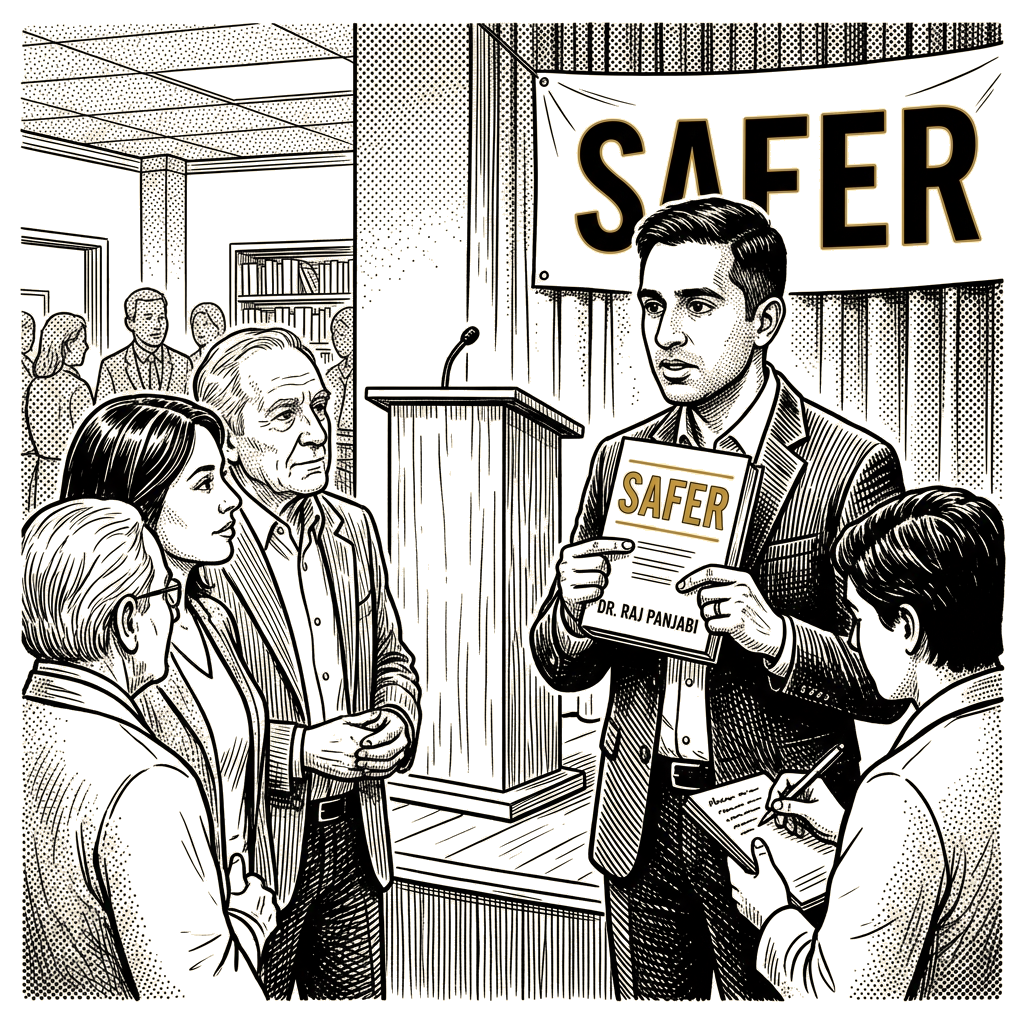
Daughter’s heart failure at age 1 inspired Panjabi’s book
Dr. Raj Panjabi has worked around playbooks his whole career. “In the intensive care unit, we have a playbook when someone’s heart stops beating,” the physician said. And when he served as a White House health adviser during the COVID emergency, “In the Situation Room, we had a playbook for pandemic preparedness.” What he found missing was a plan for emergencies closer to home. “I was frustrated that we didn’t have a playbook for crises that appear in our own living room,” he said.
The result is “Safer: A Playbook,” which Panjabi describes as three books in one: the story of how he and his wife confronted their daughter’s life-threatening condition; an exploration of the public health problems that beset the globe; and straightforward advice for anyone facing a living-room crisis. Its chapter titles telegraph his philosophy: “Turn Denial Into Action,” “Don’t Go It Alone,” “Get Ready to Pivot,” “Embrace Uncertainty.”
Panjabi was born to Indian parents in Liberia, and his family immigrated to the United States when he was 9. He became a physician and founded Last Mile Health, an award-winning humanitarian group that employs community workers to bring health information to people in remote areas. He now does medical research with scientists who are using artificial intelligence to develop the next medicine to defeat cancer or the next vaccine to stop a supervirus.
The book grew out of his own household. Panjabi’s daughter was diagnosed with heart failure at age 1. He and his wife dismissed early concerns, assuming at first that her extremely low weight was because she was a picky eater. “I was wrought with the guilt of being a dad and missing this illness — and being a doctor and missing this illness in my own daughter,” he told NPR. “I thought it was a character flaw. What I learned is that it’s not.” His daughter is 9 now and has recovered.
Denial, Panjabi said, is the first stage of almost every crisis — a medical emergency, a job loss, “that layoff you never thought would affect you.” In researching the book, he found that people have a hard time detecting slow-moving threats until they reach a tipping point. Psychologists call the tendency normalcy bias — “the idea that tomorrow will look a lot like yesterday. Until, of course, it doesn’t.”
The remedy he recommends is an if/then threshold: “If I see a warning sign, I will act in X or Y way.” In his own family, that means his daughter sees a cardiologist every couple of years for an ultrasound of the heart. “The trigger we’re looking for is whether the heart’s ability to squeeze is at a normal level or not,” he said. “Allowing a trigger to do the monitoring for you allows you to feel some agency and allows you to control what you can control.”
The playbook extends past the front door. NPR noted in the interview that measles, which the network described as eradicated in the United States 36 years ago, is back because parents are opting not to vaccinate their children. Panjabi, speaking of measles spreading in many parts of the country, said one of the most important questions to ask is where trust is still present. His advice for talking with hesitant parents: drop the blame-oriented question — “Why aren’t you following the guidelines?” — for the barrier-oriented one: “What’s in the way of you following the guidelines?”
The barriers, he said, are often practical: a parent who can’t take time off work because they work multiple shifts in a day, or can’t find enough money for a bus ticket to a clinic for a vaccine. Others say they fear a vaccine might lead to a side effect; in parts of the world where he has worked, he said, people assume vaccines can lead to sterility or infertility. “If you ask a barrier-oriented question not a blame-oriented question, you start to understand people’s beliefs and their behaviors,” Panjabi said. “And you don’t have to change someone’s beliefs for their behaviors to be more protective.”
Trust, in his telling, does not run through Washington. “It comes from your local faith leader, your local physician, your local healthcare provider, your local school,” he said. Polling now shows 80 to 90% of Americans still trust their health care provider, he added, and the book argues that connection is the strongest preparation: “Our greatest protection is connection. If we build those relationships before a crisis, we’re more likely to weather it.”
On artificial intelligence, Panjabi sees promise and peril in the same tools. The AI systems his lab collaborators use could help develop the next cancer medicine or vaccine — and “can be used by a terrorist to design a virus and make it more capable of evading our vaccines, [of] unleashing a super virus on humanity,” he said.
For uncertainty at that scale, he described a strategy psychologists use: draw a circle on a piece of paper. Outside it are the actions a person cannot control — whether, say, a terrorist decides tomorrow to misuse the technology. Inside it, Panjabi can control “whether or not the scientists I work with are minimizing the risks of the way they use AI so that we can maximize its benefit for humanity.”
He offered a concrete check on the darkest version of that fear. “You have to grow a virus in a lab. You have to have DNA to do it,” he said. “AI has not yet been able to dissolve the barrier between the screen and the freezer, as it were.” But “that doesn’t give us permission to relax,” he said: warning signs should be articulated now and acted on before the barrier dissolves.
Panjabi spoke with NPR at its headquarters on Oct. 30, having flown in that day from meetings in Boston in a sports jacket bought at the airport — his mother, who sells men’s clothing, is a tough critic of his fashion choices. The book closes on a personal note: as a freshman at Chapel Hill, rejected about three or four times by a young woman named Amisha Raja and, by his own account a terrible cook, he made peanut butter and jelly sandwiches and surprised her with lunch. It was their first date. “I don’t think the peanut butter and jelly sandwiches had a whole lot to do with her deciding to go on that date, but I’m grateful she did,” he said. Twenty-five years later and then some, the two are still together. His jelly of choice, for the record: strawberry jam, layered two-thirds jelly to one-third peanut butter.