Democratic Congress expected to demand MOUs and implementation plans be released
The setting in Lusaka looked conventional: officials in suits, big black chairs around a wooden table, a cluster of microphones, applause. But when U.S. and Zambian officials signed a global health agreement in the Zambian capital on October 8, Mich Coker, the Chargé d’Affaires at the U.S. Embassy in Zambia, told the audience it was anything but classic. “This MOU represents a fundamental shift,” Coker said, describing the two countries’ relationship as moving “from a traditional donor-recipient model to a true partnership, one grounded in Zambian leadership, in Zambian ownership and in shared accountability.”
Global health experts on all sides of the political spectrum and around the world agree with Coker that a fundamental shift in the U.S. approach to global health is underway. “The shift that’s currently unfolding is very large and it’s very rapid,” said Janeen Madan Keller, acting co-director of the Global Health Program at the Center for Global Development.
President Trump dismantled the U.S. Agency for International Development at the start of his second term, citing alleged “fraud, waste and abuse.” Clinics shut down suddenly, and patients ran out of HIV medications. In Zambia, as well as a number of other countries, many patients who relied on U.S.-supported clinics and programs faced uncertainty and, often, dire health consequences. Madan Keller and other experts describe the start of the term as months of global health turmoil. “It is a period that is best described as chaos,” Madan Keller said, describing repercussions “for people and communities in some of the poorest countries of the world.” Jennifer Kates, senior vice president and director of global and public health policy at KFF, said “for the first half of 2025, there was a complete upheaval.”
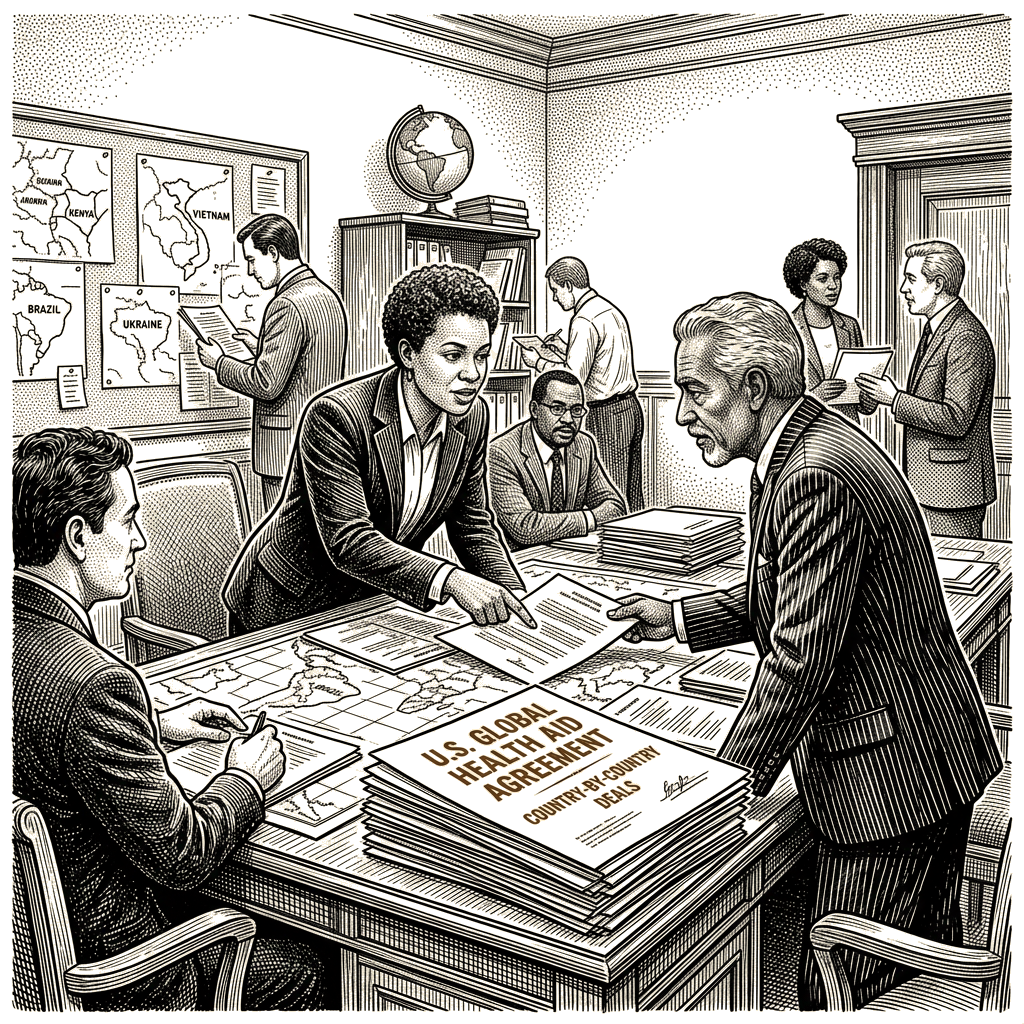
In the experts’ account, that turmoil gave way to a clearer strategy — one with big goals, a short timeline and a lot less transparency than what came before. “Starting over the summer of 2025 and going into September, there actually was a sort of step back to develop an actual strategy and a plan,” Kates said. What emerged from the State Department was the America First Global Health Strategy, with the stated goal of making “America safer, stronger, and more prosperous.” Its main instrument is a set of agreements with individual countries — a departure from past practice, when the United States worked more through large international organizations or local non-governmental organizations.
Experts describe the agreements as transactional. In Zambia, Asia Russell, executive director of the HIV/AIDS advocacy organization Health GAP, said activists exposed a plan to condition access to U.S. global health funding on access to the country’s copper and rare earth minerals — what she called a “massive scandal” that her organization helped expose. The minerals provision was separated from the global health agreement after public outcry in Zambia, but many of the agreements still require recipient countries to share data, including pathogen information.
The Zambia memorandum illustrates the terms. Coker said at the signing that the United States would pay $1.5 billion over five years, “with Zambia simultaneously committing to increase its own domestic health expenditures by $975 million. We are charting a path toward a stronger, more self-reliant health system.” Zambian Health Minister Roma Chilengi said, “We are looking to have up to about 40,000 healthcare workers recruited through this support.” Building up a country’s own health infrastructure — rather than a parallel system run by non-profits and NGOs — has been another priority of the strategy.
At the signing ceremony, Coker ticked off some of the top priorities in the new strategy, including that recipient countries increase their financial contributions to health in the years ahead and that they are transitioned off aid in the near future. Priorities like these — recipient countries contributing more and being weaned off aid money — are not new ideas; in the world of global health they have long received bipartisan support but, up until now, have been hard to implement. “This approach really does kickstart them in a new way that had not occurred before,” Kates said. In her view, though, the preceding chaos and a greatly diminished U.S. global health system make the goals harder to reach.
The pace troubles some experts. Madan Keller said the strategy aims to achieve major changes in just a handful of years. “It’s happening on a compressed timeline with arguably limited capacity to manage it, and that’s where some of the risks and concerns are coming from,” she said.
Russell argued the administration has concentrated on hammering out memoranda rather than on ambitious health goals such as reducing HIV transmission. The administration, she said, is focused on “process indicators — not impact indicators — as its first measure of success, which is basically a loser’s gambit when it comes to pandemics.” “Rubio crowed about signing documents. That doesn’t save lives,” she said.
The State Department declined an interview request but said in a statement that most African countries with memoranda have now drawn up implementation plans, and that “U.S. embassies globally are now focused on operationalizing these implementation plans [and] recipient country governments are also executing on the commitments they have made in the MOUs.”
Assessing the strategy is complicated by what experts describe as a transparency break from past U.S. practice. PEPFAR, the flagship U.S. program for HIV/AIDS, “was a gold standard for collecting data on a regular basis and sharing it transparently — and then using that data to really inform decision making,” Ramona Godbole, the former deputy director of policy, planning and programs at the now-defunct USAID, told NPR earlier this year. “Now it’s much more opaque and very hard to get the information. The agreements themselves have not been publicly released by the U.S. government,” Kates said. The text of some agreements has surfaced through litigation or Freedom of Information Act requests filed by advocacy groups, and Kates said even less is known about the implementation plans, which are supposed to contain detailed goals and metrics for how the money will be spent and what programs will be supported.
The aid at stake totals $16 billion committed across the 36 signed agreements — U.S. taxpayer money that Congress allocated to foreign aid. KFF has calculated that the total represents a 34% drop in U.S. global health aid, and the contraction has left some countries without an agreement: Zimbabwe lost U.S. global health aid after the two governments failed to agree on memorandum terms.
The State Department pushed back in its statement: “Claims of a lack of accountability and transparency are unfounded….We have and will share every signed MOU with Congress.”
This week’s midterm elections have added a new variable. With the Democratic Party returning to the majority in Congress, many expect lawmakers to demand more transparency. “I think 100% they are going to demand: give us the MOUs, show us the implementation plans, come in and tell us more detail about what you’re doing,” Kates said. She said much remains unknown about what the new Congress will do when it convenes on January 3 and how the Trump administration will respond, though she expects lawmakers to push first for more public information about what global health work the United States is and is not supporting. Whether the new majority might try to resurrect what was dismantled remains an open question.
Russell and other global health activists are calling for stricter oversight. “Congress needs to slam its feet, both feet, on the brakes unless and until it gets this information, gets this accountability,” she said.