U.S. and allies run short of Patriot and Thaad interceptors
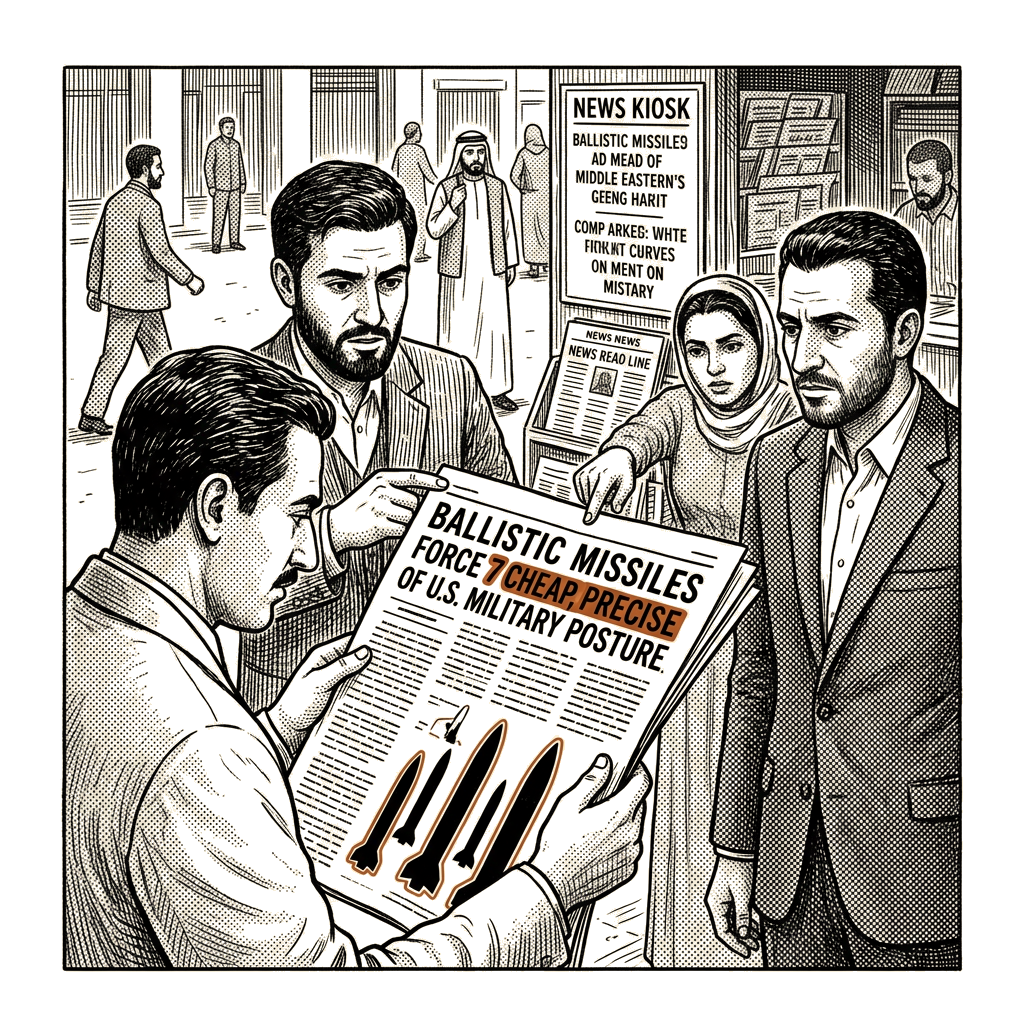
Ballistic missiles, once the preserve of nuclear superpowers, have become cheaper and more precise — a shift that has allowed Iran and Yemen’s Iran-backed Houthis to strike foes across the Middle East. U.S. and allied military officials acknowledge that the new threat must lead to a rethinking of America’s military posture worldwide, but no decisions on how to adapt have been announced so far.
The damage is visible in Bahrain’s capital, where American military compounds along the corniche are dotted with the charred hulks of destroyed radars and communications installations. Iran this year inflicted serious damage on U.S. military bases, forcing the abandonment of key American installations in the Persian Gulf. Yemen’s Houthis, meanwhile, are continuously striking Saudi airports and energy facilities, putting economic pressure on Saudi Arabia, their much wealthier adversary.
Both the United States and its regional allies are starting to run short of interceptors for the Patriot and Thaad systems, the main defenses against ballistic missiles — a shortage that U.S. and allied officials acknowledge the American military-industrial base will be unable to rectify for several years. Farther afield, the global shortfall has left Ukraine unprotected against salvos of Russian missiles aimed at its energy grid and key bridges and factories.
The imbalance carries far-reaching implications for the way the U.S. military operates. Since World War II, Washington has used a network of bases around the globe to protect allies and keep rival powers in check. Those bases are now vulnerable to attack even from adversaries located hundreds or thousands of miles away — a shift with strategic implications for the U.S. military posture in Europe and Asia as key military and infrastructure assets grow increasingly exposed. China, Russia and North Korea possess much bigger and more sophisticated ballistic-missile arsenals, and their current production of the weapons heavily outpaces U.S. and allied manufacturing of interceptors. The Pentagon did not immediately respond to a request for comment on the challenge.
“What the war in Iran has shown is that not only is the U.S. military fragile in terms of its stockpiles, but also the way that the U.S. plans to fight doesn’t work in the current era. Military power has been democratized,” said Jennifer Kavanagh, director of military analysis at Defense Priorities, a think tank that advocates restraint in American foreign policy. “The U.S. way of war relies heavily on the ability to operate from forward bases and protect these bases. But we see from the Middle East that these bases, the way they have been constructed, are simply not defensible, even against a weak adversary.”
The missile transformation is distinct from the drone revolution unfolding in Ukraine, which has absorbed much of the world’s attention. Drones carry relatively small warheads and are relatively easy to intercept; they can be extremely effective against flammable targets such as Russian or Saudi oil refineries. Ballistic missiles, with their powerful charges, can penetrate hardened structures, and drones usually cannot destroy power plants, fortified aircraft hangars or military production lines.
The advances mean that “even nonstate actors are able to operate at significant ranges, redefining what the deep battle space is,” said retired British Air Marshal Martin Sampson, who heads the Middle East office of the International Institute for Strategic Studies. Defenses against the missiles have yet to catch up with the transformation, he said. “Everything that is fixed is a target now.”
Ballistic missiles used to be very expensive and imprecise, and mid-to-late 20th-century military doctrines treated them as mostly suitable for carrying nuclear weapons — an error of several hundred meters, typical at the time, mattered little with a nuclear blast. “For a long time, these systems were so inaccurate that they didn’t have a lot of conventional value, especially over longer ranges,” said Fabian Hinz, a missile expert at the research organization Conflict Armament Research. “But what we have seen in the last few decades is the development of increasingly precise ballistic missiles, originally by some of the more advanced parties, and now this technology is spreading around the world.”
“The Western way of war was always about securing air superiority, or air supremacy really fast,” Hinz said. “But now, even if your adversary doesn’t have advanced air capabilities, they may still be able to strike your rear with missiles, and this is a major difference from the Western way of war that we have seen over the last few decades.”
The nuclear dimension long constrained missile-defense development, which was viewed as a destabilizing factor in the nuclear equilibrium between the U.S. and the Soviet Union and was limited by international treaties. The Intermediate-range Nuclear Forces Treaty between Moscow and Washington, which remained in effect until 2019, made European nations shy away from developing their own ground-launched ballistic-missile capabilities.
Few things are in shorter supply nowadays than ballistic-missile interceptors, some of the costliest and most advanced military products in existence. Only a handful of Western manufacturers can make them. Lockheed Martin, the biggest, is unable to cope with surging global demand, and its order books for Patriot PAC-3 and Thaad interceptors last well into the 2030s. Not until next year does a European producer, the Franco-Italian Samp/T consortium, plan to begin manufacturing the new-generation Aster missiles capable of addressing ballistic-missile threats. Germany, meanwhile, is deploying Israel’s Arrow 3 antiballistic-missile system.
One senior Western defense official said nations capable of providing their own ballistic-missile defenses would become locations of choice for U.S. military facilities in the coming years. Something similar has already taken shape in the Middle East, where American military operations are increasingly concentrated in Israel, which manufactures and operates its own missile-defense systems.
As the Houthis have shown, the barriers to becoming a ballistic-missile power are falling fast, with the odds stacked toward the attacker in the foreseeable future, said Fabian Hoffmann, a missile expert at the Norwegian Institute for Defense Studies. “Even the United States, with its industrial capacity, is not prepared to defend against an attacker that builds ballistic missiles at industrial scale,” he said. “In the medium and long term it may be different, but over the short term it’s really difficult.”
Many military officials question whether it makes sense to invest huge parts of their defense budgets in interceptors, arguing it is better to focus on deterrence instead. “I wonder if it’s worth it to try defending ourselves against this kind of weapon,” said retired French Lt. Gen. Michel Yakovleff. “We are now returning to the logic of deterrence between states. France has never renounced first nuclear use, and if Russia fires a salvo of 200 ballistic missiles in one night on key economic and civilian targets in Europe, it’s starting to tempt a French nuclear missile in response.”
Retired Lt. Gen. Ben Hodges, a former commander of the U.S. Army in Europe, agreed that reinforcing deterrence will have to become a key policy, alongside adaptations such as hardening air bases, dispersing forces and making them more mobile. Overseas bases, once adapted to the new missile and drone threats, will remain indispensable, he said. “You cannot defend the United States from Fort Hood, Texas, or Fort Bragg, North Carolina. You have to be able to position capabilities, logistics, maintenance, command and control out where we need it, which is why the bases in Europe are so important, as are those in the Middle East,” Hodges said. “But we have also discovered that maybe the ones in the Middle East were not as important as we thought, and are so vulnerable. There will have to be a cost-benefit analysis.”