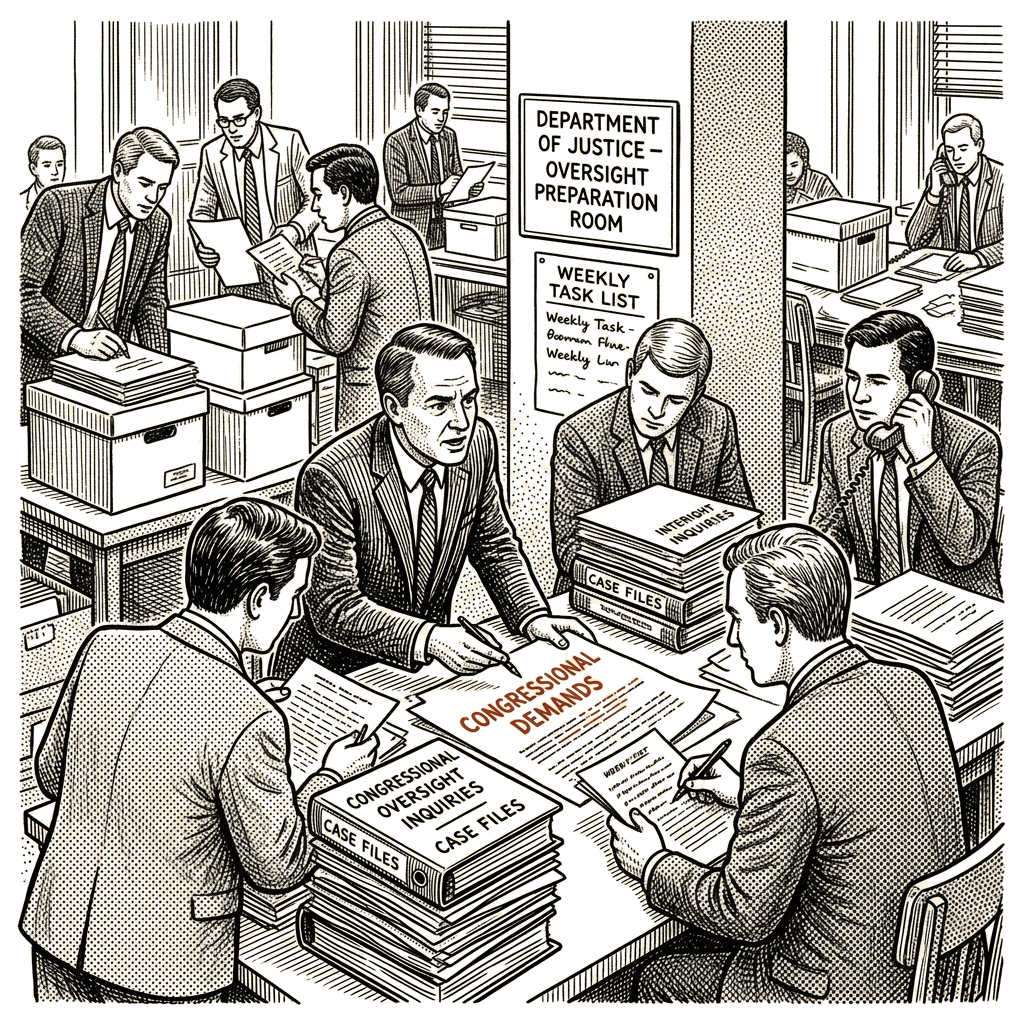
Blanche pledges cooperation as aide reportedly tells prosecutors to prepare for ‘wartime’ footing
For nearly two years, under a Republican-controlled Congress, the Justice Department pursued investigations into President Donald Trump’s perceived adversaries, fired waves of career employees and defended administration stances that judges across the country repeatedly deemed legally dubious.
Sweeping Democratic gains in Congress have now shifted the balance of power in Washington, teeing up a wave of expected investigations into those actions and others as well as scrutiny from the majority party that the department had until now managed to skirt. Democrats have promised to join already-skeptical courts in reining in the Trump administration, while a Justice Department depleted by the losses of thousands of career employees and the postelection departures of senior leaders pledges to push ahead with its agenda.
The department has, at least publicly, appeared unbowed by the altered landscape. Blanche said the department will cooperate with Congress but has also insisted that “we will not back down” from the Republican president’s agenda. Department leadership has suggested it will not let Democrats’ threats of investigations deter its pursuit of the White House’s priorities and may become even more aggressive in pressing the president’s causes.
“We will not back down. This will not slow us down. This will not stop us,” Blanche said in a Fox News interview Monday. “President Trump has two years remaining in this administration and you better believe that we’re going to use it effectively.”
Prosecutors reportedly told to brace amid postelection departures
In a call with U.S. attorneys across the country this week, Aakash Singh — a top Blanche aide — told prosecutors to prepare to be on “wartime” footing and suggested more U.S. attorneys may be pushed out after a spate of postelection departures, according to people familiar with the call who spoke on the condition of anonymity to discuss internal department discussions.
The Justice Department said the “‘wartime’ reference had everything to do with public safety,” noting that some “newly elected state and local leaders are no longer interested in partnering with federal law enforcement.”
Any additional U.S. attorney departures would follow significant departures in the days after the election, when the Senate-confirmed leaders of the department’s National Security, Civil and Civil Rights divisions all announced their resignations. The divisions will have temporary leaders but are unlikely to get Senate-confirmed ones in light of the Democratic majority.
Greg Brower, a former U.S. attorney in Nevada during President George W. Bush’s administration who later served as the FBI’s chief congressional affairs official, said the vacancies could stall the department’s work. “What that means for DOJ, potentially, is just a lot of inaction, with tough decisions not being made because typically those tough decisions are made by confirmed people at the top of the components,” Brower said.
The department said in a statement that it has “full confidence in the leaders stepping in to guide our Divisions, and its mission is unchanged: enforce the law, combat crime, and protect the American people.”
Democrats are eager to highlight what they view as abuses of power, including a succession of investigations the department launched into the president’s perceived adversaries, many of which have been rejected by grand juries, dismissed by judges or stalled without apparent progress. In the weeks leading up to the election, the department unsuccessfully sought an indictment against former White House aide Cassidy Hutchinson, accelerated an investigation into Democratic Rep. Ilhan Omar, employed an unusual maneuver to file a fresh criminal case against former FBI Director James Comey and charged two ex-FBI officials in a complaint that a judge swiftly dismissed.
The Associated Press reported that political pressure from the White House is unlikely to wane given the promotion of Stephen Miller to chief of staff.
Democrats hold the gavel but lack enforcement tools
Democrats hold the gavel but are short on foolproof ways to guarantee Republican cooperation. Lawsuits can take years, subpoenas can be arduous to enforce and criminal contempt referrals for noncompliance would be sent to the Trump administration Justice Department, where they will almost certainly not be acted on.
“It’s a standoff and I don’t know what the answer to that is yet,” said Stan Brand, a former general counsel for the House of Representatives. “I don’t know if the Congress knows.”
Tensions between the Justice Department and an opposing-party Congress are a staple of oversight dating back decades and across administrations. The Republican-led House voted in 2012 to hold then-Attorney General Eric Holder in contempt of Congress, and Democrats did the same in 2019 when William Barr led the Justice Department. There were even interparty clashes during the first Trump administration. But the AP reported that the situation now is unlike anything the current department has experienced. As the minority party in both the House and Senate, Democrats decried during hearings and in letters what they saw as the department’s erosion of independence but had little power to demand accountability, and the rare occasions when the department appeared fazed by congressional oversight generally stemmed from Republican resistance, including over the handling of the Jeffrey Epstein files or an ultimately abandoned fund to compensate Trump allies.
White House and prosecutors push back
The Democrats’ planned inquiries have already drawn opposition from Republicans and the White House, with Trump accusing Democrats of “extortion” and ordering the attorney general to conduct an investigation. The White House has asserted in a letter from counsel Will Scharf that such inquiries — a routine function of Congress — may amount to “blatant criminality.” Members of Congress enjoy broad legal protections for acts they take as lawmakers under a constitutional principle known as “speech and debate.”
“My first-year law students would fail if they wrote a letter like that,” Brand said.
The top federal prosecutor in Houston has also entered the fray. U.S. Attorney Aaron Reitz sent a warning letter to Sen. Richard Blumenthal over the Connecticut Democrat’s inquiry into funding for Trump’s White House ballroom, ordering the senator to preserve all records relevant to his inquiry and accusing him of intimidating “citizens for engaging in philanthropic practices that will benefit our nation for generations.” Blumenthal responded that he would not be intimidated.
Blanche told reporters Thursday that there were no open investigations into Democrats’ rhetoric and acknowledged that it’s not a crime to warn of looming investigations, but again expressed concern over what he described as threats against the administration.
Leah Foley, the U.S. attorney for Massachusetts, said in an interview with The Associated Press that the message from Washington was for prosecutors to continue their aggressive focus on the administration’s priorities of tackling fraud, violent crime, drug trafficking and cartels.
“I’ve been through so many administrations as a prosecutor,” said Foley, who co-chairs a committee that advises the attorney general on policies and priorities. “This is a lot of noise that’s coming out of the elections and posturing going on. But things are going to settle down and we’ve operated proficiently through divided governments before and we’ll continue to do so.”