Lawmakers urge cancellation of Afghan and Iranian deportation flights
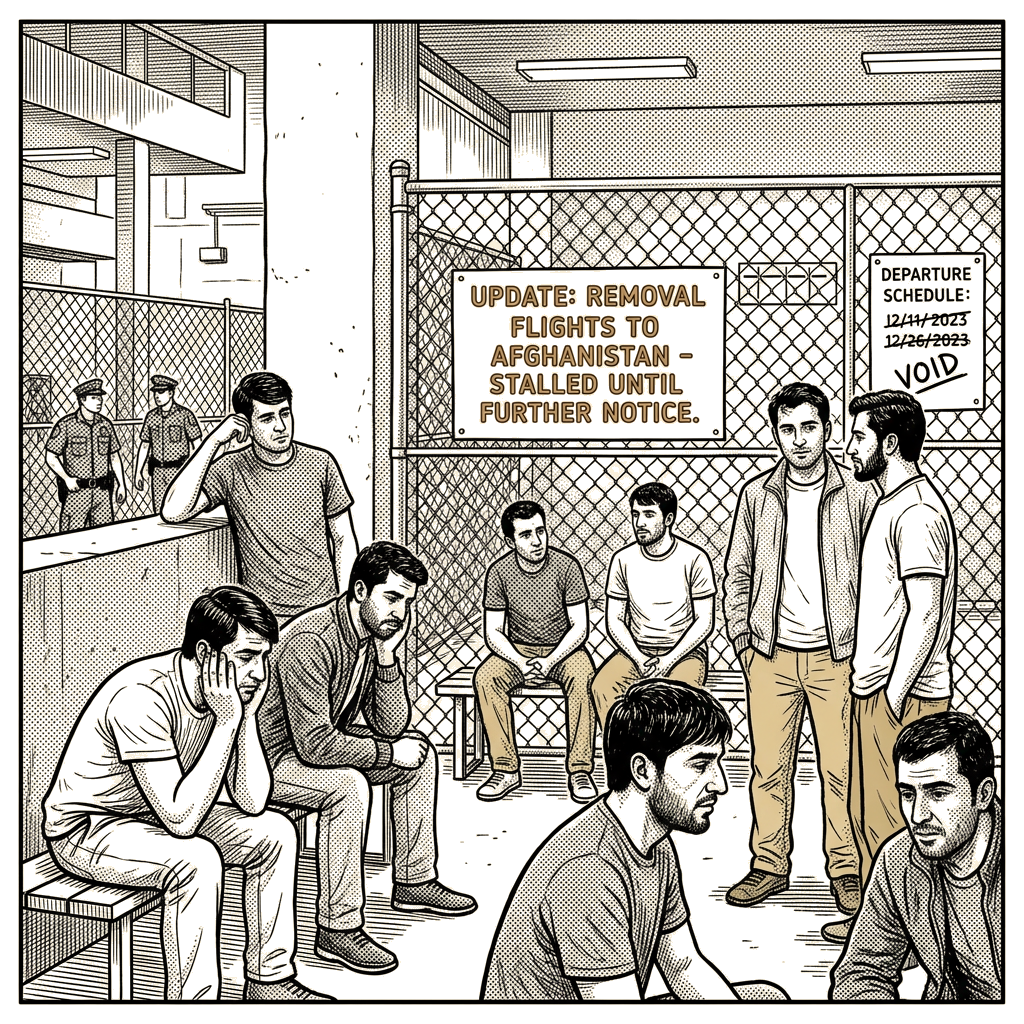
The apparent pause emerged after weeks of shifting dates. A flight originally scheduled to take the group out of the US on election day earlier this month stayed grounded after a federal judge issued a court order temporarily blocking its departure to Afghanistan or neighboring Pakistan. The New York Times reported that the whole group numbers more than 150 Afghans. The Associated Press previously reported that the federal government intends to route the detainees to their home country via Pakistan.
As that temporary court order expired last weekend, immigration advocates said they dreaded that detainees could be forced to leave during the week of 16 November, based on a rescheduled removal date given for at least one Afghan man in Immigration and Customs Enforcement detention who was due to be on the flight.
That date did not hold. Late on Tuesday it was learned that the detainee, along with a handful of other detained Afghans on the original flight manifest, no longer had a specified departure date issued by the US government. Some immigration lawyers also reported that their Afghan clients had been moved from staging facilities to long-term detention facilities, suggesting they would not be forced onto a deportation flight in the coming days.
Shawn VanDiver, founder and president of the US non-profit coalition #AfghanEvac, said a sensation of “fragile relief” had descended on the people involved, amid confusion and what he described as few details from the administration.
“In a matter of days, these allies were told they were being sent through Pakistan into the hands of the Taliban, then told they were safe, then told that nobody knows. That isn’t immigration policy. It’s whiplash inflicted on people who already survived a war,” VanDiver said. “These men and women kept their promise to America, and it’s time we kept ours by ending these removals for good.”
Some of the Afghans in the targeted group have relatives who assisted the US war on Afghanistan after the terrorist attacks of 11 September 2001 that drove out the Taliban, VanDiver said. He has previously called Donald Trump’s efforts to remove Afghans from the US cruel and carried out “in a heinous matter” as a scare tactic against others, and has opposed any option to use Pakistan as a conduit for “forced rendition”.
Immigration advocates are hoping continued pressure will produce further delays and the ultimate cancellation of the flight and any others planned for the coming weeks. In the meantime, #AfghanEvac is pushing what will become the newly Democratic-controlled Congress in January to pass a bipartisan bill that has been drafted and would give Afghans already in the US temporary protected status through July 2029, with a vetting process. Such legislation would “keep people we already vetted and brought here from being sent back to the Taliban while their cases are decided”, VanDiver said. The US supreme court in June allowed the Trump administration to strip such protections, including from Afghans.
Among the passengers reported to be on the blocked flight were Afghans whose relatives helped American troops, women, at least one gay man and members of the minority ethnic Hazara group — some of whom have said they were previously beaten by the Taliban.
Human Rights First has warned about “grave, systematic dangers” for Afghans returned to Afghanistan, including “arbitrary detentions, executions, public flogging, and retaliatory violence”, as well as restrictions on basic freedoms for women and girls. Sari Arvey, the group’s director of policy, refugee and immigrant rights, said the administration’s targeting of Afghans reflects a broader trend of creating arrangements with other governments to send people back to war zones, security crises and countries that do not have diplomatic relations with the US. The US suspended relations with Afghanistan after the Taliban government took over in 2021, forcing a scrambled evacuation.
The Department of Homeland Security said in response to questions and a request for comment that the agency complies with all lawful court orders, and that Immigration and Customs Enforcement does not comment on or confirm prospective removal operations, for operational security reasons and the safety of its officers.
More than 60 concerned lawmakers signed a letter to the DHS and the State Department, citing relevant law and calling for the cancellation of any deportation flights of Afghans or Iranians to their home countries, either directly or through any other country. “The United States is also bound not to return anyone to a country where they would face torture, and that obligation does not disappear because a flight makes a stop along the way,” the letter stated. In a separate letter, New York congressman Gregory Meeks and US senator Jeanne Shaheen of New Hampshire, both Democrats, wrote to Pakistan’s ambassador to the US, urging the Pakistani government not to collaborate in any operation to fly Afghans to Pakistan and then expel them over the border into Afghanistan. The Pakistani embassy did not respond to a request for comment.
The wider third-country practice remains in litigation. The Trump administration has held secret talks with Iran about deporting Iranians via a third country, and last Sunday an attorney reported that a US deportation flight of Iranian nationals headed to Iran via Pakistan was abruptly canceled, according to the AP. The Trump administration is also increasingly deporting immigrants to such third countries. The supreme court is still litigating the circumstances under which the federal government can deport people to regions they have no connection to, though in late September it ruled on an emergency basis, allowing the practice to continue. Federal law is designed to prevent the US government from forcing someone to return to a country where they are likely to face torture. The DHS said immigrants sent to a third country “receive notice and an opportunity to challenge their removal unless the Department of State is given diplomatic assurances from destination countries” that they would be safe upon return.
The Afghans targeted are believed to have final removal orders, which means the US can legally deport them. Critics note that failing to obtain asylum or to prove a credible fear of return to the Trump administration does not mean a person faces no serious risk at home. The US state department advises Americans: “Do not travel to Afghanistan for any reason,” warning of “civil unrest, crime, terrorism, risk of wrongful detention, kidnapping, natural disasters, and limited health facilities”. The risks for returning Afghans are seen as much greater.
“We are talking about people who’ve already been tortured, people who came with evidence – some of the most compelling claims – and the idea that they could find themselves on this flight is pretty horrifying,” said Sarah Mehta, deputy director of immigration policy at the ACLU. “Why would we send Iranians to a war zone or Afghans to one of the most repressive regimes in the world knowing, indeed, that they are going to be targeted because of the very vulnerabilities that led them to flee in the first place?”
Court documents describe individual cases. One Afghan national expected to be on any deportation flight, detained in ICE custody since late 2024, fears return because his wife served in Afghanistan’s military before the Taliban took over; he is also part of the Hazara Shia group and said he was severely beaten by the Taliban while they searched for her. Shaw Drake, assistant professor of law at the University of New Mexico School of Law and co-counsel for the man, said the immigration judge’s failure to be swayed by these risk factors was “absolutely absurd”, and argued that his client had no notice or opportunity to present a claim of fear of persecution or torture in Pakistan. The man’s mental health deteriorated after transfer to detention in El Paso, Texas, so much so that a federal court in New Mexico issued a 14-day stay to ensure the government had enacted safeguards against the risk of suicide.
Another Afghan who could be put on a flight is a Hazara man who testified to immigration officials that he feared being killed by the Taliban because he reported them to the police after they killed his father, according to US government documents. He said that a few years ago, he was captured, detained, tortured and threatened with death by the Taliban, whose members electrocuted him and beat him with sticks. US federal asylum officers acknowledged the detainee’s testimony but concluded there was insufficient evidence to show the Taliban would inflict severe mental or physical harm if he were sent back. Madhavi Narayanan, a lawyer at Human Rights First who represents him, said: “It’s another confirmation that our immigration system is not equipped to help those who are fleeing persecution and genuinely seeking safety.”