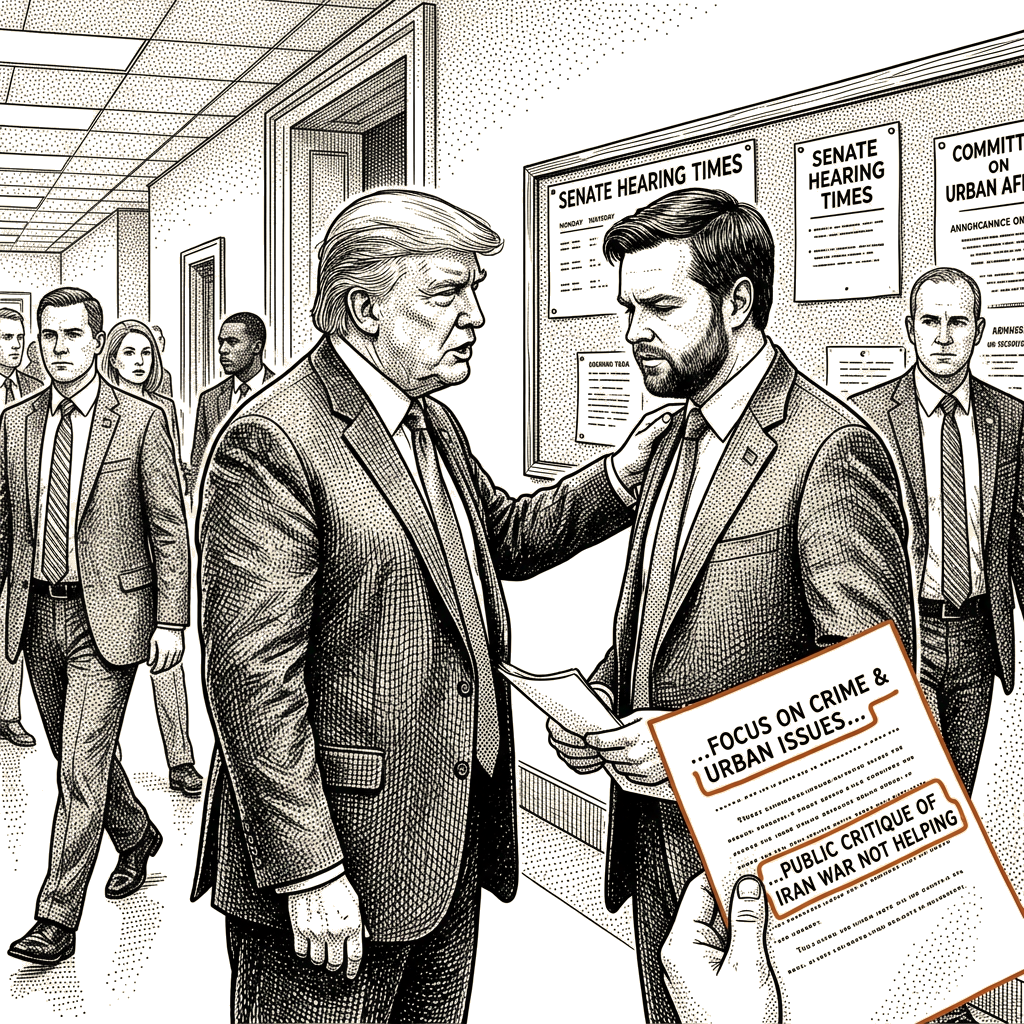
Vance’s Iran negotiation portfolio has produced no deal since spring
A rift between President Trump and Vice President JD Vance over the Iran War was already on public display in posts by both men before it came up in an NPR interview on November 15, 2026, in which host Ayesha Rascoe talked to Susan Glasser, staff writer at The New Yorker, about the exchange.
The day after Republicans suffered a major defeat in the midterm elections, Vance posted a list of what Republicans could do to win back disillusioned voters. The first item was to end the war in Iran. Trump said he didn’t disagree.
Last week, Trump posted, “we don’t need a deal with Iran.” Rather than focus on Iran, Trump said, he was asking Vance to turn his complete and total attention to corruption and crime in cities and states run by Democrats.
Glasser read the post as a rebuke delivered to the vice president himself. “I mean, not to be too blunt, but basically, you have the president of the United States saying to his own vice president, yeah. You’re kind of fired from the most important issue that we have, which is how to resolve this unresolved and unwon conflict in the Middle East,” Glasser said.
Glasser argued that the scale of the Democratic victory in the midterms has obscured how unusual the moment is. “If anything, because of how overwhelming the scale of the Democratic victory was in the elections, we’ve kind of understated the extent to which it is a remarkable thing to have had Vice President Vance publicly blame the president’s top foreign policy priority for that overwhelming defeat,” Glasser said. “Of course, we know Donald Trump. He’s furious about this.”
Rascoe noted that when Vance said the war was the problem, he spoke as if he were not part of the administration. Glasser placed the remark in the context of Vance’s own political stakes. “I think the big-picture context here, Ayesha, is clearly that Vice President Vance feels his chances, such as they are, for becoming president after Trump slipping away, largely due to the war,” Glasser said.
For Vance, Glasser said, the matter is even more foundational. Trump campaigned in 2024 as the candidate of no new wars, and Vance was selected from what Glasser called the “real MAGA America First wing of the Republican Party.” Glasser said it appears that Vance’s allies have gone to great lengths to put out news reports saying he was against the war from the beginning in the private councils the president had, even though it has technically been his portfolio since the spring to negotiate an end to the conflict with Iran. Glasser said that effort has not succeeded and that there are very dim prospects for any kind of success in a negotiated peace anytime very soon.
Glasser also framed the moment as an illustration of the difficulty any vice president faces. She said only two presidents had managed the feat, citing George H. W. Bush in 1988 after two terms of Ronald Reagan, and that one must go back to the 19th century to find another incumbent vice president who managed it.
Asked whether the exchange amounted to a breakup between Vance and Trump, Glasser pointed to the president’s history with his first vice president, Mike Pence, who faced chants of “hang Mike Pence” because he would not do what Trump wanted him to do on January 6. “So the odds, it seems to me, based on Trump’s history, were always quite high for JD Vance to have a very difficult time,” Glasser said.
Rascoe asked whether it would be a great irony if Trump leaves office and it falls to the next president to deal with the war in the Middle East, for the president who was supposed to start no new wars. “Absolutely,” Glasser said, adding that it is a very real possibility that the Iranians may continue in a nether state over the next couple of years, noting that wars and conflicts often do not end under the leaders who start them, because those leaders have so much invested politically and in their own legacies. She recalled that Trump came of age in the 1980s, that the image of Jimmy Carter was for him basically the definition of American weakness, and that Trump has, she said, a near-cult of the idea of strength. “So it would be a bitter pill, indeed, for him to swallow if the Iranians did to him some version of what they did to Jimmy Carter, which is to slowly strangle Carter’s presidency,” Glasser said.